Showing posts with label world disaster news. Show all posts

Friday, July 8, 2011

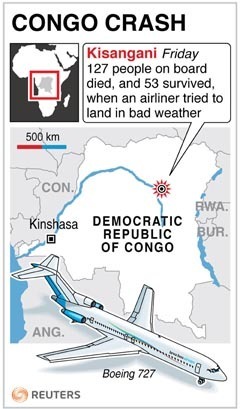
Africa DR Congo plane crash kills 127 people


A Boeing 727 passenger jet crashed into jungle in the Democratic Republic of Congo on Friday, killing 127 people on board, officials said.

The transport ministry said 51 people survived the accident which occurred during heavy rain as the aircraft came in to land at the eastern port town of Kisangani, according to Reuters.

But executives from Hewa Bora airline said only 53 people were killed and 57 survived.

"The pilot tried to land but apparently they didn't touch the runway," chief executive Stavros Papaioannou told Reuters.

Read More

http://www.globalpost.com/dispatch/news/regions/africa/110708/congo-plane-crash-hewa-bora

Wednesday, June 22, 2011

Large earthquake hits north-east Japan


A large earthquake has hit north-east Japan in the same area where a massive quake in March triggered a devastating tsunami, but there were no immediate reports of injuries or damage.

Japan's meteorological agency issued a tsunami warning for the region, but cancelled it about an hour later.

Thursday's quake hit about 30 miles (47km) from the shore of Iwate prefecture at 6.51am local time (9.51pm GMT Wednesday), the meteorological agency said. Much of the coast in the area is still heavily damaged from March's disasters.

The US Pacific Tsunami warning centre said it did not expect a destructive Pacific-wide tsunami.

The quake, 19.9 miles deep, caused tremors across the northern half of the country, including Tokyo, which is about 325 miles to the southwest. It was followed by several smaller aftershocks.

Japan is located on the Ring of Fire, an arc of volcanoes and fault lines spanning the Pacific Basin, and is regularly hit by earthquakes.

Read More

http://www.guardian.co.uk/world/2011/jun/23/earthquake-hits-north-east-japan

Tuesday, June 21, 2011

44 die in Russian plane crash


STPETERSBURG, Russia - A Russian passenger jet crashed in heavy fog and burst into flames on a highway in northwestern Russia, killing 44 people, officials said. Eight people survived.

The Tu-134 plane, belonging to the RusAir airline, had taken off from Moscow and was moments from landing at the airport of Petrozavodsk when it slammed into the highway just before midnight on Monday, said Emergencies Ministry spokeswoman Oksana Semyonova.

The ministry said in a statement on its website that 44 people were killed, including four with dual US and Russian citizenship.

Semyonova said the plane slammed into the ground about 100 meters from a small village, but no casualties were reported on the ground.

Petrozavodsk is in Karelia, near the Finnish border, about 640 kilometers northwest of Moscow.

Russia's top investigative agency said bad weather, human error or a technical malfunction might have contributed to the crash.

A 9-year-old boy and his teenage sister were among eight people who survived the crash, the ministry said.

Anton Terekhin and his 14-year-old sister Anastasia Terekhina are being treated for severe injuries in hospital in Petrozavodsk.

The brother and sister feature on a list of survivors published by the Karelia branch of the emergencies ministry on its website. They are registered as residents of the Pacific island of Sakhalin.

A spokeswoman confirmed that the two were in hospital but that their mother Oksana was killed in the crash. A stewardess, named as Yulia Skvortsova, 23, also survived, the only one of the plane's crew who was not killed.

Read More

http://www.chinadaily.com.cn/cndy/2011-06/22/content_12748617.htm

Tuesday, June 14, 2011

Shallow aftershock rocks Christchurch as experts warn of more earthquakes


A car is trapped in water on Ferry Road after two magnitude 6.0 and 5.5 earthquakes struck on Monday in Christchurch, New Zealand.


THE probability of another major earthquake hitting the devastated New Zealand city of Christchurch in the next year has increased in the wake of this week's new tremors, experts said today.

The already traumatised South Island city was rocked by major quakes on Monday, with a 5.0-magnitude aftershock at a depth of just 1km rattling the nervous residents again early today.

Christchurch mayor Bob Parker later reported no new damage was caused by today's aftershock, which was followed by others including a 4.2-magnitude shake at 2.30pm local time.

The most recent quakes - which come after the February 22 disaster that killed 182 people - have been blamed on a new faultline in the region.

New calculations by GNS Science showed that from today until June 15 next year there was now a 30 per cent chance of a quake of between magnitude 6.0 and 6.9 striking the area, compared with a 23 per cent probability expressed last month,

Read More

http://www.heraldsun.com.au/news/breaking-news/shallow-aftershock-rocks-christchurch-as-experts-warn-of-more-earthquakes/story-e6frf7jx-1226075675624

Monday, May 23, 2011

Icelandic Ash Triggers Dozens of Flight Cancellations


The Icelandic volcanic eruption triggered dozens of flight cancellations on Tuesday and an emerging backlash from airlines concerned that regulators are being too hasty in deeming airspace unsafe.

The ash cloud from Grimsvotn, the country's largest volcano, spread south and west towards the U.K., and authorities in continental Europe initiated contingency plans, though concerns emerged that regulators had not absorbed the lessons from the mass airspace closures following a similar eruption last year. That eruption led to the biggest shutdown of European airspace since World War II.

Read More

http://online.wsj.com/article/SB10001424052702303654804576341413428852714.html

Sunday, May 22, 2011

Iceland's most active volcano erupting


BEIJING, May 23 (Xinhuanet) --Iceland's most active volcano, Grimsvotn, has started erupting, accompanied by a series of small earthquakes. Amateur video filmed by a passenger on a commercial airlines flight showed what appeared to be an ash cloud of about 20 kilometers rising into the sky.

The volcano lies under the uninhabited Batnajokull glacier in southeast Iceland and last erupted in 2004. Officials say the eruption is not expected to affect European airline traffic at least for the next 24 hours although a flight ban has been imposed around the area. Whether widespread disruption occurs will depend on how long the eruption lasts, how high the ash plume rises and which way the wind blows.

The eruption last year caused most airports in northern European countries to close for five days. Authorities halted flights due to fears that dust and ash would get into aircraft engines and cause accidents after the cloud was blown into European air traffic lanes.

Read More

http://news.xinhuanet.com/english2010/video/2011-05/23/c_13889214.htm

Sunday, May 15, 2011

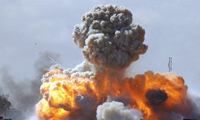
NATO bombs Libyan town near Tunisian border


TUNIS, May 15 (Xinhua) -- NATO planes on Sunday morning bombed barracks and radar installations in the Libyan town of Boukamache, some 17 km from the Tunisian border, the official TAP press agency reported.

The bombings which could be heard at the Ras El Jedir border crossing point, provoked panic among a number of Tunisians on their way back to Tunisia, TAP said, adding following the bombings, a large number of Libyan refugees fled the region and crossed into Tunisia.

On Saturday night, a Tunisian army patrol managed to thwart an infiltration attempt into Tunisian territory by forces loyal to Libyan leader Muammar Gaddafi, TAP reported.

More than 200 people tried to enter the Tunisian border, near Tataouine, in an attempt to take rebel forces by surprise. They were repelled back into Libya. No clashes were recorded. In the meantime, the Tunisian army deployed more military vehicles to protect the border area, TAP said.

Read More

http://news.xinhuanet.com/english2010/world/2011-05/15/c_13875997.htm

Monday, May 9, 2011

Libya: Hundreds feared dead as migrant boat capsizes


Several hundred people are feared to have drowned off Libya, after a boat carrying some 600 refugees trying to reach Europe broke up at sea on Friday.

The UN's refugee agency said 16 bodies, including two babies, had been found.

UNCHR has said all ships using the Mediterranean should be ready to assist such vessels, as thousands continue to flee North Africa in inadequate boats.

Nato has denied claims that its naval units left dozens of migrants to die aboard another boat in distress.

It said it was unaware of the plight of the boat, which reportedly was adrift for more than two weeks.

The Guardian newspaper said 61 of the 72 people on board the boat died of hunger or thirst, despite being spotted by a military helicopter and Nato ship.

Read More

http://www.bbc.co.uk/news/world-europe-13332536

Wednesday, March 23, 2011

New Problems at Japanese Plant Subdue Optimism


The Japanese electricians who bravely strung wires this week to all six reactor buildings at a stricken nuclear power plant succeeded despite waves of heat and blasts of radioactive steam.

The restoration of electricity at the plant, the Fukushima Daiichi Nuclear Power Station, stirred hopes that the crisis was ebbing. But nuclear engineers say some of the most difficult and dangerous tasks are still ahead — and time is not necessarily on the side of the repair teams.

The tasks include manually draining hundreds of gallons of radioactive water and venting radioactive gas from the pumps and piping of the emergency cooling systems, which are located diagonally underneath the overheated reactor vessels. The urgency of halting the spread of radioactive contamination from the site was underlined on Wednesday by the health warning that infants should not drink tap water — even in Tokyo, 140 miles southwest of the stricken plant — raised alarms about extensive contamination.

“We’ve got at least 10 days to two weeks of potential drama before you can declare the accident over,” said Michael Friedlander, who worked as a nuclear plant operator for 13 years.

Nuclear engineers have become increasingly concerned about a separate problem that may be putting pressure on the Japanese technicians to work faster: salt buildup inside the reactors, which could cause them to heat up more and, in the worst case, cause the uranium to melt, releasing a range of radioactive material.

“A meltdown is looking less likely, but a lot of radiation has been released in the reactor buildings and may continue to seep out,” said a Western nuclear power executive who asked not to be quoted by name because he did not want to risk his broad contacts in Japan. “What we might have is a slow-moving contamination problem rather than a fast-moving contamination problem.”

Read More

http://www.nytimes.com/2011/03/24/world/asia/24nuclear.html?partner=rss&emc=rss

Tuesday, March 15, 2011

South Korea to send boron to stabilize Japan reactor


South Korea said on Wednesday it would send some of its reserve boron to Japan after a request from Tokyo for the metalloid, which being is mixed with seawater to limit damage to Japan's crippled nuclear reactors.

An economy ministry official said South Korea would send 52.6 tons of boron to Japan from its reserves of 310 tons.

Tokyo has requested supplies of the key material, vital for stopping fission nuclear reactions, after its own stockpile has been largely used up at the Fukushima nuclear power plant.

Boron is the main material that goes into control rods used to halt or slow down fission reactions at nuclear reactors. Japan has mixed large amounts of boron with seawater and poured them into the reactors as an emergency measure.

A sample of the metalloid would be sent to Japan immediately for assessment, the ministry official said.

Read More

http://www.reuters.com/article/2011/03/16/us-japan-quake-boron-idUSTRE72F0KG20110316

Sunday, February 27, 2011

Two NZ earthquakes to cost NZ$20 bllion - PM Key


The two earthquakes that hit the New Zealand city of Christchurch are likely to result in an economic cost of about NZ$20 billion ($15 billion), Prime Minister John Key said on Monday.

The first earthquake, which struck on Sept. 4 and resulted in no fatalaties, is likely to have a final cost at about NZ$5 billion while the Feb. 22 quake is likely to be as much as three times the cost.

"At this stage the likely combined cost of the two earthquakes is in the order of NZ$20 billion," Key told a media briefing.

Read More

http://www.reuters.com/article/2011/02/28/newzealand-quake-idUSWLF00505620110228

Wednesday, February 23, 2011

New Zealand earthquake: Rescuers refuse to give up hope


New Zealand rescuers say they are continuing to search for survivors in the aftermath of Tuesday's powerful earthquake in Christchurch.

Superintendent Dave Cliff said it remained a rescue operation, and that specialists were working at a number of sites where there were signs of life.

At least 76 people have been killed, but 238 others are missing - up to 120 of them under one collapsed building.

Prime Minister John Key has said people should prepare for more bad news.

Officials say there might be fatalities from a number of countries.
'Unsurvivable'

The earthquake struck at a shallow depth of 5km (3.1 miles) early in the afternoon on Tuesday, when the South Island city was at its busiest.

It was Christchurch's second major tremor in five months, and New Zealand's deadliest natural disaster for 80 years.

Hundreds of foreign specialist rescuers arrived in the city on Thursday to help local police and soldiers searching through the dangerously unstable ruins for any survivors.

The BBC's Phil Mercer in Christchurch says there is an unshakeable determination among everyone there to keep looking.

But it is a meticulous and painstakingly slow operation, as rescue workers use sniffer dogs, sound detectors, thermal imaging equipment and cameras to detect any signs of lif.,

Read More

http://www.bbc.co.uk/news/world-asia-pacific-12563177

Tuesday, February 22, 2011

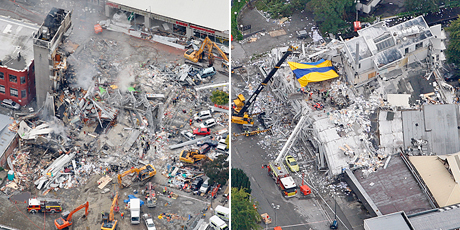
Christchurch earthquake: CTV building 'not survivable' - police


Police have abandoned all hope of finding survivors at the collapsed Canterbury TV building in central Christchurch.

Inspector Dave Lawry said he was "100 per cent" certain those trapped in the building, including a non-sworn police staff member and a group of overseas students, were dead.

All emergency personnel have been moved away from the building because of danger the unstable Grand Chancellor Hotel would collapse onto it, he said.

He felt particularly sorry for the family of what is believed to be a group of Japanese students who died inside.

"At a certain point I'm not going to risk my staff for people where I believe there is no chance of survivability."

Fires burned in the CTV building overnight and no signs of life have been detected there by cameras or listening devices.

Christchurch area commander Dave Cliff said the loss of a staff member in the building was painful.

It meant police could relate to the loss and desperation being suffered by family with loved ones still trapped, he said.

Nancy Wu, whose husband Paul Wu is among the missing in the CTV building, said news that search and rescue workers were putting efforts at the site on hold was "devastating".

"But hopefully they will return and not give up because people can still be alive for many hours. We are not giving up hope."

Read More

http://www.nzherald.co.nz/nz/news/article.cfm?c_id=1&objectid=10708252

Thursday, February 10, 2011

Six dead as plane crashes in fog at Ireland airport


A commuter plane crashed and burst into flames, killing six people and injuring another six on Thursday, as it tried to land in heavy fog at Cork Airport in Ireland, officials said.

The turboprop plane travelling from Belfast in Northern Ireland with 12 people on board flipped onto its roof as it made its third attempt to touch down at the airport in southern Ireland.

The crash was the first major air accident in Ireland since 1968 and provoked an outpouring on sympathy from politicians, churchmen and others on both sides of the border.


"I can confirm that we have six fatalities and six people are in hospital," Tom O'Sullivan, a spokesman for Cork County Council, said. Irish police gave the same toll and said four of the injured were in a serious condition.

The white and blue aircraft operated by Manx2.com airlines was left lying upside down, with its front end almost completely destroyed, photographs taken by witnesses showed.

Dozens of rescue workers and emergency vehicles surrounded the plane.

The Irish Aviation Authority said the Spanish-registered 19-seat Fairchild Metroliner SW4 plane was carrying 10 passengers and two flight crew when it crashed. The nationality of the pilots was unclear.

Visibility was so bad that the control tower was unable to see the plane when it crashed, said the authority's chief executive, Eamonn Brennan.

He said the "wind was very light but the visibility was very poor".

The pilots had tried to land on two different runways without success but the plane crashed next to a taxiway while making a third attempt, the aviation authority said in a statement.

"There is a fire, and debris has been scattered onto the runway and over a wide area," the statement said.

Jurgen Whyte, head of Ireland's air accident investigation unit, said officials were "aware the aircraft was making an approach... and as the aircraft was landing a loud bang was heard".

"The emergency services responded immediately to an aircraft that had inverted and had caught fire," Whyte said.

Cork Airport said it was closed until further notice. Incoming flights operated by British Airways, Aer Lingus and Ryanair were diverted to Shannon Airport.

The Roman Catholic Bishop of Cork, John Buckley, was in the area at the time and went directly to the airport to hold prayers with relatives who were waiting in the arrivals hall of the airport.

"The suddenness and scale of this loss of life is shocking," his office said in a statement.

Irish Prime Minister Brian Cowen expressed "shock and sadness" while President Mary McAleese said her "thoughts and prayers" were with the families of the victims.

Transport Minister Pat Carey said a full investigation was under way "and may have a Spanish and United Kingdom involvement".

Northern Ireland First Minister Peter Robinson said he was shocked by the "terrible tragedy". Some of the victims were believed to be from the British province.

Manx2 was founded in 2006 and operates flights linking Ireland, Britain and the Isle of Man, where it is based. It began the twice-daily flights from Belfast to Cork in September.

The airline said in a statement that the plane was leased from the Spanish company Flightline BCN.

"We are working with all relevant authorities to establish what happened," it said. "We would like to express our sincere sympathies to the families of those who lost their lives in this tragic accident."

The last major air accident in Ireland was in March 24, 1968 when an Aer Lingus Viscount destined for London crashed into the sea off the southeast of the country with the loss of all 61 people on board.

An experts' report in 2001 ruled out persistent rumours that a rogue British military missile could have caused the accident.

Read More

http://www.smh.com.au/world/six-dead-as-plane-crashes-in-fog-at-ireland-airport-20110211-1aowo.html

Friday, February 4, 2011

'Two dead' in Thai-Cambodia military border clash


Cambodia secured the World Heritage listing of the ancient Preah Vihear temple in 2008

Thai and Cambodian forces have exchanged artillery fire in a disputed border area, with a Cambodian soldier and a Thai civilian reported killed.

The Cambodian government has called it an "invasion", while the Thai military said it was a misunderstanding.

Tension has been rising in recent days, with both sides moving in more troops.

Shells landed in the grounds of the ancient Preah Vihear temple on the Cambodian side of the border and in a Thai village.

It is the most serious incident on the border for some time.

A Cambodian government spokesman blamed the encroachment of Thai soldiers for the fighting and said a complaint would be sent to the UN Security Council.

Long-running dispute

A Thai military official insisted that artillery fire from Cambodia was the trigger. But he said it might have been unintentional.

The fighting ended after about two hours, with both sides confirming a ceasefire.

The two countries' foreign ministers had been meeting in Cambodia to discuss the long-running border dispute when the fighting started.

The Thai nationalist "yellow-shirt" movement has called on its government to take a harder line on the issue with its smaller neighbour.

It is planning a demonstration in front of Cambodia's embassy in Bangkok on Saturday.

There has been tension in the region ever since Cambodia secured the World Heritage listing of the Preah Vihear temple in 2008.

This caused joy in Cambodia, and anguish in Thailand - which once claimed the temple.

Read More

http://www.bbc.co.uk/news/world-asia-pacific-12363768

Tuesday, February 1, 2011

Japan volcano erupts again for 6th time in southwest region


White smoke raises from Mount Shinmoedake in Kirishima mountain range in Kagoshima prefecture, Japan's southern island of Kyushu on February 1, 2011. Hundreds of people living near a Japanese volcano that has been spewing columns of smoke and ash thousands of metres into the air were forced to evacuate their homes.


TOKYO, Feb. 2 (Xinhua) -- A volcano in southwestern Japan erupted for the sixth time since last week on Wednesday morning, with the latest blast rocking the area around the Shinmoe Peak in the Kirishima volcanic group on the border of Kagoshima and Miyazaki prefectures and sending plumes of smoke 2,000 meters in the air.

The local branch of the Japan Meteorological Agency has as yet not reported any avalanches as result of the blast, nor can confirm if volcanic debris and noxious gases were spewed from the crater, although they did say debris could fall on areas within 4 kilometers of the crater.

However, the agency did confirm that no significant damage has been reported following the 1,421-meter-high volcano erupting.

The latest eruption, recorded at 5:25 a.m. local time (2025 GMT Tuesday), follows a massive blast at 11:19 p.m. Tuesday (1419 GMT) which also shot enormous columns of smoke as high as 2,000 meters into the air.

Officials from the meteorological agency noted Tuesday that the dome of lava inside the volcano had expanded to five times the size it was last Friday.

They are concerned that as molten lava is building up in the crater, as a result of subterranean pressure, another blast which is highly likely could send the lava cascading down the side of the mountain.

The volcano, until last week, had been dormant for 52 years.

Read More

http://news.xinhuanet.com/english2010/world/2011-02/02/c_13717053.htm

Thursday, January 27, 2011

Crowded ferry burns in Indonesia; at least 11 dead


JAKARTA, Indonesia — A crowded ferry caught fire in Indonesia early Friday, killing at least 11 people and sending panicked passengers jumping into the sea, officials said. Nearly 200 people were injured, some critically.

Bambang Ervan, a spokesman for the Transportation Ministry, said the fire broke out at around 3 a.m., soon after the ferry left Merak port on Java island for neighboring Sumatra.

Five rescue ships rushed to the scene.

By late morning, they had carried 427 people to safety, said Wiratno, another ministry official, adding that no one else appeared to be trapped inside.

Footage on MetroTV showed plumes of black clouds shooting from the ferry, which was also carrying dozens of cars and trucks packed with cargo.

Some survivors said the blaze was sparked by a truck driver who threw his cigarette butt onto the ground.

Roland, a doctor at one of several hospitals treating victims, said 11 bodies had been recovered.

An Indonesian newspaper showed an image of the ferry with its topsides burned as a tugboat sprayed water on it.

The Sunda Strait lies between Java and Sumatra. Merak is on Java just west of Jakarta.

Ferries are a main source of transportation in Indonesia, an archipelago nation with more than 17,000 islands and 235 million people.

Accidents are common due to overcrowding and poor safety standards.

Read More

http://www.msnbc.msn.com/id/41303466/ns/world_news-asiapacific/

Wednesday, January 26, 2011

Colombia coal mine blast kills 20, regulator says


An explosion at a small underground coal mine in northeast Colombia killed 20 workers on Wednesday, officials said, in the latest accident to hit Latin America's mining industry.

Colombia is the world's No. 5 coal exporter, with an industry dominated by major players with open-pit mines. But some smaller mines in the Andean nation are dug underground where methane gas buildups can cause accidents.

The mining regulator Ingeominas said the latest blast, in Norte de Santander province, was probably caused by methane gas and preliminary figures showed 20 fatalities.

"They've just told me there are 20 dead and six wounded," Marisa Fernandez of Ingeominas told Reuters by telephone.

Colombia's Red Cross said that eight bodies had been recovered so far along with six injured, adding that there was little chance of the remaining 12 or so miners being alive.

"I hope (God) favors me with another type of job to support my family, not this kind of mining in a murderous mine," an unnamed miner told a local television station.

Other miners, one on the verge of tears, said they feared all their colleagues were dead. Local media reported there had been other deadly blasts at the same mine in the past.

Rescuers continued searching for survivors.

The explosion was the latest in a series of mine accidents in South America, including a collapse in Chile in August that buried 33 workers until they were rescued to international jubilation after two months underground.

Colombia said that Chile was going to send a group of rescuers to help, while the government said it had shut the La Preciosa mine.

In June, a blast killed 70 miners in Colombia and, in November, nine people died at two small coal mines in the central Colombian province of Cundinamarca.

Despite the recent run of accidents, conditions for workers in Latin America's mines have improved radically in recent decades from the nightmarish conditions of past centuries after Spanish conquistadors began a hunt for gold.

The modern-day industry has helped fuel an economic boom in some nations, including Colombia, where mining is one of the main generators of foreign exchange.

Read more

http://www.reuters.com/article/idUSTRE70P4GP20110127

Thursday, January 13, 2011

476 die in Brazil mudslides


TERESOPOLIS, Brazil (AP) — The power was out, but lightning flashes illuminated the horror as villagers watched neighbors’ homes vanish under a wall of mud and water, turning neighborhoods into graveyards. Survivors dug at the earth barehanded Thursday, but all they found were bodies.

It was a scene of muddy destruction in mountain towns north of Rio, where at least 476 people were killed when torrential rains unleashed mudslides in the pre-dawn hours Wednesday, burying people alive as they slept. Officials would not venture guesses on how many people were missing — but fears were high that the death toll could sharply rise.

In the remote Campo Grande neighborhood of Teresopolis, now accessible only by a perilous five-mile (eight-kilometer) hike through mud-slicked jungle, family members pulled the lifeless bodies of loved ones from the muck. They carefully laid the corpses on dry ground, covering them with blankets.

A young boy cried out as his father’s body was found: “I want to see my dad! I want to see my dad!”

Flooding and mudslides are common in Brazil when the summer rains come, but this week’s slides were among the worst in recent memory. The disasters unduly punish the poor, who often live in rickety shacks perched perilously on steep hillsides with little or no foundations. But even the rich did not escape the damage in Teresopolis, where large homes were washed away.

“I have friends still lost in all of this mud,” said Carlos Eurico, a resident of the city’s Campo Grande neighborhood, as he motioned to a sea of destruction behind him. “It’s all gone. It’s all over now. We’re putting ourselves in the hands of God.”

In the same area, Nilson Martins, 35, carefully held the only thing pulled out alive since dawn: a pet rabbit that had somehow remained pristinely white despite the mud.

“We’re just digging around, there is no way of knowing where to look,” he said. “There are three more bodies under the rubble over there. One seems to be a girl, no more than 16, dead, buried under that mud.”

The hundreds of homes washed away in the neighborhood were turned inside out, their plumbing and electrical wires exposed. Children’s clothes littered the earth, cars were tossed upside down into thickets. An eerie quiet prevailed as people searched for life. The sounds of digging, with sticks and hands, were occasionally punctuated by shouts as another corpse was located.

Conceicao Salomao, a doctor coordinating relief efforts at a makeshift refuge inside a gymnasium in central Teresopolis, said about 750 people were staying there Thursday and about 1,000 people had sought treatment in the past day. One danger she worried about was leptospirosis, a waterborne bacterial disease.

“The hospitals around here are overflowing. The army and navy are setting up field hospitals to help,” she said.

“The worst is the feeling of impotence. We do what we can, but there are so many people.”

Rio state’s Civil Defense department said on its website that 222 people were killed in Teresopolis, 214 in nearby Nova Friburgo and 40 in neighboring Petropolis. It said about 14,000 people had been driven from their homes.

Another 37 people have died in floods and mudslides since Christmas in other parts of southeastern Brazil — 16 in Minas Gerais state north of Rio and 21 in Sao Paulo state.

Nineteen-year-old Geisa Carvalho and her mother were awakened at 3 a.m. Wednesday by a tremendous rumble as tons of muck slid down a sheer granite rock face onto their Teresopolis neighborhood of Caleme.

The power was out, but by lightning flashes they could see the torrent of mud and water rushing just a few feet (meters) from their home — and the remnants of their neighbors’ houses that were swept far down a hill.

“We were like zombies, covered in mud, in the dark, digging and digging” Carvalho said.

“I don’t even have the words to describe what I’ve seen,” said the teen’s mother, Vania Ramos. “A lot of our friends are dead or missing. There are people we may never find.”

Carvalho and Ramos said they ran out of their home moments after the mudslide and joined neighbors in digging for survivors with bare hands and sticks. They quickly located a family of four who had died under the rubble of their home — and said another neighbor’s 2-month-old baby was washed away in his crib and has yet to be found.

Nearly all the homes in their neighborhood were swept to the bottom of a hill.

Only a few rescuers had managed to hike to Caleme by Thursday and they only had shovels and machetes — not the heavier equipment needed to hunt for survivors. Residents said they had no food, water or medication, and many made the long walk for help to the center of Teresopolis, about 40 miles (65 kilometers) north of Rio.

Morgues in the cities were full and bodies covered in blankets were laid out in streets.

Officials said the area hit by slides had seen 10 inches (26 centimeters) of rain in less than 24 hours. More rain is forecast through the weekend.

Survivors across the region were seen wading through waist-high water, carrying what belongings they could, trying to reach higher ground. Many tried desperately to find relatives, though phone service was out in the region and many people were still missing hours after the rain stopped.

The floods tore out most of the steep cobblestone road leading to the Campo Grande neighborhood, creating a ravine about 16 feet (5 meters) deep and 65 feet (20 meters) wide. In many areas, pedestrians were forced to walk through muddy, slippery jungle.

President Dilma Rousseff flew by helicopter over the region Thursday and the Health Ministry said it was sending seven tons of medications, enough to treat 45,000 people for a month.

Rousseff said the destruction was an act of God — but she also said people died because homes were illegally built in areas prone to slides.

“We saw areas in which mountains untouched by men dissolved,” she told reporters in Rio after the flyover. “But we also saw areas in which illegal occupation caused damage to the health and lives of people.”

Teresopolis Mayor Jorge Mario Sedlacek decreed a state of emergency, calling the calamity “the worst to hit the town.” About 800 search-and-rescue workers from the state’s civil defense department and firefighters were digging for survivors, but hopes were dimming.

The cost to rebuild the city of Teresopolis alone was estimated at $60 million, said the city’s civil defense secretary, Flavio Luiz Castro in a report carried by the Terra news portal website.

The federal government said it was making available more than $400 million to the states affected by the rains, and officials said they would work closely with Rio de Janeiro state authorities to provide support.

Read More

http://www.suntimes.com/news/world/3295492-418/teresopolis-mud-digging-homes-neighborhood.html

Wednesday, January 12, 2011

Heavy rains leave 237 dead in southeast Brazil


At least 237 people have died in the heavy rains, flooding and mudslides that are affecting the southeastern state of Rio de Janeiro, Brazilian authorities said Wednesday.

In the mountainous municipality of Teresopolis, which has been the most heavily affected, the death toll stands at 122, while in the neighboring town of Nova Friburgo 97 people have died, according to the latest report by firefighters.

State Environment Secretary Carlos Mink called it "the worst catastrophe in the history of Teresopolis," a city founded in 1891, and Mayor Jorge Mario Sedlacek echoed that sentiment.

Meanwhile, in the municipality of Petropolis, also in the mountainous region, 18 people have lost their lives, according to a government communique.

Emergency management officials released initial calculations that speak of at least 50 people who have disappeared, but they admitted that both that figure and the number of confirmed deaths could rise because emergency crews are moving into more critically affected regions.

The rescue teams are continuing to work intensely in the affected zones, many of which have been completely covered by the water and mud.

The life-saving activities are proving very difficult because of the complex topography in the areas deluged by the storm.

The downpours began on Tuesday night and have particularly affected the mountainous region of Rio de Janeiro, where at least four cities have been put on alert due to landslides that have buried an unknown number of houses.

The storms across Rio de Janeiro followed heavy rains Tuesday in the neighboring state of Sao Paulo, where at least 13 people died in flooding and mudslides.

Officials are particularly concerned about the situation in Franco da Rocha, a suburb of Sao Paulo city whose urban zone remains completely flooded.

Authorities in both affected states have begun to prepare a number of shipments of humanitarian aid that will be distributed in the regions where the situation is most critical once weather conditions permit.

Read more:
http://latino.foxnews.com/latino/news/2011/01/13/heavy-rains-leave-dead-southeast-brazil/#ixzz1At3A0BiJ