Showing posts with label Japan. Show all posts

Thursday, June 23, 2011

Lady Gaga urges fans to visit Japan


The flamboyant pop star, in Tokyo this week for a benefit concert for tsunami victims, said yesterday she is making a point to get out and enjoy the city and its food, and that her fans should do the same thing.

"I can't say enough to people all over the world that the majority of Japan right now, Japan in general, is very safe," she said.

"It's fine to come here. It's beautiful."

Many performers and athletes have cancelled appearances in Japan after the March 11 earthquake and tsunami that caused widespread destruction and set off a crisis at the Fukushima nuclear power plant about 220 kilometres north of Tokyo.

Tens of thousands of people were forced to leave homes near the plant because of the radiation danger, but even far from the evacuation zone, Japanese tourism has suffered because of the disaster.

Lady Gaga said she couldn't wait for the chance to show her support.

"The most important thing, and the best thing, we could do for Japan right now is to boost tourism, and so everyone come to Japan and come enjoy the beautiful country," she said.

The singer received a certificate from the commissioner of the Japan Tourism Agency yesterday thanking her for her support and money-raising efforts.

Lady Gaga will appear at MTV Video Music Aid Japan on Saturday and move on to Taiwan on July 1.

Read More

http://www.heraldsun.com.au/entertainment/music/gaga-urges-fans-to-visit-japan/story-e6frf9hf-1226081389515

Wednesday, June 22, 2011

Large earthquake hits north-east Japan


A large earthquake has hit north-east Japan in the same area where a massive quake in March triggered a devastating tsunami, but there were no immediate reports of injuries or damage.

Japan's meteorological agency issued a tsunami warning for the region, but cancelled it about an hour later.

Thursday's quake hit about 30 miles (47km) from the shore of Iwate prefecture at 6.51am local time (9.51pm GMT Wednesday), the meteorological agency said. Much of the coast in the area is still heavily damaged from March's disasters.

The US Pacific Tsunami warning centre said it did not expect a destructive Pacific-wide tsunami.

The quake, 19.9 miles deep, caused tremors across the northern half of the country, including Tokyo, which is about 325 miles to the southwest. It was followed by several smaller aftershocks.

Japan is located on the Ring of Fire, an arc of volcanoes and fault lines spanning the Pacific Basin, and is regularly hit by earthquakes.

Read More

http://www.guardian.co.uk/world/2011/jun/23/earthquake-hits-north-east-japan

Monday, June 6, 2011

Japan admits twice as much radiation released


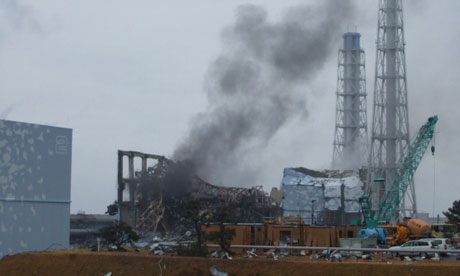
ELEANOR HALL: To Japan now where nearly three months after the earthquake, tsunami and nuclear disaster, Japan's nuclear authority has dramatically revised up its estimates of the amount of radiation emitted from the Fukushima nuclear plants in the week after the earthquake.

In a statement overnight, the Nuclear and Industrial Safety Agency more than doubled its original estimate of the radiation in the atmosphere.

Plutonium has also been found for the first time in soil just a few kilometres from the plant. Tests have confirmed the plutonium came from the plant, but researchers say the levels are not a cause for alarm.

A short time ago I spoke to Tokyo correspondent Mark Willacy.

ELEANOR HALL: Mark this is an extraordinary admission from Japan's nuclear safety agency isn't it, that the earlier estimates of the danger were out by more than 100 per cent?

MARK WILLACY: Well the safety agency says that it was taking on board figures that were provided to it by TEPCO because they're based on basically water injection assumptions. Now that's quite technical but that water was pumped in to try and stop the meltdown - as we know now there were partial meltdowns in three of the reactors.

Now the nuclear safety agency is saying it's pushing up - it's doubling the amount of radiation released in the week after the crisis. It's more than doubling it to 770,000 terabecquerels. Now that probably doesn't mean much to people but it is quite a lot of radiation escaping into the atmosphere.

Read More

http://www.abc.net.au/worldtoday/content/2011/s3237652.htm

Thursday, April 21, 2011

Japan earmarks first $50 billion for post-quake rebuild


Wakana Kumagai, 6, waits for her mother Yoshiko after visiting the grave of her father, who was killed by the March 11 tsunami

Japan's cabinet approved on Friday almost $50 billion of spending for post-earthquake rebuilding, a downpayment on the country's biggest public works effort in six decades.

The emergency budget of 4 trillion yen ($48.5 billion), which is likely be followed by more reconstruction spending packages, is still dwarfed by the overall cost of damages caused by the March 11 earthquake and tsunami, estimated at $300 billion.

"With this budget, we are taking one step forward toward reconstruction ... and toward restarting the economy," Finance Minister Yoshihiko Noda told reporters after a cabinet meeting.

The magnitude 9.0 earthquake and 15 meter tsunami that followed caused Japan's gravest crisis since World War Two, killing up to 28,000 people and destroying tens of thousands of homes.

It also smashed a nuclear power plant which began leaking radiation, a situation the plant's operator says could take all year to bring under control.

Read More

http://www.reuters.com/article/2011/04/22/us-japan-idUSTRE72A0SS20110422

Wednesday, March 30, 2011

Japan says battle to save nuclear reactors has failed


Japanese officials have conceded that the battle to salvage four crippled reactors at the Fukushima Daiichi power plant has been lost.

The plant's operator, Tokyo Electric Power [Tepco], said the reactors would be scrapped, and warned that the operation to contain the nuclear crisis, now well into its third week, could last months.

Tepco's announcement came as new readings showed a dramatic increase in radioactive contamination in the sea near the atomic complex.

The firm's chairman, Tsunehisa Katsumata, said it had "no choice" but to scrap the Nos 1-4 reactors, but held out hope that the remaining two could continue to operate. It is the first time the company has conceded that the at least part of the plant will have to be decommissioned.

But the government's chief spokesman, Yukio Edano, repeated an earlier call for all six reactors at the 40-year-old plant to be decommissioned. "It is very clear looking at the social circumstances," he said.

Tens of thousands of people living near the plants have been evacuated or ordered to stay indoors, while the plant has leaked radioactive materials in to the sea, soil and air.

On Thursday, the International Atomic Energy Agency [IAEA] suggested widening the 30-kilometre exclusion zone around the plant after finding that radiation levels at a village 40 kilometres from the plant exceeded the criteria for evacuation.

"We have advised [Japanese officials] to carefully assess the situation, and they have indicated that it is already under assessment," Denis Flory, a deputy director of the IAEA, said.

The French president, Nicolas Sarkozy, was due to arrive in Tokyo on Thursday to show support for the Fukushima operation and for talks with his Japanese counterpart, Naoto Kan. Sarkozy, the current G8 chair, is the first foreign leader to visit Japan since the 11 March earthquake and tsunami.

An emotional Kastumata apologised for the anxiety the crisis has caused.

Read More

http://www.guardian.co.uk/world/2011/mar/31/japan-battle-save-nuclear-reactors-failed

Sunday, March 20, 2011

Japan's disaster toll rises with 18,000 deaths


FUKUSHIMA, Japan -- The toll of Japan's triple disaster came into clearer focus Monday after police estimates showed more than 18,000 people died, the World Bank said rebuilding may cost $235 billion and more cases of radiation-tainted vegetables and tap water turned up.

Japanese officials reported progress over the weekend in their battle to gain control over a nuclear complex that began leaking radiation after suffering quake and tsunami damage, though the crisis was far from over, with a dangerous new surge in pressure reported in one of the plant's six reactors.

The announcement by Japan's Health Ministry late Sunday that tests had detected excess amounts of radioactive elements on canola and chrysanthemum greens marked a low moment in a day that had been peppered with bits of positive news: First, a teenager and his grandmother were found alive nine days after being trapped in their earthquake-shattered home. Then, the operator of the overheated nuclear plant said two of the six reactor units were safely cooled down.

"We consider that now we have come to a situation where we are very close to getting the situation under control," Deputy Cabinet Secretary Tetsuro Fukuyama said.

Still, serious problems remained at the Fukushima Dai-ichi nuclear complex. Pressure unexpectedly rose in a third unit's reactor, meaning plant operators may need to deliberately release radioactive steam. That has only added to public anxiety over radiation that began leaking from the plant after a monstrous earthquake and tsunami devastated northeastern Japan on March 11 and left the plant unstable. As day broke Monday, Japan's military resumed dousing of the complex's troubled Unit 4.

The World Bank said in report Monday that Japan may need five years to rebuild from the catastrophic disasters, which caused up to $235 billion in damage, saying the cost to private insurers will be up to $33 billion and that the government will spend $12 billion on reconstruction in the current national budget and much more later.

The safety of food and water was of particular concern. The government halted shipments of spinach from one area and raw milk from another near the nuclear plant after tests found iodine exceeded safety limits. Tokyo's tap water, where iodine turned up Friday, now has cesium. Rain and dust are also tainted.

Early Monday , the Health Ministry advised Iitate, a village of 6,000 people about 30 kilometers (19 miles) northwest of the Fukushima plant, not to drink tap water due to elevated levels of iodine. Ministry spokesman Takayuki Matsuda said iodine three times the normal level was detected there - about one twenty-sixth of the level of a chest X-ray in one liter of water.

In all cases, the government said the radiation levels were too small to pose an immediate health risk.

But Tsugumi Hasegawa was skeptical as she cared for her 4-year-old daughter at a shelter in a gymnasium crammed with 1,400 people about 80 kilometers (50 miles) from the plant.

"I still have no idea what the numbers they are giving about radiation levels mean. It's all so confusing," said Hasegawa, 29, from the small town of Futuba in the shadow of the nuclear complex. "And I wonder if they aren't playing down the dangers to keep us from panicking. I don't know who to trust."

All six of the nuclear complex's reactor units saw trouble after the disasters knocked out cooling systems. In a small advance, the plant's operator declared Units 5 and 6 - the least troublesome - under control after their nuclear fuel storage pools cooled to safe levels. Progress was made to reconnect two other units to the electric grid and in pumping seawater to cool another reactor and replenish it and a sixth reactor's storage pools.

But the buildup in pressure inside the vessel holding Unit 3's reactor presented some danger, forcing officials to consider venting. The tactic produced explosions of radioactive gas during the early days of the crisis.

"Even if certain things go smoothly, there would be twists and turns," Chief Cabinet Secretary Yukio Edano told reporters. "At the moment, we are not so optimistic that there will be a breakthrough."

Growing concerns about radiation add to the overwhelming chain of disasters Japan has struggled with since the 9.0-magnitude quake. The resulting tsunami ravaged the northeastern coast. All told, police estimates show more than about 18,400 died. More than 15,000 deaths are likely in Miyagi, the prefecture that took the full impact of the wave, said a police spokesman.

"It is very distressing as we recover more bodies day by days," said Hitoshi Sugawara, the spokesman.

Police in other parts of the disaster area declined to provide estimates, but confirmed about 3,400 deaths. Nationwide, official figures show the disasters killing more than 8,600 people, and leaving more than 13,200 people missing, but those two lists may have some overlap.

The disasters have displaced another 452,000, who are living in shelters.

Fuel, food and water remain scarce. The government in recent days acknowledged being caught ill-prepared by an enormous disaster that the prime minister has called the worst crisis since World War II.

Bodies are piling up in some of the devastated communities and badly decomposing even amid chilly rain and snow.

"The recent bodies - we can't show them to the families. The faces have been purple, which means they are starting to decompose," says Shuji Horaguchi, a disaster relief official setting up a center to process the dead in Natori, on the outskirts of the tsunami-flattened city of Sendai. "Some we're finding now have been in the water for a long time, they're not in good shape. Crabs and fish have eaten parts."

Contamination of food and water compounds the government's difficulties, heightening the broader public's sense of dread about safety. Consumers in markets snapped up bottled water, shunned spinach from Ibaraki - the prefecture where the tainted spinach was found - and overall expressed concern about food safety.

Experts have said the amounts of iodine detected in milk, spinach and water pose no discernible risks to public health unless consumed in enormous quantities over a long time. Iodine breaks down quickly, after eight days, minimizing its harmfulness, unlike other radioactive isotopes such as cesium-137 or uranium-238, which remain in the environment for decades or longer.

High levels of iodine are linked to thyroid cancer, one of the least deadly cancers if treated. Cesium is a longer-lasting element that affects the whole body and raises cancer risk.

Rain forecast for the Fukushima area also could further localize the contamination, bringing the radiation to the ground closer to the plant.

Edano tried to reassure the public for a second day in a row. "If you eat it once, or twice, or even for several days, it's not just that it's not an immediate threat to health, it's that even in the future it is not a risk," Edano said. "Experts say there is no threat to human health."

No contamination has been reported in Japan's main food export - seafood - worth about $1.6 billion a year and less than 0.3 percent of its total exports.

Amid the anxiety, there were moments of joy on Sunday. An 80-year-old woman and her teenage grandson were rescued from their flattened two-story house after nine days, when the teen pulled himself to the roof and shouted to police for help.

Other survivors enjoyed smaller victories. Kiyoshi Hiratsuka and his family managed to pull his beloved Harley Davidson motorcycle from the rubble in their hometown of Onagawa. The 37-year-old mechanic said he knows it will never work anymore. "But I want to keep it as a memorial."

Yamaguchi reported from Tokyo, as did Associated Press writers Elaine Kurtenbach, Kelly Olsen, Charles Hutzler and Jeff Donn. Associated Press writer Jay Alabaster contributed from Natori, Japan.

Read More

http://www.forbes.com/feeds/ap/2011/03/20/general-as-japan-earthquake_8366181.html

Sunday, February 13, 2011

Japan eclipsed by China as world's second economy


TOKYO — Japan surrendered its 42-year ranking as the world's second-biggest economy to China in 2010, after data Monday showed a fourth-quarter contraction caused by weaker consumer spending and a strong yen.

While Japan was expected to fall behind a surging China in the year, the data underlined the weak state of a Japanese economy burdened by deflation, soft domestic demand and pressured by the industrialised world's biggest debt.

"It is difficult for the deflation-plagued Japanese economy to achieve self-sustained growth," said Naoki Murakami, chief economist at Monex Securities.

While China's leap forward reflects a shift in economic power as the country transforms itself from poverty-hit communist state to global heavyweight, it highlights the need for Japan to re-energise its economy, analysts said.

Its post-war "economic miracle" put it at number two behind the United States for 42 years, but stagnation after its property bubble burst in the 1990s helped put booming China on course to supplant it this year.

However, Japan remains around 10 times richer on a per-capita basis, according to the International Monetary Fund.

Japan's real gross domestic product slipped by an annualised 1.1 percent in the October-December quarter as the expiration of auto subsidies hit car sales, a new tobacco tax sapped cigarette demand and a strong yen hurt exports.

While the first contraction in five quarters was not as severe as analyst expectations of a 2.4 percent slide, according to a Dow Jones Newswires poll of economists, Japanese GDP data is subject to constant revision.

The economy grew 3.9 percent in 2010, government data showed -- its first annual growth in three years. But this was not enough to keep it ahead of surging China.

Nominal GDP of $5.474 trillion in 2010 put it behind China's $5.879 trillion, the data showed.

Despite Japan crawling out of a severe year-long recession in 2009, its recovery remains fragile with deflation, high public debt, weak domestic demand and a strong yen all concerns for policymakers.

Last month Standard & Poor's cut Japan's credit rating one notch to "AA-" from "AA", saying the government lacked a "coherent strategy" to ease a debt running near 200 percent of GDP, the highest of any developed nation.

Nearly a third of government spending is being swallowed up by a social security system catering to a rapidly greying society, Standard & Poor's warned, with that ratio set to rise without reforms as Japan continues to age.

Prime Minister Naoto Kan's centre-left government has prioritised social security reform and a tax system overhaul, but has seen his approval ratings tumble and the opposition has so far refused to begin talks on the issue.

Private consumption, accounting for about 60 percent of Japan's GDP, slid by 0.7 percent on-quarter in Oct-Dec as subsidies for green car purchases expired and as cigarette sales were dented by Japan's biggest ever tobacco tax hike.

Exports slipped in the quarter as the Japanese yen surged to 15-year highs against the dollar, making Japanese goods more expensive overseas and eroding repatriated profits.

But many analysts expect the economy to rebound in the January-March quarter as the rising tide of global recovery lifts Japan, amid a recent pick up in corporate spending and exports.

"The contraction will not last long," said Murakami. "Companies' manufacturing activities are recovering rapidly in January-March this year from their bottom in October 2010."

The government said Japan's economy would be helped by recovery elsewhere and could reap the benefits of its huge neighbour China, the world's number-one export market.

"We welcome, as a neighboring nation, that China's economy is advancing rapidly," said Kaoru Yosano, minister for fiscal policy.


Read More

http://www.google.com/hostednews/afp/article/ALeqM5gZttZRIzJpROt_EaZMfH_NosIecw?docId=CNG.7fc4d4a85840416799351787f9748bf5.81

Tuesday, January 11, 2011

NKorea slams SKorea over defense ties with Japan


SEOUL, South Korea -- North Korea is criticizing South Korea for pushing to strengthen defense ties with Japan, calling the cooperation a dangerous plot to invade the North.

The North's government-run Uriminzokkiri website made the criticism Wednesday, two days after South Korea and Japan agreed to launch consultations on accords to share intelligence and provide each other's militaries with fuel, food and other materials.

The pacts, if signed, will be the two countries' first military agreement since Tokyo's brutal colonial rule of the Korean peninsula ended in 1945.

The North says the accords will help a U.S. plot to attack the North with its allies.

Seoul and Washington have repeatedly said they have no intention of invading North Korea.


Read More

http://www.washingtonpost.com/wp-dyn/content/article/2011/01/11/AR2011011107341.html

Sunday, November 14, 2010

Japan is test case for Pac Rim free trade zone


Protesters shout slogans during a rally against China near the venue of the APEC forum in Yokohama, near Tokyo, Sunday, Nov. 14, 2010. Chinese President Hu Jintao is visiting the economic summit among a territorial dispute between the Asian giants.

YOKOHAMA, Japan — Although Asia-Pacific leaders have committed themselves to achieving a Pacific-wide free trade zone following an annual summit, host Japan may prove a key test case for how realistic that vision is.

Acknowledging that Japan's economic power is declining, Prime Minister Naoto Kan declared his country must open up its markets and embrace free trade — or risk getting left further behind other regional rivals.

"Japan is determined to reopen itself," Kan said at a press conference Sunday that wound up the Asia-Pacific Economic Cooperation forum, alluding to the historic role that Yokohama, which hosted the summit, played more than 150 years ago as one of the first Japanese ports to open up to the West.

That bold declaration represents a change for Japan, which for decades had been ruled by conservative administrations that were reluctant to engage in trade liberalization and were closely tied with farmers who fiercely oppose lowering protective tariffs. Imported rice, for example, is subject to a 778 percent tariff.

Japan and the other 20 members of APEC will face many such tough choices as they strive to execute their shared commitment to free trade and greater regional integration as outlined in the leaders' communique issued at the end of the weekend meeting.

Their overarching goal: To work toward establishing a Free Trade Area of the Asia-Pacific that would envelope all members, from behemoths China and the U.S. to tiny Brunei and New Zealand. Slashing tariffs and other barriers to imports and investments, the so-called FTAAP would cover half the world's global commerce and two-fifths of its trade. Kan said the rough target date was 2020.

The Asia-Pacific region has led the world's still-weak recovery from the financial crisis, and the region's leaders are convinced that open markets are a sure way to ensure future growth. Still, creating such a huge free trade zone is a highly complicated endeavor given the region's diversity and vested interests opposed to opening markets.

China's transformation into the world's second-largest economy — overtaking Japan this year — and the dynamism that has helped it lead the global recovery, was made possible mainly by opening to foreign trade and investment. While Washington complains that Beijing keeps its currency artificially low, giving China's exports an unfair price advantage, consumers have benefited enormously from lower-priced imports.

Japan's economy, meanwhile, has been stagnant for two decades, stymied by weak demand and a shrinking population even as regional rivals such as South Korea — which is racing ahead of Japan in free trade deals — are becoming formidable competitors.

"Other Asian economies are catching up to or surpassing Japan," Kan said Sunday after the summit ended.

"Japan would like to stay as a country with vigor, and to survive in this context, we really need to have economic integration with Asian and Pacific Rim friends and countries so that together we can grow," he said.

Although Japan has long sought to boost demand at home, the resource-scarce country remains strongly dependent on exports.

Driven by a sense of urgency, Japan's government — led by the ruling Democrats, who overthrew the long-ruling conservatives last year — announced a striking new openness toward free trade in a policy paper last week, just before the APEC meetings, as a way to revive growth.

Calling the present a "watershed moment," Tokyo promised to "open up the country." It pledged to wrap up free trade negotiations with Australia, resume suspended trade talks with South Korea, and seek new free trade partners, warning the country needed to become a more attractive place to invest. On Sunday, Japan signed a free trade deal with Peru.

Japan must now decide whether to join a U.S.-backed free trade grouping called the Trans-Pacific Partnership, which the APEC leaders held up as a building block for an eventual Pacific-wide free trade zone. The U.S., Australia, Malaysia, Vietnam and Peru are negotiating to join the TPP bloc, which currently brings together the small economies of Chile, New Zealand, Brunei and Singapore.

Big Japanese corporations are urging Kan to join or put Japan at a disadvantage, but he is already facing an intense fight from farmers who fret that a flood of cheaper agricultural products will ruin them.

"We small-scale farmers cannot compete with large-scale growers abroad," said Ryoichi Fujimaki, a 43-year-old vegetable farmer near Yokohama.

While Kan has also promised to revitalize Japan's farming industry and overhaul agricultural policy, but hasn't given details.

Some APEC leaders urged Japan to consider the big picture.

"You cannot guide your integration policy on only one sector," said Chilean President Sebastian Pinera, noting that agriculture represented less than 2 percent of Japan's economy. "If the country as a whole will win because of the FTA, that means it can compensate the losers and still there will be something for the winners."

Read More


http://www.google.com/hostednews/ap/article/ALeqM5gCc1vIYhQ1adq3bHfkSD4jAk_piA?docId=f8a5bb98819b4dff8d4f8af8b283865a