Showing posts with label nato. Show all posts

Sunday, May 15, 2011

NATO bombs Libyan town near Tunisian border


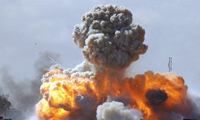
TUNIS, May 15 (Xinhua) -- NATO planes on Sunday morning bombed barracks and radar installations in the Libyan town of Boukamache, some 17 km from the Tunisian border, the official TAP press agency reported.

The bombings which could be heard at the Ras El Jedir border crossing point, provoked panic among a number of Tunisians on their way back to Tunisia, TAP said, adding following the bombings, a large number of Libyan refugees fled the region and crossed into Tunisia.

On Saturday night, a Tunisian army patrol managed to thwart an infiltration attempt into Tunisian territory by forces loyal to Libyan leader Muammar Gaddafi, TAP reported.

More than 200 people tried to enter the Tunisian border, near Tataouine, in an attempt to take rebel forces by surprise. They were repelled back into Libya. No clashes were recorded. In the meantime, the Tunisian army deployed more military vehicles to protect the border area, TAP said.

Read More

http://news.xinhuanet.com/english2010/world/2011-05/15/c_13875997.htm

Monday, May 9, 2011

Libya: Hundreds feared dead as migrant boat capsizes


Several hundred people are feared to have drowned off Libya, after a boat carrying some 600 refugees trying to reach Europe broke up at sea on Friday.

The UN's refugee agency said 16 bodies, including two babies, had been found.

UNCHR has said all ships using the Mediterranean should be ready to assist such vessels, as thousands continue to flee North Africa in inadequate boats.

Nato has denied claims that its naval units left dozens of migrants to die aboard another boat in distress.

It said it was unaware of the plight of the boat, which reportedly was adrift for more than two weeks.

The Guardian newspaper said 61 of the 72 people on board the boat died of hunger or thirst, despite being spotted by a military helicopter and Nato ship.

Read More

http://www.bbc.co.uk/news/world-europe-13332536

Thursday, April 28, 2011

NATO airstrike mistakenly kills 12 Libyan rebels


Reporting from Benghazi, Libya—
A NATO airstrike in the besieged rebel-held city of Misurata mistakenly killed 12 Libyan rebels, an official with the transitional government confirmed Thursday, while new fighting was reported on Libya's western border with Tunisia.

The strike Wednesday was at least the third reported friendly fire incident since North Atlantic Treaty Organization fighter jets began pounding forces loyal to Moammar Kadafi more than five weeks ago in a mission to protect Libyan civilians.

Leaders of the anti-Kadafi forces have labeled the incidents unfortunate accidents in a worthy cause, reflecting wide support in rebel ranks for the NATO strikes.

Nonetheless, both NATO and the rebels have said additional precautions — such as marking rebel vehicles and reporting precise positions to NATO — have been employed to avoid further tragedies.

"It is regrettable, but we know the people of Misurata understand," said Shamsiddin Abdulmolah, a press liaison with the transitional council, who confirmed the death toll. "We know NATO didn't do this on purpose."

There was no immediate response from North Atlantic Treaty Organization officials.

NATO's bombing campaign is widely seen as having prevented Kadafi forces from retaking rebel-held territory, including the eastern city of Benghazi, de facto capital of the opposition. Despite the deadly friendly fire episodes, rebel officials have urged their international allies to step up the air campaign against the Kadafi regime.

Two previous inadvertent NATO strikes on anti-Kadafi forces left at least 18 rebels dead and many injured.

Reports from the scene indicated that Wednesday's strike occurred near Misurata's port, which has been a lifeline for supplies into the city and refugees going out. NATO has been bombarding loyalist forces shelling the port area.


Read More

http://www.latimes.com/news/nationworld/world/la-fg-libya-fighting-20110429,0,2078877.story

Sunday, April 24, 2011

Hundreds of Taliban in tunnel jail escape


Some 540 Taliban officers and commanders have escaped from Kandahar prison via a 320 metre-long tunnel, Afghan government officials have confirmed to Al Jazeera.

A Taliban official on Monday also confirmed the overnight escape, boasting that the prison break had been "very well-planned" and that it was five months in the making, Al Jazeera's Qais Azimy, reporting from Kabul, said.

According to a Taliban statement the tunnel was not dug by the inmates but by fighters outside the prison.

"Mujahideen started digging a 320 metre-long to the prison from the south side, which was completed after a five month period, bypassing check posts and the Kandahar-Herat main highway leading directly to the political prison," the statement read.

"The tunnel reached its target last night, from where the prisoner Mujahideen were led away through the escape route by three previously informed inmates in a period of four and a half hours, starting from 11:00 pm last night and ending at 3:30 am this morning. Mujahideen later on sent vehicles to the inmates who were led away to secure destinations."

"They all have made it safe to our centres and there was no fighting," Yousuf Ahmadi, a Taliban spokesman, said.

Ahmadi said that 106 were Taliban commanders while the rest were foot soldiers. Kandahar police said they have re-captured eight commanders so far.

The Taliban claim that the prison guards did not notice the escape until four hours after the operation was completed.

The prison in Kandahar typically holds drug dealers as well as Taliban commanders captured by NATO forces, our correspondent said.

If the officials have the correct number for those who have escaped - 540 Taliban commanders and senior officers on the run - then this break will constitute a "big success" for the Taliban.

It is also sure to "have a dramatic effect on the fight against the Taliban in the region," said Azimy.

Security concerns

There have been previous escapes from this prison. In June 2008, Taliban fighters attacked the facility in southern Afghanistan, blasting through its entrance and engaging in a gun battle with police.

Nearly all of the estimated 1,150 prisoners, including some 400 Taliban, escaped, according to Afghan officials.

A Taliban spokesperson said that two suicide bombers blew themselves up near the entrance of the gate to the prison before 30 Taliban fighters attacked and killed 16 policemen.

Kandahar prison was the scene of a mass hunger strike by hundreds of inmates in May, 2008 during which 47 of the prisoners sewed their lips shut after complaining they had been tortured and denied fair trials.

Kandahar is seen as the birthplace of the Taliban movement and the city and surrounding area is scene of some of the worst fighting in Afghanistan.

Read More

http://photogallery.indiatimes.com/news/india/sathya-sai-baba-passes-away/articleshow/8077610.cms

Thursday, March 24, 2011

NATO to Run No-Fly Zone While U.S.-Led Force Hits Qaddafi Troops


March 25 -- NATO agreed to take command of the Libya no-fly zone, stopping short of assuming responsibility for airstrike missions against Libyan ground forces that sparked discord within the 28-nation alliance.

The limited agreement among members of the North Atlantic Treaty Organization may delay a U.S. handoff of responsibility for strikes on Muammar Qaddafi’s fighters. The anti-Qaddafi coalition will continue to handle actions which don’t involve the no-fly zone, said NATO Secretary-General Anders Fogh Rasmussen. Foreign ministers from coalition nations plan to meet March 29 in London to discuss Libya issues.

U.S. Navy Adm. Bill Gortney said yesterday the coalition flew 130 sorties in a 24-hour period, of which 49 were sent to hit designated ground targets. The allies are striking Libyan government forces that continue to attack civilians in coastal cities Misrata, Ajdabiya and Zentan and launched 14 more Tomahawk cruise missiles against Libyan air-defense and SCUD missile sites.

French officials, who pushed hardest for military action, predicted a quick end to the conflict. French Defense Minister Gerard Longuet said in Paris that the coalition has intercepted conversations among Libyan officers indicating that many are ready to abandon the regime.

Oil Prices

“The military action will be counted in days and in weeks, not in months,” French Foreign Minister Alain Juppe said at a Paris press conference.

Oil prices have jumped about 25 percent since the Libyan rebellion began last month, heightening concerns about Middle East crude supplies. The revolt has evolved from the kind popular uprising seen in Egypt and Tunisia into a civil war. Elsewhere, Syria announced a steps in response to protests, including a possible end to 48-year emergency rule that suspended most rights. In Yemen, the political opposition to President Ali Abdullah Saleh announced plans for nationwide protests against the state-of-emergency law just passed by Saleh’s loyalists.

Crude oil slipped from the highest level since September, with crude for May delivery falling 15 cents to settle at $105.60 a barrel on the New York Mercantile Exchange. Gold futures jumped to a record of $1,448.60 an ounce.

Cease-Fire Talks

UN Secretary General Ban Ki-moon, after reporting to the Security Council on Libya developments, said in New York he expects Libyan government and opposition representatives to hold cease-fire talks today under African Union auspices in Addis Ababa, Ethiopia.

Rasmussen said NATO’s role will be limited for now to the no-fly zone. Earlier in the week, NATO said it would take charge of enforcing the UN arms embargo on Libya. NATO will take over command of the no-fly-zone operations in one or two days, according to an administration official authorized to brief reporters on the condition his name not be used.

Secretary of State Hillary Clinton held a four-way conference call with foreign ministers from the U.K., France and Turkey, according to Mark Toner, a State Department spokesman. She later said that NATO would further consider plans to assume command of the ground-strike missions.

“We have not decided yet whether we will take on a broader responsibility,” Rasmussen said

Read More

http://www.businessweek.com/news/2011-03-24/nato-to-run-no-fly-zone-while-u-s-led-force-hits-qaddafi-troops.html

Sunday, November 21, 2010

NATO's 2014 Afghanistan departure date laden with ambiguity


The two-day summit that ended Saturday in Lisbon committed NATO countries to an open-ended involvement in Afghanistan. While the leaders of the European-American alliance set a goal of withdrawing their combat troops over the next four years, they also signed an accord with Afghan President Hamid Karzai pledging long-term military and reconstruction assistance.

They also endorsed a plan to start handing off responsibility for security to Afghan forces next spring, with foreign troops switching to a support and training role and with the aim of completing the transfer within four years.

But NATO chief Anders Fogh Rasmussen officials said the date was not a deadline. Combat operations could continue beyond 2014, he warned, and the pace of the transition will have to be determined by conditions on the ground in each town, district and province.

The meeting brought together leaders of the countries that have troops on the ground, 28 of them members of NATO and 20 others that joined the international force over the nine years that it has slogged away in Afghanistan.

Political support among NATO leaders for an extended military engagement is already wearing thin.

The Dutch ended their combat role this summer, withdrawing their 1,950 troops after four years in Uruzgan province in the centre of the country.

Prime Minister Stephen Harper told the summit that Canada would not budge from its plans to withdraw its military forces next year. He said the 950 military trainers that Canada has agreed to send in their place will leave March of 2014, regardless of whether other allied forces remain in Afghanistan until the end of that year or beyond.

The rest of the assembled presidents and prime ministers, many with elections looming in the next two years, had clearly hoped to bring home a less ambiguous timetable for withdrawal so that they could face down growing domestic opposition to the war.

Instead, they got a sobering assessment of the situation on the ground from General David Petraeus, the American commander of the 130,000-strong international force.

“After several years during which security deteriorated and governance stalled, we have regained the initiative,” he told them in a prepared statement at the closed-door meeting.

“Continued patience will enable us to sustain it,” he added, “despite the inevitable setbacks that lie ahead.”

Some 150,000 allied soldiers, the bulk of them American, are now deployed in Afghanistan. They have faced their most intensive fighting, and sustained their highest casualties, in the past year as the United States moved in 30,000 extra troops.

British and German leaders, as did President Barack Obama, said they intended to thin out their forces but were prepared to keep some troops in the country if needed beyond 2014.

British Prime Minister David Cameron, in an interview with Sky News after the summit, said some of the country’s 9,500 soldiers would stay on to train Afghan forces or deliver aid. “There will not be British troops in large numbers and they won’t be in a combat role” by 2015, he said.

French President Nicolas Sarkozy, though, was already anticipating a quicker drawdown. Although NATO officials said they could not say where the first transfers to Afghan forces were likely to occur, Mr. Sarkozy told reporters in Lisbon that some 40 districts have been deemed secure enough to be handed over to Afghan security forces.

He said one of them is in Kapisa province where most of the 3,000 French soldiers are deployed, and that one would be transferred next year.

The summit laid bare the frustrations of many of the NATO country leaders with Mr. Karzai.

They acknowledged that Mr. Karzai, as a fellow politician, he has his own constituency to win over by making good on his campaign promise to have international troops transfer authority over his country’s affairs by 2014. But they also publicly admonished him to more to clean up corruption and appoint local officials on the basis of competence rather than political favouritism.

Four years probably will not be enough, according David Sedwill, the top NATO administrator in Afghanistan and the civilian counterpart to Gen. Petraeus. He told the NATO leaders that they can encourage the Afghan government to establish the rule of law, but four years may not be enough.

Mr. Sedwill, a British diplomat, described a visit he made to the city of Marjeh in Helmand province earlier this year after allied forces pushed out the Taliban. The community was traumatized, he said, but less by their experience with the Taliban than by with the “brutal and predatory” Afghan police who were in charge before the insurgents took over.

“By 2014,” he said, “there will still be pockets of tribal, ethnic, criminal and political violence throughout Afghanistan.”

Read More

http://www.theglobeandmail.com/news/world/natos-2014-afghanistan-departure-date-laden-with-ambiguity/article1807792/
Thursday, November 18, 2010

Pentagon says 2014 Afghan deadline "aspirational"


President Hamid Karzai's target to take the lead from NATO in securing Afghanistan by the end of 2014 is only "aspirational" and may not be possible everywhere in the country, the Pentagon said on Thursday.

The 2014 target is expected to be a top agenda item at a NATO summit in Lisbon this week, where world leaders including President Barack Obama will lay the plans for their troops' eventual exit from the unpopular war.

Karzai has said he wants the Afghan army and police to take control of the country by 2014, a target Defense Secretary Robert Gates and Secretary of State Hillary Clinton have called realistic.

"I would emphasize two things here: Number one, it is the end of 2014, so effectively, it's by 2015," Pentagon Press Secretary Geoff Morrell told reporters.

"Although the hope is, the goal is, to have Afghan security forces in the lead over the preponderance of the country by then, it does not necessarily mean that ... everywhere in the country they will necessarily be in the lead," he added.

Mark Sedwill, the top NATO civilian representative in Afghanistan, said earlier this week that the transition process may run into 2015 and beyond, and that after foreign troops step down from combat roles the country could see "eye-watering levels of violence".

Analysts have interpreted the NATO comments as an attempt to soften the timeline while sticking to a more appealing message that U.S. and NATO forces are preparing for an eventual exit after more than nine years of war.

Violence in Afghanistan is at its worst since the Taliban were overthrown in late 2001, with record casualties on all sides of the conflict, and the insurgency spreading to previously peaceful northern and western parts of the country.

The Taliban, who some analysts say may be heartened by a deadline for the departure of foreign troops, have said they aim to continue to step up their military campaigns.

"Basically we have no expectation that (foreign troops) will leave without any pressure," Taliban spokesman Zabihullah Mujahid told Reuters by phone from an undisclosed location.

"They should learn from our history, but it seems they do not. Whatever strategy or timetable they adopt, it will not have an impact on our pressure."

Karzai, already embroiled in a dispute with NATO's commander about a recent criticism of the visibility and intensity of foreign forces' operations, declined direct comment on Sedwill's recent remarks.

His spokesman said that the president expected the summit to focus on transition, and would underline the need for Afghan forces to play a more high-profile role in operations.

Read more

http://www.reuters.com/article/idUSTRE6AI0KV20101119