Showing posts with label world disaster. Show all posts

Friday, July 8, 2011

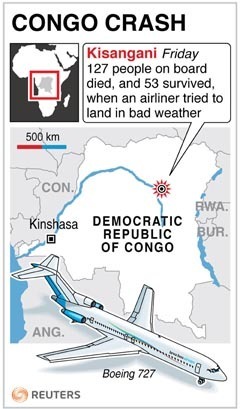
Africa DR Congo plane crash kills 127 people


A Boeing 727 passenger jet crashed into jungle in the Democratic Republic of Congo on Friday, killing 127 people on board, officials said.

The transport ministry said 51 people survived the accident which occurred during heavy rain as the aircraft came in to land at the eastern port town of Kisangani, according to Reuters.

But executives from Hewa Bora airline said only 53 people were killed and 57 survived.

"The pilot tried to land but apparently they didn't touch the runway," chief executive Stavros Papaioannou told Reuters.

Read More

http://www.globalpost.com/dispatch/news/regions/africa/110708/congo-plane-crash-hewa-bora

Wednesday, June 22, 2011

Large earthquake hits north-east Japan


A large earthquake has hit north-east Japan in the same area where a massive quake in March triggered a devastating tsunami, but there were no immediate reports of injuries or damage.

Japan's meteorological agency issued a tsunami warning for the region, but cancelled it about an hour later.

Thursday's quake hit about 30 miles (47km) from the shore of Iwate prefecture at 6.51am local time (9.51pm GMT Wednesday), the meteorological agency said. Much of the coast in the area is still heavily damaged from March's disasters.

The US Pacific Tsunami warning centre said it did not expect a destructive Pacific-wide tsunami.

The quake, 19.9 miles deep, caused tremors across the northern half of the country, including Tokyo, which is about 325 miles to the southwest. It was followed by several smaller aftershocks.

Japan is located on the Ring of Fire, an arc of volcanoes and fault lines spanning the Pacific Basin, and is regularly hit by earthquakes.

Read More

http://www.guardian.co.uk/world/2011/jun/23/earthquake-hits-north-east-japan

Tuesday, June 21, 2011

44 die in Russian plane crash


STPETERSBURG, Russia - A Russian passenger jet crashed in heavy fog and burst into flames on a highway in northwestern Russia, killing 44 people, officials said. Eight people survived.

The Tu-134 plane, belonging to the RusAir airline, had taken off from Moscow and was moments from landing at the airport of Petrozavodsk when it slammed into the highway just before midnight on Monday, said Emergencies Ministry spokeswoman Oksana Semyonova.

The ministry said in a statement on its website that 44 people were killed, including four with dual US and Russian citizenship.

Semyonova said the plane slammed into the ground about 100 meters from a small village, but no casualties were reported on the ground.

Petrozavodsk is in Karelia, near the Finnish border, about 640 kilometers northwest of Moscow.

Russia's top investigative agency said bad weather, human error or a technical malfunction might have contributed to the crash.

A 9-year-old boy and his teenage sister were among eight people who survived the crash, the ministry said.

Anton Terekhin and his 14-year-old sister Anastasia Terekhina are being treated for severe injuries in hospital in Petrozavodsk.

The brother and sister feature on a list of survivors published by the Karelia branch of the emergencies ministry on its website. They are registered as residents of the Pacific island of Sakhalin.

A spokeswoman confirmed that the two were in hospital but that their mother Oksana was killed in the crash. A stewardess, named as Yulia Skvortsova, 23, also survived, the only one of the plane's crew who was not killed.

Read More

http://www.chinadaily.com.cn/cndy/2011-06/22/content_12748617.htm

Tuesday, June 14, 2011

Shallow aftershock rocks Christchurch as experts warn of more earthquakes


A car is trapped in water on Ferry Road after two magnitude 6.0 and 5.5 earthquakes struck on Monday in Christchurch, New Zealand.


THE probability of another major earthquake hitting the devastated New Zealand city of Christchurch in the next year has increased in the wake of this week's new tremors, experts said today.

The already traumatised South Island city was rocked by major quakes on Monday, with a 5.0-magnitude aftershock at a depth of just 1km rattling the nervous residents again early today.

Christchurch mayor Bob Parker later reported no new damage was caused by today's aftershock, which was followed by others including a 4.2-magnitude shake at 2.30pm local time.

The most recent quakes - which come after the February 22 disaster that killed 182 people - have been blamed on a new faultline in the region.

New calculations by GNS Science showed that from today until June 15 next year there was now a 30 per cent chance of a quake of between magnitude 6.0 and 6.9 striking the area, compared with a 23 per cent probability expressed last month,

Read More

http://www.heraldsun.com.au/news/breaking-news/shallow-aftershock-rocks-christchurch-as-experts-warn-of-more-earthquakes/story-e6frf7jx-1226075675624

Monday, May 23, 2011

Icelandic Ash Triggers Dozens of Flight Cancellations


The Icelandic volcanic eruption triggered dozens of flight cancellations on Tuesday and an emerging backlash from airlines concerned that regulators are being too hasty in deeming airspace unsafe.

The ash cloud from Grimsvotn, the country's largest volcano, spread south and west towards the U.K., and authorities in continental Europe initiated contingency plans, though concerns emerged that regulators had not absorbed the lessons from the mass airspace closures following a similar eruption last year. That eruption led to the biggest shutdown of European airspace since World War II.

Read More

http://online.wsj.com/article/SB10001424052702303654804576341413428852714.html

Sunday, May 22, 2011

Iceland's most active volcano erupting


BEIJING, May 23 (Xinhuanet) --Iceland's most active volcano, Grimsvotn, has started erupting, accompanied by a series of small earthquakes. Amateur video filmed by a passenger on a commercial airlines flight showed what appeared to be an ash cloud of about 20 kilometers rising into the sky.

The volcano lies under the uninhabited Batnajokull glacier in southeast Iceland and last erupted in 2004. Officials say the eruption is not expected to affect European airline traffic at least for the next 24 hours although a flight ban has been imposed around the area. Whether widespread disruption occurs will depend on how long the eruption lasts, how high the ash plume rises and which way the wind blows.

The eruption last year caused most airports in northern European countries to close for five days. Authorities halted flights due to fears that dust and ash would get into aircraft engines and cause accidents after the cloud was blown into European air traffic lanes.

Read More

http://news.xinhuanet.com/english2010/video/2011-05/23/c_13889214.htm

Wednesday, April 27, 2011

Train overturns in Taiwan, kills five mainland tourists


TAIPEI, April 27 (Xinhua) -- A small train overturned in Taiwan's Ali Mountain area on Wednesday, killing at least five tourists and injuring more than 100 as of 11:00 p.m. local time.

The deceased, all female, were confirmed to be mainland tourists from tour groups, according to Taiwan authorities.

Sources with the Chiayi fire department say a tree branch had broken and fallen over the railway line, which hit the last carriage and then caused several carriages to overturn.

"There was a loud clattering sound, and we thought it was an earthquake. But later we knew that huge tree branches smashed into a carriage," recalled Chen Zhenbin, 58, from the Wenzhou city in eastern Zhejiang Province, after being sent to the St. Martin De Porres Hospital in Chiayi.

Chen told Xinhua that he and his two sisters were sitting in the eighth carriage when the accident happened.

"The sixth, seventh and eighth carriages were overturned, but our carriage was stopped by the trees at the side of the road and didn't roll too far," Chen said, adding that the three of the passengers later climbed out of the upside-down carriage.

"I heard tourists in the sixth and seventh carriages shouting for help. We went there quickly and helped pull people out. But still, some were crushed under the carriage and didn't stand a chance," Chen said.

As of 11:00 p.m., a total of 112 members from the tour groups, including the five deceased and 18 seriously injured, had been sent to nearby hospitals, according to Xinhua's tally based on Taiwan authorities and the Chiayi county government.

A spokesperson with the St. Martin De Porres Hospital told Xinhua that among 40 received by the hospital, one died prior to arrival and the rest were in a stable condition. Most of them had minor wounds such as bruises on faces and limbs.

"We will save the injured at all costs with the Taiwan side," said Liu Kezhi, director of the Cross-Strait Tourism Exchange Association's Taipei office, as he visited the hospital.

Read More

http://news.xinhuanet.com/english2010/china/2011-04/27/c_13848287.htm

Wednesday, March 30, 2011

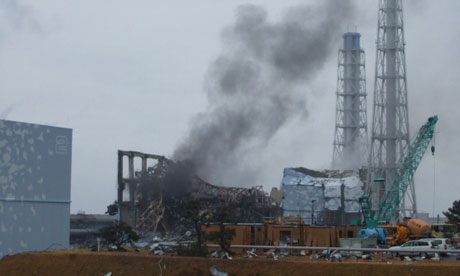
Japan says battle to save nuclear reactors has failed


Japanese officials have conceded that the battle to salvage four crippled reactors at the Fukushima Daiichi power plant has been lost.

The plant's operator, Tokyo Electric Power [Tepco], said the reactors would be scrapped, and warned that the operation to contain the nuclear crisis, now well into its third week, could last months.

Tepco's announcement came as new readings showed a dramatic increase in radioactive contamination in the sea near the atomic complex.

The firm's chairman, Tsunehisa Katsumata, said it had "no choice" but to scrap the Nos 1-4 reactors, but held out hope that the remaining two could continue to operate. It is the first time the company has conceded that the at least part of the plant will have to be decommissioned.

But the government's chief spokesman, Yukio Edano, repeated an earlier call for all six reactors at the 40-year-old plant to be decommissioned. "It is very clear looking at the social circumstances," he said.

Tens of thousands of people living near the plants have been evacuated or ordered to stay indoors, while the plant has leaked radioactive materials in to the sea, soil and air.

On Thursday, the International Atomic Energy Agency [IAEA] suggested widening the 30-kilometre exclusion zone around the plant after finding that radiation levels at a village 40 kilometres from the plant exceeded the criteria for evacuation.

"We have advised [Japanese officials] to carefully assess the situation, and they have indicated that it is already under assessment," Denis Flory, a deputy director of the IAEA, said.

The French president, Nicolas Sarkozy, was due to arrive in Tokyo on Thursday to show support for the Fukushima operation and for talks with his Japanese counterpart, Naoto Kan. Sarkozy, the current G8 chair, is the first foreign leader to visit Japan since the 11 March earthquake and tsunami.

An emotional Kastumata apologised for the anxiety the crisis has caused.

Read More

http://www.guardian.co.uk/world/2011/mar/31/japan-battle-save-nuclear-reactors-failed

Wednesday, March 16, 2011

Helicopter crews struggle to douse nuclear reactor


Japanese crews braved radiation to fly helicopters over the Fukushima Dai-ichi nuclear plant Thursday, dumping sea water on the critically damaged Unit 3 reactor.

The crews, using CH-47 Chinook helicopters, worked in 40-minute shifts to limit their exposure. However, strong winds appeared to blow much of the water from the target, limiting the dangerous operation's effectiveness.

Dozens of people have remained at the scene, working against the clock to prevent harmful levels of radioactive material from spewing into the air.

Officials had initially ruled out using helicopters, saying the radiation would be too dangerous.

Meanwhile, at the Unit 4 reactor, there are concerns that water has completely evaporated from a pool for spent fuel rods. If confirmed, it means there is nothing that is preventing the rods from reaching dangerous temperatures.

"There is no water in the spent fuel pool and we believe that radiation levels are extremely high, which could possibly impact the ability to take corrective measures," chief of the U.S. Nuclear Regulatory Commission Gregory Jaczko said at a House Energy and Commerce subcommittee hearing Wednesday.

If Jaczko is correct, the outer shell of the rods could explode with enough force to propel radioactive fuel over a wide area.

The U.S. is calling on Americans in Japan to stay at least 80 kilometres away from the plant, while Japan's official evacuation zone is only about 20 km. The Obama administration has also authorized plans to transport Americans out of the country as radiation fears grow.

Power line

Thursday brought one potential piece of good news: Tokyo Electric Power Co. said they were close to completing a new power line that could power cooling systems to end the crisis at the nuclear plant.

When completed, it will restore power to pumps that will send a steady supply of water to the six reactors, cooling down any fuel cells.

TEP spokesperson Naoki Tsunoda said officials will test the power line "as soon as possible," but could not say exactly when it would be completed.

The crisis in Japan, sparked by a 9.0-magnitude earthquake that created a monstrous tsunami, prompted a rare address to the nation by 77-year-old Emperor Akihito.

In the televised speech, the emperor urged the Japanese people to give each other hope, despite a horrific death toll expected to exceed 10,000.

"I think it is important for all of us, in various ways and however small, to share the burden of the difficult period that the victims now face," he said.

Read More

http://www.ctv.ca/CTVNews/World/20110317/japan-nuclear-reactor-radiation-110317/

Monday, March 14, 2011

World briefs

SUICIDE ATTACK KILLS 33: A suicide attacker blew himself up Monday in an army recruiting center in the northern Afghanistan province of Kunduz, killing 33 and injuring 40 others, officials said. The bombing — aimed at young men who were seeking to join the army — was the latest in a wave of insurgent attacks in Kunduz, where Afghan security forces are scheduled to assume responsibility for security later this month. Among the dead were three army officers; the rest were civilians, including four street children, he said.

POLITICAL CHANGE: Chinese Premier Wen Jiabao on Monday endorsed political change as a worthwhile goal — as long as it doesn’t happen too soon and is closely supervised by the Chinese Communist Party. The comments immediately set off conjecture about whether Wen was stepping back from what was widely interpreted as support for reform last year in an interview he gave to CNN. But knowing whether Wen’s comments signaled an actual change in his approach — or, even whether he had been truly advocating reform last year — was all but impossible to tell. The Chinese government reveals almost nothing of its deliberations.

HAITI CANDIDATES UNFAZED: Haiti’s two presidential candidates on Monday dismissed concerns that the apparently imminent return of exiled former President Jean-Bertrand Aristide would disrupt the election, despite a U.S. State Department warning he could be a destabilizing presence. Candidate Michel Martelly, a singer, said Aristide should postpone his arrival until after the election. Mirlande Manigat, a university administrator and former first lady, expressed no misgivings.

RENAULT AGENT ARRESTED: A security agent for Renault has been charged with fraud and accused of inventing industrial espionage claims that led the French carmaker to wrongly suspect — and suspend — three executives, the state prosecutor said Monday. The company quickly sent a deep apology to the wrongly accused employees and said it would return them to their jobs or provide an indemnity.

ABBAS CONDEMNS KILLING: The Palestinian president, Mahmoud Abbas, expressed abhorrence Monday about the killing of five members of a family in a Jewish settlement in the West Bank. The emphatic condemnation, delivered over Israel’s public radio, came after Israel criticized the Palestinian leadership for what it considered to be an initially mealy-mouthed response. “This act was abominable, inhuman and immoral,” Abbas said in a rare interview with Israel Radio, conducted in Arabic.

ATTACKS ON TOURISTS CRITICIZED: A robbery and assault on three gay American tourists at their vacation cottage has St. Lucia officials scrambling to assure visitors that the southern Caribbean island is safe and welcoming for gay people. Tourism Minister Allen Chastanet issued an apology Monday to three men from Atlanta after masked bandits broke into their mountain rental home in Soufriere. One victim said the gunmen made slurs against gays, white people and Americans during the March 3 assault.

JOURNALISTS DEPORT: Armed Yemeni security forces raided an apartment shared by four Western journalists Monday and deported them because of their coverage of a growing uprising against the country’s longtime ruler, one of the reporters said. The journalists, two Americans and two Britons in their 20s, contribute to the Wall Street Journal, the Los Angeles Times and others.

FLOODING IN BRAZIL: Floods in southern and southeastern Brazil have forced about 31,000 people to leave their homes, authorities said Monday. Three people have died in landslides triggered by the rains. One person remained missing.

RUSSIA POSTPONES FLIGHT: Russian officials have postponed the March 30 launch of a rocket carrying a U.S. and Russian crew to the international space station because of a communication problem found during testing. The new launch will probably be in April.

Read more:
http://www.kansascity.com/2011/03/14/2725974/world-briefs-suicide-attack-kills.html#ixzz1Gdlunmmh

Thursday, February 24, 2011

New Zealand quake toll rises as hope fades for survivors


(Reuters) - International rescue teams searched through the rubble of quake-ravaged Christchurch on Friday for more than 200 people still missing, but rain and cold were dimming hopes of finding more survivors in the country's worst natural disaster in decades.

Teams from quake-prone countries such as Japan, Taiwan and the United States used sniffer dogs and microphones to scour collapsed buildings for any sign of life, after Tuesday's 6.3 magnitude tremor struck the country's second biggest city.

The disaster has so far claimed 113 lives, and authorities warned the death toll was set to climb.

Many of the missing were students who had come to the city, one of New Zealand's most attractive, from Japan, China, Taiwan and India to learn English against a backdrop of the country's dramatic southern alps.

"For those people in those far off places, your families are our families, your children are our children," Christchurch Mayor Bob Parker said in a message to their families overseas, promising searchers would not abandon hope.

Tales were emerging of daring rescues, with doctors in the depths of one collapsed building having to use a Swiss Army knife to amputate one man's legs to free him.

"There wasn't really any other option. Essentially the procedure was performed with a Swiss Army knife. I know that sounds terrible, but that's all we had," doctor Stuart Philip told the Dominion Post newspaper.

Rescuers pulled aside massive stone blocks and 13 one-tonne church bells from the toppled spire of the landmark ChristChurch Cathedral in the city heart, where as many as 22 bodies could now be trapped in a square popular with tourists.

"We're having to move extremely slowly, we're working brick by brick. There are a lot of loved ones in here that we want to get out," rescue worker Steve Culhane told.

Police said 228 people were listed as missing. The list could include many people whose bodies have been found but yet to be identified. More than 2,500 were injured in the quake, and more than 160 of them seriously.

Fears that a teetering 26-storey hotel might be toppled by aftershocks eased after engineers found the building had stabilized over the past day, allowing an exclusion zone around it to be narrowed and for rescuers to enter nearby buildings.

Read More

http://www.reuters.com/article/2011/02/25/us-newzealand-quake-idUSTRE71L04320110225

Thursday, February 10, 2011

Six dead as plane crashes in fog at Ireland airport


A commuter plane crashed and burst into flames, killing six people and injuring another six on Thursday, as it tried to land in heavy fog at Cork Airport in Ireland, officials said.

The turboprop plane travelling from Belfast in Northern Ireland with 12 people on board flipped onto its roof as it made its third attempt to touch down at the airport in southern Ireland.

The crash was the first major air accident in Ireland since 1968 and provoked an outpouring on sympathy from politicians, churchmen and others on both sides of the border.


"I can confirm that we have six fatalities and six people are in hospital," Tom O'Sullivan, a spokesman for Cork County Council, said. Irish police gave the same toll and said four of the injured were in a serious condition.

The white and blue aircraft operated by Manx2.com airlines was left lying upside down, with its front end almost completely destroyed, photographs taken by witnesses showed.

Dozens of rescue workers and emergency vehicles surrounded the plane.

The Irish Aviation Authority said the Spanish-registered 19-seat Fairchild Metroliner SW4 plane was carrying 10 passengers and two flight crew when it crashed. The nationality of the pilots was unclear.

Visibility was so bad that the control tower was unable to see the plane when it crashed, said the authority's chief executive, Eamonn Brennan.

He said the "wind was very light but the visibility was very poor".

The pilots had tried to land on two different runways without success but the plane crashed next to a taxiway while making a third attempt, the aviation authority said in a statement.

"There is a fire, and debris has been scattered onto the runway and over a wide area," the statement said.

Jurgen Whyte, head of Ireland's air accident investigation unit, said officials were "aware the aircraft was making an approach... and as the aircraft was landing a loud bang was heard".

"The emergency services responded immediately to an aircraft that had inverted and had caught fire," Whyte said.

Cork Airport said it was closed until further notice. Incoming flights operated by British Airways, Aer Lingus and Ryanair were diverted to Shannon Airport.

The Roman Catholic Bishop of Cork, John Buckley, was in the area at the time and went directly to the airport to hold prayers with relatives who were waiting in the arrivals hall of the airport.

"The suddenness and scale of this loss of life is shocking," his office said in a statement.

Irish Prime Minister Brian Cowen expressed "shock and sadness" while President Mary McAleese said her "thoughts and prayers" were with the families of the victims.

Transport Minister Pat Carey said a full investigation was under way "and may have a Spanish and United Kingdom involvement".

Northern Ireland First Minister Peter Robinson said he was shocked by the "terrible tragedy". Some of the victims were believed to be from the British province.

Manx2 was founded in 2006 and operates flights linking Ireland, Britain and the Isle of Man, where it is based. It began the twice-daily flights from Belfast to Cork in September.

The airline said in a statement that the plane was leased from the Spanish company Flightline BCN.

"We are working with all relevant authorities to establish what happened," it said. "We would like to express our sincere sympathies to the families of those who lost their lives in this tragic accident."

The last major air accident in Ireland was in March 24, 1968 when an Aer Lingus Viscount destined for London crashed into the sea off the southeast of the country with the loss of all 61 people on board.

An experts' report in 2001 ruled out persistent rumours that a rogue British military missile could have caused the accident.

Read More

http://www.smh.com.au/world/six-dead-as-plane-crashes-in-fog-at-ireland-airport-20110211-1aowo.html

Wednesday, January 12, 2011

Heavy rains leave 237 dead in southeast Brazil


At least 237 people have died in the heavy rains, flooding and mudslides that are affecting the southeastern state of Rio de Janeiro, Brazilian authorities said Wednesday.

In the mountainous municipality of Teresopolis, which has been the most heavily affected, the death toll stands at 122, while in the neighboring town of Nova Friburgo 97 people have died, according to the latest report by firefighters.

State Environment Secretary Carlos Mink called it "the worst catastrophe in the history of Teresopolis," a city founded in 1891, and Mayor Jorge Mario Sedlacek echoed that sentiment.

Meanwhile, in the municipality of Petropolis, also in the mountainous region, 18 people have lost their lives, according to a government communique.

Emergency management officials released initial calculations that speak of at least 50 people who have disappeared, but they admitted that both that figure and the number of confirmed deaths could rise because emergency crews are moving into more critically affected regions.

The rescue teams are continuing to work intensely in the affected zones, many of which have been completely covered by the water and mud.

The life-saving activities are proving very difficult because of the complex topography in the areas deluged by the storm.

The downpours began on Tuesday night and have particularly affected the mountainous region of Rio de Janeiro, where at least four cities have been put on alert due to landslides that have buried an unknown number of houses.

The storms across Rio de Janeiro followed heavy rains Tuesday in the neighboring state of Sao Paulo, where at least 13 people died in flooding and mudslides.

Officials are particularly concerned about the situation in Franco da Rocha, a suburb of Sao Paulo city whose urban zone remains completely flooded.

Authorities in both affected states have begun to prepare a number of shipments of humanitarian aid that will be distributed in the regions where the situation is most critical once weather conditions permit.

Read more:
http://latino.foxnews.com/latino/news/2011/01/13/heavy-rains-leave-dead-southeast-brazil/#ixzz1At3A0BiJ

Monday, January 10, 2011

Iran Air crash toll rises to 77, eight critical


The Iran Air Boeing 727 crashed while attempting to land in bad weather with 106 on board, officials said. At least eight of the injured were in a critical condition.

"So far, 52 out of 77 victims have been identified and among the fatalities there were 36 men and 16 women," IRNA quoted deputy head of Azarbayjan-e Gharbi coroner's office, Hamid Davoudabadi, as saying.

The semi-official Mehr news agency said four Iraqi nationals were among those killed.

Ahmad Majidi, head of the crisis management office at the Transport Ministry, told ISNA news agency that the flight had taken off from Tehran in good visibility.

By the time the plane arrived in the city of Urumiyeh, in a mountainous area near the border with Turkey, about 1,000 km (600 miles) northwest of the capital, there was zero visibility due to snow and fog, state TV said.

LIGHTS WENT OUT

Survivor Hossein Haqiqi said the pilot announced an emergency landing. "Then, exactly like in the movies, the plane hit the ground and the lights went out. I fainted and was not conscious of anything," ISNA quoted him as saying.

Another passenger, Nasrin Fatahzadeh, said rescuers cut through the plane's seats to pull her free.

President Mahmoud Ahmadinejad ordered an accelerated investigation while IRNA reported the plane's black box flight recorder had been found.

"The government has announced three days of mourning in the province," IRNA said.

State television showed the wreckage of the plane, which appeared to have broken into several sections on impact. Huge gaps were torn in the fuselage.

Iran has suffered several crashes in the past few decades. Tehran says U.S. sanctions have prevented it from buying new aircraft or spare parts from the West.

The last major air crash in Iran was in July 2009, when a Caspian Airlines Tupolev aircraft bound for Armenia caught fire in mid-air and crashed into farmland near the city of Qazvin, killing all 168 people on board.

One of the country's worst air accidents was in February 2003 when an Iranian Ilyushin-76 troop carrier crashed in southeast Iran, killing all 276 Revolutionary Guard soldiers and crew aboard.

Read More

http://www.globalnews.ca/canada/Iran+plane+crash/4086640/story.html

Monday, January 3, 2011

Australia flood death toll rises; rains cause more havoc


Police rescue German tourists near the northern town of Jabiru after their car became stuck going through crocodile-infested waters. (Northern Territory police / January 3, 2011)


Floodwaters in Australia's Queensland state created havoc in at least 22 cities and towns throughout the region grappling with several weeks of devastating rains, officials said Monday.

At least three people have been killed in the flooding since Saturday, and Queensland officials said as many as 10 have died in weather-related incidents beginning in late November.

About 200,000 people have been affected by the flooding, with many leaving their homes and seeking rest and food at relief centers, officials said. Spillover from Fairbairn Dam, the second-largest catchment area in Australia, was causing evacuations and other problems in several towns.

In the city of Rockhampton, the Fitzroy River caused the closure of the Bruce and Capricorn highways to the south and east, along with the local airport.

"Rockhampton is now completely stranded — a town of 75,000 people, no airport, rail or road," Queensland Premier Anna Bligh told Australian Broadcasting Corp. radio.

Prime Minister Julia Gillard declared the scene from the air as "truly startling" after flying over the town of Emerald, where some residents were returning to clean up after being evacuated on New Year's Eve.

"You see how widespread the floodwaters are and how affected Emerald is, how many houses have been affected," she said. "The patches that are not covered by floodwaters are a lot less than the area that is covered by floodwaters, so it's a very tough time in Emerald."

Although waters have begun to recede in some areas, others are looking at a week in which the situation could get considerably worse. Forecasters warned of more rain.

The Australian Defense Force was flying supplies to Mackay in the north and planned to truck them down to Rockhampton while the road was still accessible. The Fitzroy River is expected to peak Thursday.

Emergency services personnel from other states are also likely to fly in to assist with the response to the flooding, which in many cases has affected areas that were already isolated. Many of Queensland's emergency workers have been on duty since before Christmas, and many have lost their own homes in the deluge.

Warren Bridson, acting assistant director-general of Emergency Management Queensland, said conditions called for a protracted response and recovery.

"While some towns' river systems are still rising, others are moving into recovery mode and looking to reestablish their homes and businesses," Bridson said.

The Australian Red Cross was anticipating that at least 2,000 people would be staying in its seven emergency shelters in central and southern Queensland by Monday evening, and was setting up more shelters for the towns of St. George and Surat, where officials say water levels have not yet peaked.

The town of Theodore, population 351, was evacuated during the weekend and two successive waves of water have submerged every building. Residents were staying in a mining camp in the town of Moura and will probably have to be moved to another location in the next few weeks.

St. George and Surat are expecting even worse.

Much of the water is spillover from Fairbairn Dam, with a maximum capacity that is five times that of Sydney Harbor. It is at 140% capacity, officials said.

"It's an enormous wall of water and it's slowly moving down the state and that's why some towns are being hit twice," Red Cross spokesman Michael Gillies Smith said. "Thousands of homes are going to be destroyed and some evacuation centers will be open for a number of weeks."

Greg Goebel, the Red Cross' executive director in Queensland, said his organization was rushing to get staff members to towns before the waters cut them off. Although people were returning home where they could, they were finding their residences inundated with mud and silt — and wildlife, he said.

"A lot of snakes have come out," Goebel said. "Residents have come home to find [highly venomous] red-bellied black snakes and brown snakes. And around Rockhampton there's certainly going to be an increase in crocodiles in creeks and streams."

"Country people are quite stoic in Australia, but it's wearing thin," he said. "It's a huge disaster. Some people won't get home to their homes for at least another week, 10 days."

Goebel said the Red Cross was also moving into its recovery stage, encouraging people to donate cash rather than goods, and would soon start sending outreach teams with trained counselors to help residents reestablish their lives.


Read More

http://www.latimes.com/news/nationworld/world/la-fg-australia-floods-20110104,0,4348510.story


Tuesday, December 21, 2010

Tsunami warning for Japan after 7.4 quake


A strong earthquake with a preliminary magnitude of 7.4 has struck in the Pacific Ocean, triggering a tsunami warning off the southern coast of Japan.

Japan's Meteorological Agency said the quake occurred about 80 miles off the southern coast of Chichi Island in the Pacific Ocean. The offshore quake struck at around 2:20 a.m. local time.

The U.S. Geological Survey also put the quake's magnitude at 7.4.

The Japanese agency issued a tsunami alert of up to 6 feet for nearby islands and warnings of milder tsunami for the southern coasts on the main Japanese island.

A minor swelling of waves of about 1 foot was observed on the island's shorelines about 40 minutes after the quake, the agency said. The island is about 600 miles south of Tokyo.

The agency later downgraded the tsunami alert on the island to a warning and said only smaller waves of up to 1.5 feet were predicted. But the agency's seismology official Hirofumi Yokoyama said island residents should use caution for "several more hours'' given the size of the quake's magnitude.

There was no immediate report of any damage or injuries.

"It shook quite violently. I'm sure everyone was scared,'' said Kenji Komura, principal at a high school on the island. He rushed to school, where about 20 students gathered to take refuge. Despite the shaking, nothing fell on the floor or got damaged at school, Komura said.

About 170 people evacuated to several community centers and school buildings on the Chichi and nearby Haha islands, public broadcaster NHK said. Tomoo Yamawaki, a fisheries cooperative official on the Chichi island, said he has observed no significant swelling of the waves so far.

"We've taken all fishing boats on the island off coast to protect them from the tsunami,'' said Yamawaki, who is in charge of community tsunami broadcast, told NHK. "We haven't observed any significant change in the waves, but we urge all residents to immediately evacuate to a safer place.''

Japan is one of the world's most earthquake-prone countries. In 1995, a magnitude-7.2 quake in the western port city of Kobe killed 6,400 people.

Read More

http://www.npr.org/2010/12/21/132242941/strong-earthquake-near-japan-triggers-tsunami-warning

Monday, December 20, 2010

27 die in bus crash horror: Bodies strewn on road

IPOH, MALAYSIA: Three Malaysians and 24 Thais were killed in the country's worst road accident when an express bus they were travelling in overturned and crashed into a rocky slope along the Simpang Pulai-Kampung Raja road, about 15km from here yesterday.

The double-decker bus had 37 people on board when it was heading down from Cameron Highlands.

At 11.40am, it breached a concrete divider, rolled over a few times and crashed roofside into a rocky slope before coming to a halt on its side in a monsoon drain at the foot of the slope.

Click here to find out more!
The bodies of some of the dead victims were strewn on the road, with some of their body parts mutilated due to the impact.

The roof of the double-decker bus was partially torn from its body with the upper deck's floor pressing down on passengers seated on in the lower deck.

A rescue team comprising about 100 personnel from various agencies took about three hours to retrieve the deceased dead and the those seriously injured.

Acting Perak police chief Datuk Zakaria Yusuf said 22 out of the 27 victims died on the spot while the rest succumbed to their injuries either on the way to or after being admitted to Ipoh Hospital.

The condition of the remaining 10 victims was being monitored closely due to the seriousness of their injuries they had sustained during the impact.

"At this point in time, we cannot ascertain the cause of the accident but police suspect that it could have been caused by a technical problem or speeding,".

"However, what can be said for certain is that the impact was great to have caused so many fatalities," he said at the site of the accident.

Zakaria said the first team of firemen and policemen reached the scene around noon, about 20 minutes after the accident.

He said police were still trying to ascertain the identities of the victims deceased and the injured.

"The three Malaysians who died on the spot were the bus driver of the bus, the assistant bus driver and a tour guide

"All of them are employees of San Express Holiday Sdn Bhd based in Jitra, Kedah. Which is the owner of the double-decker express bus based in Jitra, Kedah."

The road was closed to traffic on both sides until 4pm, after which vehicles coming down from Cameron Highlands were allowed to pass.

At press time, the road leading up to Cameron Highlands was still closed to traffic to facilitate forensic investigation into the accident and to allow ow the bus to be towed hereback to Ipoh.

The site of yesterday's accident is about 500m from the spot where an Kurnia Bestari express bus had plunged into a ravine on Dec 23, 2004 while proceeding downhill on the same road, killing five passengers and seriously injuring 17 others.

MEN

1. Omar Shahidan, 48 (Malaysian driver)
2. Charcart Knagsuwan, 48
3. Pooporn Poolsaeng, 41
4. Sumruay Swatphet, 48
5. Pongtiawest Akararachewwanont, 45
6. Thitisak Pongtanarat, 51
7. Ekachai Na Banexane, 64
8. Phayone Kruajinli , 49
9. Weera Chuntranwaggn (no age)
10. Soontorn Kian a/l Kian, 38 (Thai Malaysian, tourist guide)

WOMEN

11. Thanyarat Poolsang, 36
12. Nutthiya Inyim, 50
13, Puthinaree Akkrarachewannot, 42
14. Suchanchira Chaigueai, 40
15. Sriwai Swatphet, 42
16. Priya Prassakul Chai, 48
17. Chutima Throukool, 25
18. Junpen Pongthanarat, 50
19. Matana Phromduang, 51
20. Ampaiwan Thiangtham, 50
21. Maliwani Mekmahhprom, 53
22. Achara Wiwati, 36
23. Isarya Thiangtham, 25
24. Areena Somgserm (no age)
25. Natkritta Poolsaeng, 6
26. Rund Da (no age)
27. Darunee Songsern (no age).

Four men (two critical) and six women were admitted to the Raja Permaisuri Bainun Hospital in Perak.


Read More

http://news.asiaone.com/News/AsiaOne%2BNews/Malaysia/Story/A1Story20101221-253867.html
Sunday, December 19, 2010

Mexican city devastated by pipeline blast; 28 die


SAN MARTIN TEXMELUCAN, Mexico -- A massive oil pipeline explosion lay waste to parts of a central Mexican city Sunday, incinerating people, cars, houses and trees as gushing crude turned streets into flaming rivers. At least 28 people were killed, 13 of them children, in a disaster authorities blamed on oil thieves.

The blast in San Martin Texmelucan, initally estimated to have affected 5,000 residents in a three-mile (five-kilometer) radius, scorched homes and cars and left metal and pavement twisted and in some cases burned to ash in the intense heat.

Relatives sobbed as firefighters pulled charred bodies from the incinerated homes, some of the remains barely more than piles of ashes and bones.

Officials identified all but four of the dead by Sunday night. Although they released some names, they didn't say if they were all residents of the area or possible suspects.

Housewife Zoyla Perez Cortes, 27, said she awoke about 5:30 a.m. to a strange, overpowering smell, like gasoline. Minutes later, her street looked like it was flowing in tar and then erupted in flames. Her husband knocked down a wall allowing them to escape out the back of their two-story, cement-brick home with their three children.

Her brother-in-law is being treated for burns in a hospital, but she didn't know the fate of his wife and two children.

"It was like we were living in an inferno," she said, her eyes red from crying. "Everything was covered in smoke."


Aside from the deaths, at least 52 people were hurt and 84 remained in a shelter late Sunday after fleeing San Martin, which is about 55 miles (90 kilometers) east of Mexico City. More than 115 homes were scorched, 32 of them destroyed.

The explosion was apparently caused by thieves trying to steal crude oil, said Valentin Meneses, interior secretary for the state of Puebla, where San Martin is located. Investigators found a hole in the pipeline and equipment for extracting crude, said Laura Gurza, chief of the federal Civil Protection emergency response agency.

"They lost control because of the high pressure with which the fuel exits the pipeline," he said.

The oil flowed more than half a mile (one kilometer) down a city street before diverting into a river. At some point a spark of unknown origin caused both to erupt in flames.

Several bodies were found in cars near the location of the leak, but authorities didn't know if the dead were involved in the theft or just there by coincidence.

Read More

http://www.washingtonpost.com/wp-dyn/content/article/2010/12/19/AR2010121901903.html?hpid=moreheadlines

Tuesday, December 7, 2010

'Israel has much to learn about controlling fires'


A day after the devastating Carmel forest fire that destroyed five million trees was finally extinguished, Israel planted 18 saplings in the region as a symbol of gratitude to the 18 foreign delegations that came to its aid, Deputy Foreign Minister Danny Ayalon told hundreds of foreign firefighters at an official send-off luncheon in Jerusalem on Tuesday.

“This was the most devastating fire in the history of Israel, and your help shows the strength of the human spirit,” Ayalon said. “These trees represent the roots all of you have now in Israel.”

The firefighters, dressed in clean uniforms and clearly happy to be heading home starting that evening, praised the cooperation among the various delegations, as well as Israel’s quick decision to ask for international assistance.


“I was in the helicopter yesterday and I saw how much damage there was on the ground, and I don’t think anyone could have handled this on their own,” said Col. Stefan Balsiger, commander of the Swiss delegation, which numbered 35 and brought with it three Cougar helicopters. “You need friends to fight a... disaster like this.”

Spanish High Officer Roberto de Domingo, who arrived with five aircraft and 22 firefighters, echoed British, Swiss, and French firefighters who said they had never before seen a fire of this magnitude, saying no amount of preparation could have averted this disaster. “These things you can only learn after you’ve suffered them,” de Domingo said.

But other firefighters said they were shocked by Israel’s complete lack of preparedness for forest fires and its unwillingness to have firefighters on the ground following the use of aircraft.

“We see that you didn’t do anything about prevention,” said pilot Stelios Kotzikas from Cyprus, who came with a nine-member delegation and said his country had battled three fires the same size as the Carmel blaze over the past three years.

Kotzikas suggested that Israel adopt Cyprus’s anti-forest fire methods, like clearing 100-meter-wide strips of trees and underbrush, and using bulldozers to clear out burned areas to prevent fires from reigniting.

“During the firefighting, you didn’t bring any bulldozers to clean up,” he said. “This was a big surprise to us; it was something unbelievable. You should have a minimum of 20 bulldozers, and we saw only one.”

As one of the first international delegations in the air, the planes from Cyprus were dropping water on the fire by 9 a.m. on Friday morning.

Kotzikas said that as more aircraft arrived over the course of the day, the skies grew increasingly chaotic and the Israel Air Force had difficulty coordinating the activity. He added, however, that confusion over positions and radio frequencies was cleared up by Saturday morning, and praised the IAF’s ability to adapt quickly to the situation.

But even graver, some firefighters said, was the lack of coordination between aircraft and crews on the ground. “When airplanes attack, ground forces must move in closer to extinguish the fire completely, because the helicopter cannot extinguish a fire by itself,” Kotzikas explained.

At a press conference on Saturday morning, while the flames were still raging, Prime Minister Binyamin Netanyahu stressed that the battle to stop the fire would be determined in the air. Indeed, aside from the 92-member delegation from Bulgaria, the personnel from abroad had been trained to fight fires from above.

Lt. Kostas Tzakiris, from the 70-member Greek delegation, said he believed Israel’s unwillingness to put crews “inside the fire” stemmed from the high death toll at the outset.

“It’s not that you don’t have experience,” Tzakiris said, “but you’re afraid to do this because you’re afraid there will be more victims.”

The coming days promise a blistering state comptroller’s report followed by months of investigations and finger pointing. Yet the mood at the send-off luncheon was upbeat.

“It’s very exciting and it’s very emotional to see the outpouring of support and great sympathy we get from all these nations around the world,” Ayalon told The Jerusalem Post as he moved from table to table to personally thank the departing crews.

Spanish firefighter de Domingo agreed.

“This is the part that really makes me so happy,” he said. “To know people are capable of working together happily, putting aside color and ideology. It’s something you wouldn’t expect to happen in this reality.”

Read More

http://www.jpost.com/NationalNews/Article.aspx?id=198466

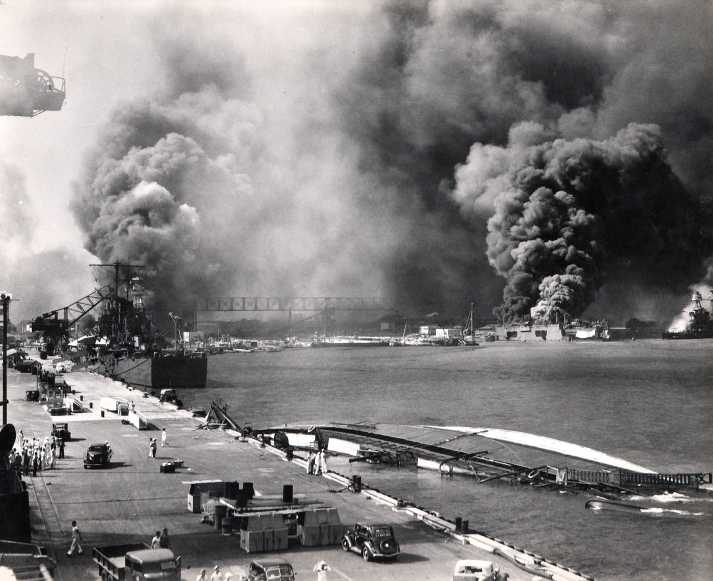
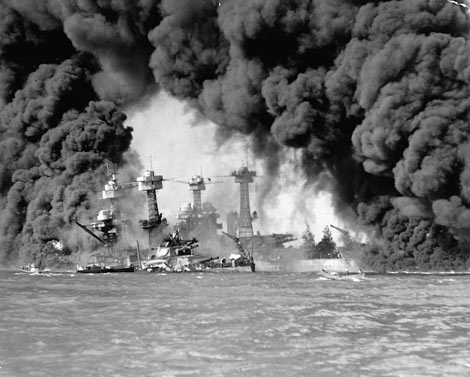
Pearl Harbor survivor recalls escaping sinking USS Utah


Glendora resident Theodore Roosevelt didn't have to be at Pearl Harbor.

When he first enlisted in the Navy at age 17, they assigned him to work intelligence out of a block house in Long Beach.

But he didn't join the Navy to work intelligence; he joined to go to sea. And the young man could see the ships he wanted to serve on from the slots of his secure block house. So he asked for a transfer. Within days he was onboard the USS Utah.


Despite what he saw and lived over the next five years, he never regretted the decision.

"The whole time I always knew that whatever was going to happen to me - whether I was killed or not - I asked for it," said Roosevelt, a third-cousin of the president of the same name.

What happened to him was a tour of duty that saw 14 major battles, including those at Midway, Guadalcanal, and Okinawa.

And it started with Pearl Harbor - the surprise early morning Japanese attack of a Naval base at Pearl Harbor, Hawaii, 69 years ago today.

Roosevelt was three decks down on the USS Utah when the attack began. The first word the crew got of anything out of the ordinary was a call to man their battle stations. Roosevelt headed down to his position on the fourth deck. Just as he got there, the ship was hit, "blowing a hole the size of this room," he said gesturing to the large den he built on the back of his Glendora home where he lives with his wife of 65 years.

Water started flooding into the ship and Roosevelt scurried back up to the third deck. He looked back at the men below.


"I knew they were drowning. I could read their eyes saying, I wish I was there with you," he said. "I'll never forget that."

Moments later, another torpedo tore through the ship and water again flooded in. This time, Roosevelt was inundated with water. He swam to an open hatch and again escaped to the deck above. There he and another seaman dodged the Japanese air attack by hiding under the ship's turrets, whose guns had been removed years before.

"I didn't know what was going on," Roosevelt recalled.

Eventually Roosevelt slid down off the rolled USS Utah and swam to Fort Island. On shore, he ducked into a construction trench, where he waited out the attack.

"When it was over I got up and saw there was fire everywhere. There were bodies everywhere," he said.

He ran to one of the still-standing buildings, where the injured were brought. There, a few medics attempted to treat the injured. Since Roosevelt was uninjured, but had no medical experience, they assigned him the task of lighting cigarettes and handing them to severely injured men.

He thought he was giving them a little nicotine relief.

"Later I learned that they had what are called gut shots - they were hurt so bad the cigarette drag killed them. I remember, they would take one puff, and go ahhh," Roosevelt said, rolling his head back and closing his eyes.

The medics had assigned the then 17-year-old Roosevelt to put the men - some with huge wounds in their chest or missing their legs - out of their misery.

The next two days, Roosevelt collected bodies from the harbor's waters and buried them in a mass grave at Red Hill Cemetery.

Roosevelt, now 87, recalls the days vividly and tells the story matter of factly, repeating over and over again that he was not a hero.

By Dec. 10, Roosevelt was assigned to serve on the USS Ralph Talbot, a destroyer that would see battle across the Pacific Theater.

"Through it all, I never got a scratch. I have seen so many people killed and hurt all around me. I never not a scratch," he said.

When Roosevelt was 14, the patriarch of his Mormon church gave him a blessing with a foretelling message.

"He said `In your life, you are gonna go through great strife. Men all around you are going to die. But you will come out unscratched,"' Roosevelt said. "I read those words before every battle. But that doesn't mean I wasn't scared."


Read More

http://www.sgvtribune.com/news/ci_16794250