Showing posts with label julian assange. Show all posts

Tuesday, April 26, 2011

Swiss bank list has Indian names: Assange


NEW DELHI: In an interview that could trigger a new controversy over Indian businessmen stashing black money in Swiss banks, WikiLeaks founder Julian Assange has said he had seen Indian names in a list of Swiss bank account holders and added that the data was going to be made public.

"Yes, there are Indian names in the data that we have already published or are going to publish. I can't remember specifically whether there are Indian names in the coming publication. But I have read Indian names," Assange told Times Now in an interview telecast on Tuesday. He, however, declined to reveal anything more on the issue at this stage.

In the course of the 50-minute interview, Assange appealed to Indians to "absolutely not lose hope" that names of those with secret Swiss accounts will come out in future. Hinting that WikiLeaks might work with specialized agencies before releasing the Swiss bank data he pulled up the Indian government for not being aggressive like Germany in going after the list of Indian account holders. "India should be more aggressive because India seems like it is losing per capita more tax money than Germany."

Assange had earlier claimed that he was handed over documents of bank accounts by a former banker Rudolf Elmer and the whistleblower also claimed that the names in the documents came from "US, Britain, Germany, Austria and Asia — from all over," and include "business people, politicians, people who have made their living in the arts and multinational conglomerates — from both sides of the Atlantic".

Assange also dismissed the contention of the Indian government that accords on double taxation were coming in the way of tracking the trail of black money. "Double taxation does not have anything to do with asset hiding. It doesn't simply cover asset hiding," he said. Assange said that issue of stashing black money in foreign banks was worse than local corruption as when money is pushed offshore, "... everytime they are selling rupees and the result is that the currency of the nation is debased... everything for all Indians become expensive as a result of that transfer."


Read More

http://timesofindia.indiatimes.com/india/Swiss-bank-list-has-Indian-names-Assange/articleshow/8095782.cms

Monday, March 21, 2011

Cash-for-Votes cables are authentic: Assange to NDTV


New Delhi: In an exclusive interview to NDTV's Prannoy Roy, Julian Assange says that Prime Minister Manmohan Singh is wrong to have questioned the authenticity of the WikiLeaks cable that stormed the Indian Parliament last week. However, he also stressed the charges are worth investigating.

A cable in 2008 sent from a US diplomat in Delhi says that the Congress bought MPs ahead of its crucial vote of confidence. The Left had pulled out of the government over the nuclear deal with the US.

Speaking to NDTV, Assange says the PM's statements "seem like a deliberate attempt to mislead the public by suggesting that governments around the world do not accept the material and it is not verified."

The WikiLeaks founder also says, "the cables are authentic but the contents of the cables may or may not be correct. They need to be investigated, interrogated."

Here is an excerpt from that interview.

NDTV: There is of course an alternate point of view that what you revealed in these cables is a set of opinions and assessments made by some American diplomats in the US embassy. And you were just saying that 'my task ends there in revealing these secret cables' but there are other points of view that says that it leaves a lot of collateral damage where opinions and assessments by these officials are taken as facts to embarrass and weaken their states. And people ask you is that a fair thing to do, just leave this out and wash your hands off it?

Assange: Absolutely not....it is not correct to say that all these cables are mere opinions by US diplomats...that is not true. These are official correspondence sent by Ambassadors, sent in their official capacity back to Washington. Their motivations are to improve their career prospects generally. So they want Washington to understand that they are engaged in the country. They are getting good sources of information and they are reporting back. This seems to be the predominant thing. But they report what they say are facts and they also present opinions...it is important to keep these two different. In the cases of these Indian cables which are causing such a furor about bribery...such an interesting case...it is very hard to understand why the US Embassy official would lie about that to Washington. What is more interesting is under what basis was he told that information? That the US Embassy official was shown that cash? Could it have been that it is a US issue? Could it have been to demonstrate how compliant certain parts of Indian Parliament work with US interest? Or it could have been to set up or frame another group? It is hard to see what benefit there would be in framing another group to Washington through that method. It is not clear what benefit it would be. ...Of course what the officials say and how they gain their knowledge too must be investigated and interrogated. But the comment I have been hearing from Prime Minister Singh....these, to me, seem like a deliberate attempt to mislead the public by suggesting that governments around the world do not accept the material and it is not verified ...absolutely false! Hillary Clinton last year December spoke to the Indian government last year, perhaps to Prime Minister Singh or that level to forewarn that this material would be coming out. There is no doubt that these are bonafide reports sent by the American Ambassador back to Washington and these should be seen in that context. That does not mean every fact in them is correct, you have to look at their sources and how they gave this information.


Read More

http://www.ndtv.com/article/india/cash-for-votes-cables-are-authentic-assange-to-ndtv-93174

Monday, February 7, 2011

Julian Assange 'would face bias in Sweden', retired judge says


The prosecutor leading the rape and sexual assault case against Julian Assange is a "malicious" radical feminist who is "biased against men", a retired senior Swedish judge has told the hearing into Assange's extradition to Sweden.

In caustic evidence on the first day of the two-day hearing, Brita Sundberg-Weitman, a former appeal court judge, told Belmarsh magistrates court that Sweden's chief prosecutor, Marianne Ny, who is seeking the WikiLeaks founder's extradition, "has a rather biased view against men". "I can't understand her attitude here. It looks malicious," she said.

Geoffrey Robertson QC, acting for Assange, asked if it was her view that Ny wanted "to get [Assange] into her clutches and then arrest him no matter what?"

"Yes" said Sundberg-Weitman. "It might be her attitude to have the man arrested and maybe let him suffer for a few weeks to have him softer [for interrogation]."

Such was the hostility towards Assange in Sweden that "most people take it for granted that he's raped two women", she said. The country is seeking Assange's extradition in relation to allegations of rape, sexual assault and sexual molestation made by two women in August.

He denies all the allegations and has not been charged.

Under cross-examination by Clare Montgomery QC, for the Swedish government, however, Sundberg-Weitman admitted she had no personal knowledge of the conduct of the prosecutor in the case, basing her views instead on what she had been told.

She also acknowledged that while she believed the warrant to have been disproportionate, a Swedish district court and the appeal court, considering evidence from Assange's Swedish lawyer Björn Hurtig, had judged it both proportionate and legal. "I must say I am very concerned about the state of the rule of law in Sweden," she said in response. "It has been decaying since the mid-1970s."

The hearing is being presided over by Judge Howard Riddle, the chief magistrate. Assange listened intently from the dock, watched by supporters including Jemima Goldsmith, Bianca Jagger and Tony Benn, who had agreed to attend following an invitation from Goldsmith.

Montgomery also led the former judge to acknowledge that she was not an expert in the European arrest warrant, despite criticising its use in this case, and challenged line by line the newspaper article on which she said she was basing her assertion that Ny was a "radical feminist".

Sundburg-Weitman pointed to lectures on sexual violence that the prosecutor had made, to which Montgomery said: "But she's a rape prosecutor." The former judge maintained her assertion that the prosecutor was "a bit biased".

Robertson argued that both Ny and Claes Borgström, the lawyer representing the two women, were politically motivated. Ny had illegally confirmed Assange's identity on the charges when asked by a Stockholm tabloid, he said (accused sex offenders are customarily anonymous in Sweden).

"This man Borgström", meanwhile, had vilified Assange in the press and "would be behind bars for contempt in this country," the lawyer said.

Also called by the defence was Göran Rudling, a Swedish blogger and campaigner on the country's rape laws, which he believes are not tough enough.

Rudling said he was not a supporter of Assange or WikiLeaks, but had taken an interest in the case after finding tweets that were later deleted sent by "Miss A", one of the two women, in the hours after the alleged offences, in which she had asked if anyone was holding a crayfish party that she could attend with Assange, and in a tweet from the party that she was "sitting outside at 2am, with the coolest and smartest people".

"It meant that the story told to police was not consistent with the tweets," he said. He had reported the tweets to police but had not heard back from them, he said.

Rudling also translated another document for the court that he had found on the internet, entitled "A seven point programme for legal revenge", apparently posted by Miss A in January 2010 but deleted in November. The last point included the admonition: "Remember, your victim has to suffer as much as he made you suffer."

Asked had he seen the police file relating to the case, Rudling said his knowledge was based on a 100-page bundle of documents faxed in November by Hurtig to Mark Stephens, Assange's British solicitor, and leaked onto the internet last week.

Earlier, Robertson, in opening the case for the defence, said that the Swedish custom of trying rape cases in secret was a "flagrant denial of justice". Assange had been subject to "trial by media", and it was "hyperbolic and irrational to suggest there was wickedness involved" in Assange's sexual behaviour, he said.

All relationships had "moments of frustration, irritation and argument", he said. "It doesn't mean that the police are entitled to slip between the bedclothes."

The act of "minor rape" allegedly committed by Assange against the second woman would not be an extradition offence in English law, he said. After three "utterly consensual" sex acts, she had objected to Assange having sex with her again without a condom, but "she let him continue". "It's not natural to call this rape."

Outside court, Assange said that since August "a black box has been applied to my life. On the outside of that black box has been written the word rape. That box has now, thanks to an open court process, been opened. I hope in the next days you will see that the box is in fact empty."

Wednesday, February 2, 2011

WikiLeaks nominated for Nobel Peace Prize for 'transparency'


Wikileaks is nominated for a Nobel Peace Prize by a Norwegian Politician. The whistle blowing WikiLeaks website, that landed its founder behind bars, is nominated for the Nobel Peace Prize due to its use as a “gauge of transparency in the world.”

Snorre Valen, a member of the Norweigian coalition government’s Socialist Left Party, is the man behind the WikiLeaks nomination, according to ABC News.

Valen cites Liu Xiaobo, a jailed Chinese dissident, as an example of someone who was in trouble with the law and still won the Nobel Peace Prize. Xiaobo was jailed for his work in human rights, democracy, and freedom of speech in China.

Wikileaks founder, Julian Assange, who is originally from Australia, is currently out on bail in Britian fighting extradition back to Sweden. He is accused of sexual assault in Sweden. He is staying at a home of his friend, where he has limited time off the property according to the provisions of his bail.

Read More

http://www.examiner.com/pop-culture-in-hartford/wikileaks-nominated-for-noble-peace-prize-for-transparency-says-politician#ixzz1CrpLpfDx

Monday, December 27, 2010

Assange signs book deals worth more than £1m


Julian Assange has signed book deals worth more than £1m in the US and UK, to allow the WikiLeaks founder to cover his legal fees and maintain the whistleblowing site.

He will be racing a disgruntled former colleague to release an autobiography telling his side of the WikiLeaks story. Both books are to be published by divisions of Random House next year.


Mr Assange is fighting allegations of sexual assault in Sweden while trying to continue the gradual release of thousands of US diplomatic cables through WikiLeaks.

Released on bail by the British high court in mid-December, he spent Christmas wearing a tracking tag, confined to a friend’s mansion home in East Anglia.

The US administration, which has been angered and embarrassed by successive leaks of its foreign-policy secrets through WikiLeaks, is believed to be exploring ways to prosecute Mr Assange.

The controversy did not dissuade readers of Time magazine voting Mr Assange their “person of the year” for his campaign for freedom of information and radical transparency from governments.

He has agreed an $800,000 (£520,000) contract with Knopf, a US imprint of Random House, the Bertelsmann-owned publisher, and another £325,000 deal for the UK with Canongate, an independent publishing house based in Edinburgh.

But although the deals are expected to net Mr Assange more than £1.1m ($1.7m) after the book is sold in other countries and serialised in newspapers around the world, Mr Assange said he had agreed to write his autobiography only reluctantly.

“I don’t want to write this book, but I have to,” he told the Sunday Times. “I have already spent £200,000 for legal costs and I need to defend myself and to keep WikiLeaks afloat.”

Mr Assange did not describe how he would divide the proceeds from his autobiography between his own personal legal costs and the operational funds required by WikiLeaks, which he has described as a large and distributed organisation that is not solely reliant on him.

WikiLeaks’ operational costs have more than tripled since it drew up budgeting plans at the beginning of the year, due to the increased scope of information it has reviewed and published. Before “cablegate”, it released huge amounts of files about the Iraqi and Afghan wars.

The whistleblowing site relies largely on donations from individuals, but had its fund-raising channels curtailed after several US financial services firms stopped processing payments to its account.

Bank of America, MasterCard, Visa and PayPal have all stopped directing funds to WikiLeaks in recent weeks. They deny Mr Assange’s accusations that the actions were politically motivated. Mr Assange’s Swiss bank has also frozen his account.

Last week, Daniel Domscheit-Berg, a former WikiLeaks spokesman, announced he would publish a tell-all book next year about his time with the site.

Crown Publishing, another division of Random House, will release “Inside Wikileaks: My Time with Julian Assange at the World’s Most Dangerous Website” in 14 countries in February.

The author, who called himself Daniel Schmitt when he worked at WikiLeaks, fell out with Mr Assange over the running and strategic priorities of the site.

He has said that the allegations of Mr Assange’s sexual misconduct would be better handled privately and have become a burden to WikiLeaks.

Read More

http://www.ft.com/cms/s/0/e0d0e164-1142-11e0-a26b-00144feabdc0,dwp_uuid=9a36c1aa-3016-11da-ba9f-00000e2511c8.html

Sunday, December 19, 2010

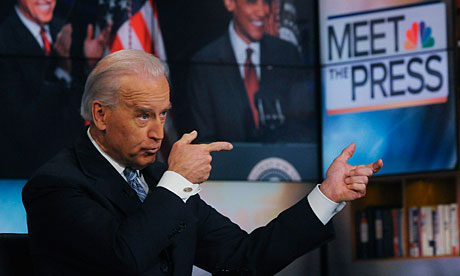
Julian Assange like a hi-tech terrorist, says Joe Biden


The US vice-president, Joe Biden, today likened the WikiLeaks founder, Julian Assange, to a "hi-tech terrorist", the strongest criticism yet from the Obama administration.

Biden claimed that by leaking diplomatic cables Assange had put lives at risk and made it more difficult for the US to conduct its business around the world.

His description of Assange shows a level of irritation that contrasts with more sanguine comments from other senior figures in the White House, who said the leak had not done serious damage.

Interviewed on NBC's Meet the Press, Biden was asked if the administration could prevent further leaks, as Assange warned last week. "We are looking at that right now. The justice department is taking a look at that," Biden said, without elaborating.

The justice department is struggling to find legislation with which to prosecute Assange.

Asked if what Assange had done was criminal, Biden seemed to suggest it would be considered criminal if it could be established that the WikiLeaks founder had encouraged or helped Bradley Manning, the US intelligence analyst suspected of being behind the leak. Biden claimed this was different from a journalist receiving leaked material.

"If he conspired to get these classified documents with a member of the US military that is fundamentally different than if someone drops on your lap … you are a press person, here is classified material."

Asked if he saw Assange as closer to a hi-tech terrorist than the whistleblower who released the Pentagon papers in the 1970s, which disclosed the lie on which US involvement in Vietnam was based, Biden replied: "I would argue it is closer to being a hi-tech terrorist than the Pentagon papers. But, look, this guy has done things that have damaged and put in jeopardy the lives and occupations of people in other parts of the world.

"He's made it more difficult for us to conduct our business with our allies and our friends. For example, in my meetings – you know I meet with most of these world leaders – there is a desire now to meet with me alone, rather than have staff in the room. It makes things more cumbersome – so it has done damage."

The interview, though broadcast yesterday, was conducted on Friday. In an interview the previous day, he had been more neutral about WikiLeaks, saying: "I don't think there's any substantive damage."

The US secretary of state, Hillary Clinton, led criticism of the WikiLeaks revelations at the end of November when she accused the website of mounting an "attack" on the world.


Read More

http://www.guardian.co.uk/media/2010/dec/19/assange-high-tech-terrorist-biden

Thursday, December 16, 2010

WikiLeaks's Assange walks free on bail in London


WikiLeaks founder Julian Assange, fighting extradition to Sweden over alleged sex crimes, walked free on bail from a British jail on Thursday protesting his innocence and pledging to continue exposing official secrets.

Assange spoke to a crowd of journalists and supporters waiting in outside the High Court in London five hours after a judge said he could be released on 200,000 pounds ($312,000) bail under stringent conditions.

"It's great to smell fresh air of London again," Assange, illuminated by a blizzard of photographers' flashes, said.

WikiLeaks has angered U.S. authorities by publishing hundreds of a trove of 250,000 U.S. diplomatic cables, including details of overseas installations that Washington regards as vital to its security.

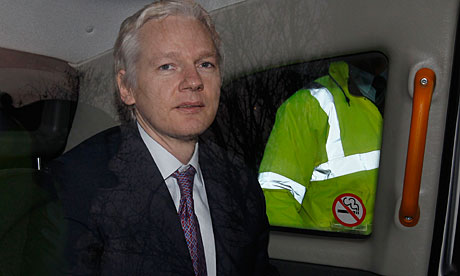
Assange, wearing a dark suit and open-necked white shirt, brandished court papers titled "Swedish Judicial Authority vs Julian Paul Assange." He was then driven away in a four-wheel-drive vehicle.

The 39-year-old Australian later arrived at Ellingham Hall, in Suffolk eastern England, where he must live as a condition of his bail. He spoke to reporters at the mansion that belongs to a former army officer and Assange supporter, Vaughan Smith.

"I continue on with our work. Clearing my name is not the highest task I have. The highest task I have is to continue with my work."

Janice Game, 63, who lives opposite the Georgian house said she had come out to see reporters waiting in the snow for Assange to drive through the gates of the 650 acre estate.

"I do not think that Vaughan would have him at the house unless he believed completely that he was innocent."

Assange has spent nine days in a London jail after Sweden issued an arrest warrant for him over allegations of sexual misconduct made by two female WikiLeaks volunteers. Assange denies the accusations.

Assange told reporters soon after his release that he was more concerned the United States might try to extradite him than he was about being extradited to Sweden.

Assange and his lawyers have voiced fears that U.S. prosecutors might be preparing to indict him for espionage over WikiLeaks' publication of the documents.

"We have a rumor today from my lawyers in the United States, it's not confirmed yet, that there has been an indictment made against me in the United States," Assange said.

The New York Times said on Wednesday federal prosecutors were looking for evidence that he had conspired with a former U.S. Army intelligence analyst suspected of leaking classified documents.

Shortly before Assange's release, his mother Christine, who had flown over from Australia, said she could not wait to see her son and "to hold him close."


Read More

http://www.reuters.com/article/idUSL3E6N80HH20101217

Wednesday, December 15, 2010

Julian Assange bail decision made by UK authorities, not Sweden


The decision to have Julian Assange sent to a London jail and kept there was taken by the British authorities and not by prosecutors in Sweden, as previously thought, the Guardian has learned.

The Crown Prosecution Service will go to the high court tomorrow to seek the reversal of a decision to free the WikiLeaks founder on bail, made yesterday by a judge at City of Westminster magistrates court.

It had been widely thought Sweden had made the decision to oppose bail, with the CPS acting merely as its representative. But today the Swedish prosecutor's office told the Guardian it had "not got a view at all on bail" and that Britain had made the decision to oppose bail.

Lawyers for Assange reacted to the news with shock and said CPS officials had told them this week it was Sweden which had asked them to ensure he was kept in prison.

Karin Rosander, director of communications for Sweden's prosecutor's office, told the Guardian: "The decision was made by the British prosecutor. I got it confirmed by the CPS this morning that the decision to appeal the granting of bail was entirely a matter for the CPS. The Swedish prosecutors are not entitled to make decisions within Britain. It is entirely up to the British authorities to handle it."

As a result, she said, Sweden will not be submitting any new evidence or arguments to the high court hearing tomorrow morning. "The Swedish authorities are not involved in these proceedings. We have not got a view at all on bail."

After the Swedish statement was put to the CPS, it confirmed that all decisions concerning the opposing of bail being granted to Assange had been taken by its lawyers. It said: "In all extradition cases, decisions on bail issues are always taken by the domestic prosecuting authority. It would not be practical for prosecutors in a foreign jurisdiction … to make such decisions."

Last week Sweden issued a warrant for Assange's arrest and extradition over sexual assault allegations. On 7 December the British prosecutor, Gemma Lindfield, convinced the senior district court judge Howard Riddle that Assange must be kept in custody because he was a flight risk.

Yesterday the judge accepted that Assange could be released on bail, but he was kept in Wandsworth prison after the CPS said it wanted to appeal against the decision to grant bail to a higher court.

The CPS's formal grounds of appeal for the hearing tomorrow morning, seen by the Guardian, will say that Assange must be kept in prison until a decision is made whether to extradite him, which could take months.


Read More:

http://www.guardian.co.uk/media/2010/dec/15/julian-assange-bail-decision-uk

Monday, December 13, 2010

Julian Assange to appear in court to appeal for release


The WikiLeaks founder, Julian Assange, will try to win his release from prison tomorrow, a week after being held on remand after Sweden requested his arrest over allegations that he sexually assaulted two women.

Even if the judge at Westminster magistrates court in London grants Assange bail, he could still be held.

The Crown Prosecution Service, which will represent the Swedish authorities in the UK court, has the right to appeal against any bail decision. Usually the suspect would be held in custody until an appeal hearing anyway.

Raj Joshi, a former head of the European and international division at the CPS, and an expert on extradition, said: "If they feel they have grounds for opposing bail, they would be duty bound to appeal that. He'll be held pending the appeal, and until it is decided. That hearing is usually held within 48 hours."

The chances of Assange going underground, given that his face was "plastered all around the world", were low, he added. "With a number of conditions, such as, maybe, a tag, it would be difficult to see why bail would not be granted."

The decision on whether to oppose bail will be made by the Swedish authorities, with Britain's CPS merely representing their interests at tomorrow's hearing. Speculation that the US could lodge an extradition request continued over the weekend, but it is regarded as highly unlikely that any such request would be lodged tomorrow.

Lady Kennedy, who has extensive experience in human rights, has joined Assange's defence team.

His case has stirred fresh controversy about European arrest warrants, which the Swedish authorities would use for his extradition.

Lady Ludford MEP, the Liberal Democrat European justice and human rights spokeswoman, claimed the arrest warrant system, which she said she supported, was being used by Sweden to carry out a fishing expedition. Sweden had yet to formally charge Assange with any offence.

In a letter to the Guardian, Ludford wrote that past cases showed that it was "not a legitimate purpose for an EAW to be used to conduct an investigation to see whether that person should be prosecuted". She added: "Normal cross-border cooperation on collection of evidence or interrogation of suspects called 'mutual legal assistance', using for example video-conferencing or a summons for temporary transfer of a suspect, should be used when more appropriate. "I urge the UK courts to refuse to allow the Assange EAW to be a fishing expedition without a pending actual prosecution. EU rules should be properly respected so that the integrity of the European arrest warrant process is protected."

Ahead of the case, lawyers today visited Assange in Wandsworth prison, south London, where the 39-year-old is being held in the segregation unit.

Assange's mother Christine is understood to have flown from Queensland, Australia to London to attend his bail hearing afternoon. It also emerged last night that the film-maker, Michael Moore, has offered to post security for the WikiLeaks founder.

Assange's lawyer Mark Stephens visited him in Wandsworth prison yesterday afternoon and said his client was being held under harsher conditions than last week. He claimed Assange was being confined to his cell for all but half an hour a day, and denied association with others prisoners, access to the library or TV.

"He's subject to the most ridiculous censorship," Stephens said. "Time magazine sent him a copy of the magazine with him on the cover and they censored it not just by ripping off the cover but by destroying the whole magazine."

Stephens also claimed a number of letters to Assange from media organisations have not reached him. He said Assange was under 24-hour video surveillance and had complained that a tooth which broke off while he was eating had later been stolen from his cell.

Stephens said Assange's UK legal team had still not seen the prosecution evidence against him. "His Swedish lawyers have some of the material but not all and it's in Swedish so we can't take proper instructions."

The decision by the district judge Howard Riddle to remand Assange into custody was made despite the film director Ken Loach, the journalist John Pilger, and the socialite Jemima Khan, offering sureties for him totalling £180,000. The judge had concluded that because of the "serious" nature of the allegations against Assange, his "comparatively weak community ties" in the UK, and the fact it was believed he had the financial means and the ability to abscond, there was a substantial risk he would fail to surrender to the courts.

The allegations about Assange were made by two women. The first complainant, known as Miss A, said she was the victim of "unlawful coercion" on the night of 14 August in 2009 in Stockholm. The court heard Assange was alleged to have "forcefully" held her arms and used his body weight to hold her down. The second charge alleged he had "sexually molested" her by having sex without using a condom. A third charge claimed Assange "deliberately molested" Miss A on 18 August.

A fourth charge, relating to a woman called Miss W, alleges that on 17 August, Assange "improperly exploited" a situation where she was asleep, to have sex with her without using a condom.

A poll by Comres for CNN revealed today that 44% of Britons believe the charges against Assange are an excuse to place him in custody so the US can prosecute him over the US embassy cable leaks. But the same number say he should be sent to Sweden for questioning.

Meanwhile a dating site profile from 2007, supposedly created by Assange, had prompted by yesterday some lively online debate. The profile on the OKCupid site featured pictures of Assange, though gave the name Harry Harrison – who described himself as a "passionate and often pig- headed activist intellectual" who sought to change the world. He concluded: "Write to me if you are brave."

Read More

http://www.guardian.co.uk/media/2010/dec/13/assange-in-court-appeal-release

Tuesday, December 7, 2010

Celebs, media vie to see WikiLeaks founder in court


The Westminster Magistrates Court was ill prepared for the media scrum that landed on its doorstop on Tuesday. That's when police confirmed that WikiLeaks editor and founder Julian Assange had voluntarily turned himself in and was now under arrest.

Swarms of cameras, microphones and reporters with earpieces dangling were buzzing around outside the court, trying to figure out which entrance Assange and his legal tem would use.

Despite the media scrutiny, Assange managed to whiz past in a car and straight into the back entrance of the courthouse with hardly a photo being taken.

His lawyer, Mark Stephens, was not so lucky: Mobbed the moment he appeared at the front door, though he seemed unruffled by the attention. He sported a dark suit with pink pinstripes and a tie dotted with a skull-and-cross bones motif. A nod to the Pirate Party (a Swedish political party) that has supported WikiLeaks perhaps, I asked? No, more like Alexander McQueen, he replied.

Inside, it was standing room only as reporters crammed into the small courtroom. A buzz went through the gallery as Jemima Khan, the ex-wife of former Pakistani cricket star Imran Khan, took her seat. Clearly, few expected to see a bona-fide celebrity at the proceedings today. Journalist John Pilger and British film director Ken Loach also offered to post money for Assange's bail -- indications perhaps that Assange may soon become a cause celebre.

But the main event was Assange. He showed little emotion as the hearing played out. When the court asked for his address, he gave a cagey reply: "For correspondence or other purposes?" he asked. He initially gave a PO Box before reluctantly scribbling down an address that was read out loud by a court recorder.

Judge Howard Riddle denied Assange bail, citing, among other issues, the "nomadic lifestyle" of the man behind WikiLeaks. He also repeatedly stated that this hearing was "not about WikiLeaks." Actually, once he said, this was "not about Wikipedia," setting off a few snickers from reporters.

This was the first time the details of the alleged sex crimes Assange faces were revealed in court. Among them, use of force and two charges of unprotected sex without a condom, despite the women's insistence that he use one. Reporters looked at each other trying to figure out the details of Swedish law.

The proceedings ran under an hour. There was genuine surprise when Riddle announced there would be no release on bail and Assange would be spending his time in jail until December 14.

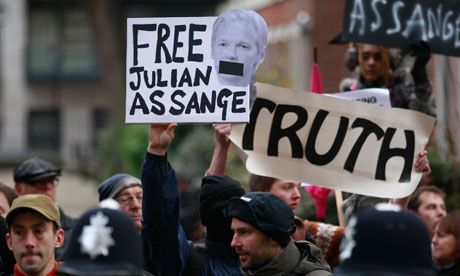
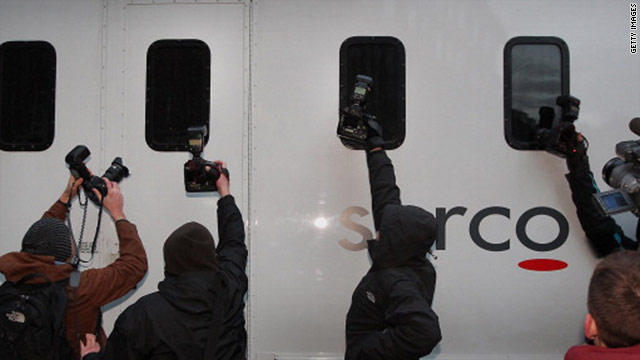
When the police van carrying Assange pulled out of the courthouse, a media pack was waiting. Cameras flashing, microphones flying, and dozens of supporters shouting cries of: "We love you!" and "Julian Assange is a political prisoner." They ran after the van hoping to catch a glimpse of the once-elusive founder of WikiLeaks.


Read More

http://edition.cnn.com/2010/WORLD/asiapcf/12/07/assange.wikileaks.court.scene/