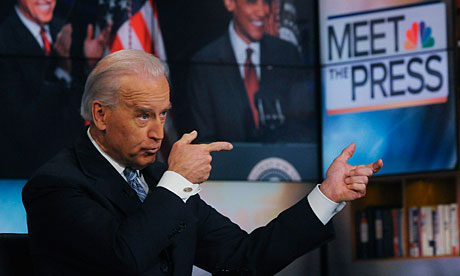
The US vice-president, Joe Biden, today likened the WikiLeaks founder, Julian Assange, to a "hi-tech terrorist", the strongest criticism yet from the Obama administration.
Biden claimed that by leaking diplomatic cables Assange had put lives at risk and made it more difficult for the US to conduct its business around the world.
His description of Assange shows a level of irritation that contrasts with more sanguine comments from other senior figures in the White House, who said the leak had not done serious damage.
Interviewed on NBC's Meet the Press, Biden was asked if the administration could prevent further leaks, as Assange warned last week. "We are looking at that right now. The justice department is taking a look at that," Biden said, without elaborating.
The justice department is struggling to find legislation with which to prosecute Assange.
Asked if what Assange had done was criminal, Biden seemed to suggest it would be considered criminal if it could be established that the WikiLeaks founder had encouraged or helped Bradley Manning, the US intelligence analyst suspected of being behind the leak. Biden claimed this was different from a journalist receiving leaked material.
"If he conspired to get these classified documents with a member of the US military that is fundamentally different than if someone drops on your lap … you are a press person, here is classified material."
Asked if he saw Assange as closer to a hi-tech terrorist than the whistleblower who released the Pentagon papers in the 1970s, which disclosed the lie on which US involvement in Vietnam was based, Biden replied: "I would argue it is closer to being a hi-tech terrorist than the Pentagon papers. But, look, this guy has done things that have damaged and put in jeopardy the lives and occupations of people in other parts of the world.
"He's made it more difficult for us to conduct our business with our allies and our friends. For example, in my meetings – you know I meet with most of these world leaders – there is a desire now to meet with me alone, rather than have staff in the room. It makes things more cumbersome – so it has done damage."
The interview, though broadcast yesterday, was conducted on Friday. In an interview the previous day, he had been more neutral about WikiLeaks, saying: "I don't think there's any substantive damage."
The US secretary of state, Hillary Clinton, led criticism of the WikiLeaks revelations at the end of November when she accused the website of mounting an "attack" on the world.
Biden claimed that by leaking diplomatic cables Assange had put lives at risk and made it more difficult for the US to conduct its business around the world.
His description of Assange shows a level of irritation that contrasts with more sanguine comments from other senior figures in the White House, who said the leak had not done serious damage.
Interviewed on NBC's Meet the Press, Biden was asked if the administration could prevent further leaks, as Assange warned last week. "We are looking at that right now. The justice department is taking a look at that," Biden said, without elaborating.
The justice department is struggling to find legislation with which to prosecute Assange.
Asked if what Assange had done was criminal, Biden seemed to suggest it would be considered criminal if it could be established that the WikiLeaks founder had encouraged or helped Bradley Manning, the US intelligence analyst suspected of being behind the leak. Biden claimed this was different from a journalist receiving leaked material.
"If he conspired to get these classified documents with a member of the US military that is fundamentally different than if someone drops on your lap … you are a press person, here is classified material."
Asked if he saw Assange as closer to a hi-tech terrorist than the whistleblower who released the Pentagon papers in the 1970s, which disclosed the lie on which US involvement in Vietnam was based, Biden replied: "I would argue it is closer to being a hi-tech terrorist than the Pentagon papers. But, look, this guy has done things that have damaged and put in jeopardy the lives and occupations of people in other parts of the world.
"He's made it more difficult for us to conduct our business with our allies and our friends. For example, in my meetings – you know I meet with most of these world leaders – there is a desire now to meet with me alone, rather than have staff in the room. It makes things more cumbersome – so it has done damage."
The interview, though broadcast yesterday, was conducted on Friday. In an interview the previous day, he had been more neutral about WikiLeaks, saying: "I don't think there's any substantive damage."
The US secretary of state, Hillary Clinton, led criticism of the WikiLeaks revelations at the end of November when she accused the website of mounting an "attack" on the world.
Read More
http://www.guardian.co.uk/media/2010/dec/19/assange-high-tech-terrorist-biden

