Showing posts with label wikileaks case. Show all posts

Thursday, December 23, 2010

Assange says 'high chance' he would be killed in US jail


WikiLeaks chief Julian Assange said in an interview published Thursday there was a "high chance" he would be killed in a US jail if he were to be extradited from Britain on espionage charges.

The Australian is on bail in Britain fighting a bid by Sweden to extradite him over sex assault claims, but Washington is believed to be considering how to indict him over the leaking of thousands of US diplomatic cables.

Assange told The Guardian it would be "politically impossible" for Britain to send him across the Atlantic, adding that the government of Prime Minister David Cameron would want to show it had not been "co-opted" by Washington.

"Legally the UK has the right to not extradite for political crimes. Espionage is the classic case of political crimes. It is at the discretion of the UK government as to whether to apply to that exception," he said.

He said US authorities were "trying to strike a plea deal" with Bradley Manning, the US army soldier suspected of providing WikiLeaks with the cables.

Assange added that if the United States succeeded in getting him extradited from Britain or Sweden, then there was a "high chance" of him being killed "Jack Ruby-style" in an American prison.

Ruby, a nightclub owner, shot dead Lee Harvey Oswald at a police station in Dallas, Texas days after Oswald was arrested for the assassination of US President John F. Kennedy in 1963.

Ruby's alleged links to organised crime sparked conspiracy theories about his involvement in an overall plot surrounding the assassination of Kennedy.

Assange has previously said that he and other WikiLeaks staff have received death threats since the website began to release a cache of around 250,000 secret US State Department cable in November.

The 39-year-old has been staying at a friend's country mansion in eastern England since his release from jail last week on strict bail conditions that include reporting to police daily and wearing an electronic tag.

A court in London is due to hold a full hearing on the Swedish extradition request starting February 7.

Read More

http://www.google.com/hostednews/afp/article/ALeqM5g3aIipRuLxgHxrr-q2Vsh8Q0ISxw?docId=CNG.d082576fa7a8aae22f83a4e5f6909993.d61

Thursday, December 16, 2010

WikiLeaks's Assange walks free on bail in London


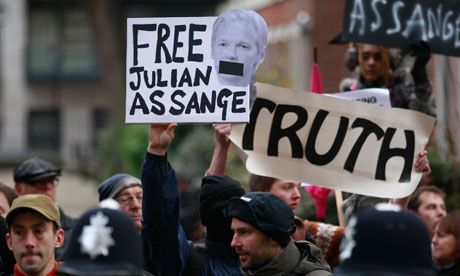
WikiLeaks founder Julian Assange, fighting extradition to Sweden over alleged sex crimes, walked free on bail from a British jail on Thursday protesting his innocence and pledging to continue exposing official secrets.

Assange spoke to a crowd of journalists and supporters waiting in outside the High Court in London five hours after a judge said he could be released on 200,000 pounds ($312,000) bail under stringent conditions.

"It's great to smell fresh air of London again," Assange, illuminated by a blizzard of photographers' flashes, said.

WikiLeaks has angered U.S. authorities by publishing hundreds of a trove of 250,000 U.S. diplomatic cables, including details of overseas installations that Washington regards as vital to its security.

Assange, wearing a dark suit and open-necked white shirt, brandished court papers titled "Swedish Judicial Authority vs Julian Paul Assange." He was then driven away in a four-wheel-drive vehicle.

The 39-year-old Australian later arrived at Ellingham Hall, in Suffolk eastern England, where he must live as a condition of his bail. He spoke to reporters at the mansion that belongs to a former army officer and Assange supporter, Vaughan Smith.

"I continue on with our work. Clearing my name is not the highest task I have. The highest task I have is to continue with my work."

Janice Game, 63, who lives opposite the Georgian house said she had come out to see reporters waiting in the snow for Assange to drive through the gates of the 650 acre estate.

"I do not think that Vaughan would have him at the house unless he believed completely that he was innocent."

Assange has spent nine days in a London jail after Sweden issued an arrest warrant for him over allegations of sexual misconduct made by two female WikiLeaks volunteers. Assange denies the accusations.

Assange told reporters soon after his release that he was more concerned the United States might try to extradite him than he was about being extradited to Sweden.

Assange and his lawyers have voiced fears that U.S. prosecutors might be preparing to indict him for espionage over WikiLeaks' publication of the documents.

"We have a rumor today from my lawyers in the United States, it's not confirmed yet, that there has been an indictment made against me in the United States," Assange said.

The New York Times said on Wednesday federal prosecutors were looking for evidence that he had conspired with a former U.S. Army intelligence analyst suspected of leaking classified documents.

Shortly before Assange's release, his mother Christine, who had flown over from Australia, said she could not wait to see her son and "to hold him close."


Read More

http://www.reuters.com/article/idUSL3E6N80HH20101217

Wednesday, December 15, 2010

Julian Assange bail decision made by UK authorities, not Sweden


The decision to have Julian Assange sent to a London jail and kept there was taken by the British authorities and not by prosecutors in Sweden, as previously thought, the Guardian has learned.

The Crown Prosecution Service will go to the high court tomorrow to seek the reversal of a decision to free the WikiLeaks founder on bail, made yesterday by a judge at City of Westminster magistrates court.

It had been widely thought Sweden had made the decision to oppose bail, with the CPS acting merely as its representative. But today the Swedish prosecutor's office told the Guardian it had "not got a view at all on bail" and that Britain had made the decision to oppose bail.

Lawyers for Assange reacted to the news with shock and said CPS officials had told them this week it was Sweden which had asked them to ensure he was kept in prison.

Karin Rosander, director of communications for Sweden's prosecutor's office, told the Guardian: "The decision was made by the British prosecutor. I got it confirmed by the CPS this morning that the decision to appeal the granting of bail was entirely a matter for the CPS. The Swedish prosecutors are not entitled to make decisions within Britain. It is entirely up to the British authorities to handle it."

As a result, she said, Sweden will not be submitting any new evidence or arguments to the high court hearing tomorrow morning. "The Swedish authorities are not involved in these proceedings. We have not got a view at all on bail."

After the Swedish statement was put to the CPS, it confirmed that all decisions concerning the opposing of bail being granted to Assange had been taken by its lawyers. It said: "In all extradition cases, decisions on bail issues are always taken by the domestic prosecuting authority. It would not be practical for prosecutors in a foreign jurisdiction … to make such decisions."

Last week Sweden issued a warrant for Assange's arrest and extradition over sexual assault allegations. On 7 December the British prosecutor, Gemma Lindfield, convinced the senior district court judge Howard Riddle that Assange must be kept in custody because he was a flight risk.

Yesterday the judge accepted that Assange could be released on bail, but he was kept in Wandsworth prison after the CPS said it wanted to appeal against the decision to grant bail to a higher court.

The CPS's formal grounds of appeal for the hearing tomorrow morning, seen by the Guardian, will say that Assange must be kept in prison until a decision is made whether to extradite him, which could take months.


Read More:

http://www.guardian.co.uk/media/2010/dec/15/julian-assange-bail-decision-uk

Monday, December 13, 2010

Julian Assange to appear in court to appeal for release


The WikiLeaks founder, Julian Assange, will try to win his release from prison tomorrow, a week after being held on remand after Sweden requested his arrest over allegations that he sexually assaulted two women.

Even if the judge at Westminster magistrates court in London grants Assange bail, he could still be held.

The Crown Prosecution Service, which will represent the Swedish authorities in the UK court, has the right to appeal against any bail decision. Usually the suspect would be held in custody until an appeal hearing anyway.

Raj Joshi, a former head of the European and international division at the CPS, and an expert on extradition, said: "If they feel they have grounds for opposing bail, they would be duty bound to appeal that. He'll be held pending the appeal, and until it is decided. That hearing is usually held within 48 hours."

The chances of Assange going underground, given that his face was "plastered all around the world", were low, he added. "With a number of conditions, such as, maybe, a tag, it would be difficult to see why bail would not be granted."

The decision on whether to oppose bail will be made by the Swedish authorities, with Britain's CPS merely representing their interests at tomorrow's hearing. Speculation that the US could lodge an extradition request continued over the weekend, but it is regarded as highly unlikely that any such request would be lodged tomorrow.

Lady Kennedy, who has extensive experience in human rights, has joined Assange's defence team.

His case has stirred fresh controversy about European arrest warrants, which the Swedish authorities would use for his extradition.

Lady Ludford MEP, the Liberal Democrat European justice and human rights spokeswoman, claimed the arrest warrant system, which she said she supported, was being used by Sweden to carry out a fishing expedition. Sweden had yet to formally charge Assange with any offence.

In a letter to the Guardian, Ludford wrote that past cases showed that it was "not a legitimate purpose for an EAW to be used to conduct an investigation to see whether that person should be prosecuted". She added: "Normal cross-border cooperation on collection of evidence or interrogation of suspects called 'mutual legal assistance', using for example video-conferencing or a summons for temporary transfer of a suspect, should be used when more appropriate. "I urge the UK courts to refuse to allow the Assange EAW to be a fishing expedition without a pending actual prosecution. EU rules should be properly respected so that the integrity of the European arrest warrant process is protected."

Ahead of the case, lawyers today visited Assange in Wandsworth prison, south London, where the 39-year-old is being held in the segregation unit.

Assange's mother Christine is understood to have flown from Queensland, Australia to London to attend his bail hearing afternoon. It also emerged last night that the film-maker, Michael Moore, has offered to post security for the WikiLeaks founder.

Assange's lawyer Mark Stephens visited him in Wandsworth prison yesterday afternoon and said his client was being held under harsher conditions than last week. He claimed Assange was being confined to his cell for all but half an hour a day, and denied association with others prisoners, access to the library or TV.

"He's subject to the most ridiculous censorship," Stephens said. "Time magazine sent him a copy of the magazine with him on the cover and they censored it not just by ripping off the cover but by destroying the whole magazine."

Stephens also claimed a number of letters to Assange from media organisations have not reached him. He said Assange was under 24-hour video surveillance and had complained that a tooth which broke off while he was eating had later been stolen from his cell.

Stephens said Assange's UK legal team had still not seen the prosecution evidence against him. "His Swedish lawyers have some of the material but not all and it's in Swedish so we can't take proper instructions."

The decision by the district judge Howard Riddle to remand Assange into custody was made despite the film director Ken Loach, the journalist John Pilger, and the socialite Jemima Khan, offering sureties for him totalling £180,000. The judge had concluded that because of the "serious" nature of the allegations against Assange, his "comparatively weak community ties" in the UK, and the fact it was believed he had the financial means and the ability to abscond, there was a substantial risk he would fail to surrender to the courts.

The allegations about Assange were made by two women. The first complainant, known as Miss A, said she was the victim of "unlawful coercion" on the night of 14 August in 2009 in Stockholm. The court heard Assange was alleged to have "forcefully" held her arms and used his body weight to hold her down. The second charge alleged he had "sexually molested" her by having sex without using a condom. A third charge claimed Assange "deliberately molested" Miss A on 18 August.

A fourth charge, relating to a woman called Miss W, alleges that on 17 August, Assange "improperly exploited" a situation where she was asleep, to have sex with her without using a condom.

A poll by Comres for CNN revealed today that 44% of Britons believe the charges against Assange are an excuse to place him in custody so the US can prosecute him over the US embassy cable leaks. But the same number say he should be sent to Sweden for questioning.

Meanwhile a dating site profile from 2007, supposedly created by Assange, had prompted by yesterday some lively online debate. The profile on the OKCupid site featured pictures of Assange, though gave the name Harry Harrison – who described himself as a "passionate and often pig- headed activist intellectual" who sought to change the world. He concluded: "Write to me if you are brave."

Read More

http://www.guardian.co.uk/media/2010/dec/13/assange-in-court-appeal-release
Wednesday, December 8, 2010

Hackers Set Sights on Visa in Fight for WikiLeaks


Hackers have declared an Internet war in support of WikiLeaks, with groups of anonymous attackers disabling major credit card websites in retaliation for denying service to the controversial website.

The group, going by the name "Anonymous," rallied its supporters in a Twitter post Wednesday, calling for them to get their "weapons" ready to attack the Visa website for the next phase of "Operation Payback."

The same group claimed responsibility for crippling the MasterCard website for much of the day Wednesday using denial of service attacks, which overwhelm a website with data requests.

Both Visa and MasterCard have stopped processing donations to WikiLeaks as the online organization faces tremendous political pressure for publishing secret U.S. diplomatic cables.

Wikileaks released a cable Wednesday showing that in February 2010 U.S. officials lobbied Russia on behalf of MasterCard and Visa to ensure that a proposed Russian law did not adversely affect their businesses.

There are now more than 1,000 Internet "mirror sites" hosting WikiLeaks content, which is more than double the number of sites that existed days ago.

An executive of the online payment company PayPal said Wednesday it decided to suspend its business with WikiLeaks after the U.S. State Department said the website's activities are illegal.

State Department spokesman P.J. Crowley said in a Twitter message that the U.S. government did not write to PayPal requesting any action regarding WikiLeaks.

The website's founder, Julian Assange, surrendered to authorities in Britain Tuesday and is in custody while he fights extradition to Sweden, where he is wanted for questioning about alleged sex offenses.

Swedish prosecutor Marianne Ny says the investigation has nothing to do with WikiLeaks and that she has no intention of handing Assange over to the United States if he is extradited to Sweden.

Read More

http://www.voanews.com/english/news/Hackers-Avenge-WikiLeaks-Leader-with-Operation-Payback-111520314.html