Showing posts with label wikileaks cable. Show all posts

Monday, April 25, 2011

WikiLeaks: al Qaeda watched towers burn


Khalid Sheikh Mohammed, the 9/11 plot mastermind for al Qaeda, was in Pakistan, watching the attacks on television. according to WikiLeaks documents.

Each of us remembers where we were on September 11, 2001, but we never knew what the masterminds of al Qaeda's terrorist plot were doing that terrible day.

Now, we have an answer, as found in more than 700 documents from the U.S. military prison at Guantanamo Bay, and just published by WikiLeaks.

As it turns out, while Americans watched in horror as the twin towers burned, al Qaeda's top leaders were watching, too. CBS News correspondent David Martin reports that Khalid Sheik Mohammed, the plot mastermind, was in Karachi, Pakistan, watching on television with Ramsi bin al Shib, the day-to-day coordinator of the operation.

"After the success of the attacks, the operatives prostrated themselves and gave thanks to Allah," one document says.

Abd al Rahim al Nashiri, who engineered the bombing of the USS Cole, couldn't be there. He was in a Karachi hospital after having had his tonsils out. Nashiri may have been the most dedicated terrorist of all. "He reportedly received injections to promote impotence (rather than be distracted by women)," a document says.

The documents, based on the interrogation of prisoners at Guantanamo Bay, say after 9/11, all senior operatives left Pakistan for Afghanistan to meet with Osama bin Laden, who had watched the attacks from Kandahar.

Bin Laden and his deputy, Ayman al Zawahiri, spent the next couple of months moving about Afghanistan by car, finally taking refuge in the Tora Bora mountains. In mid-December 2001, the two disappeared across the border into Pakistan. The others were eventually captured, but not before Bin al Shib threatened to slit his own throat rather than be taken alive.

Of course, one should not believe everything a captured terrorist says. One sensational but unconfirmed claim found in the documents says al Qaeda had a nuclear bomb it would set off if Bin Laden were ever captured.

Read More

http://www.cbsnews.com/stories/2011/04/25/eveningnews/main20057231.shtml?tag=cbsnewsTwoColUpperPromoArea


Sunday, April 17, 2011

U.S. secretly backed Syrian opposition groups, cables released by WikiLeaks show


The State Department has secretly financed Syrian political opposition groups and related projects, including a satellite TV channel that beams anti-government programming into the country, according to previously undisclosed diplomatic cables.

The London-based satellite channel, Barada TV, began broadcasting in April 2009 but has ramped up operations to cover the mass protests in Syria as part of a long-standing campaign to overthrow the country’s autocratic leader, Bashar al-Assad. Human rights groups say scores of people have been killed by Assad’s security forces since the demonstrations began March 18; Syria has blamed the violence on “armed gangs.”

Barada TV is closely affiliated with the Movement for Justice and Development, a London-based network of Syrian exiles. Classified U.S. diplomatic cables show that the State Department has funneled as much as $6 million to the group since 2006 to operate the satellite channel and finance other activities inside Syria. The channel is named after the Barada River, which courses through the heart of Damascus, the Syrian capital.

The U.S. money for Syrian opposition figures began flowing under President George W. Bush after he effectively froze political ties with Damascus in 2005. The financial backing has continued under President Obama, even as his administration sought to rebuild relations with Assad. In January, the White House posted an ambassador to Damascus for the first time in six years.

The cables, provided by the anti-secrecy Web site WikiLeaks, show that U.S. Embassy officials in Damascus became worried in 2009 when they learned that Syrian intelligence agents were raising questions about U.S. programs. Some embassy officials suggested that the State Department reconsider its involvement, arguing that it could put the Obama administration’s rapprochement with Damascus at risk.

Syrian authorities “would undoubtedly view any U.S. funds going to illegal political groups as tantamount to supporting regime change,” read an April 2009 cable signed by the top-ranking U.S. diplomat in Damascus at the time. “A reassessment of current U.S.-sponsored programming that supports anti-[government] factions, both inside and outside Syria, may prove productive,” the cable said.

Read More

http://www.washingtonpost.com/world/us-secretly-backed-syrian-opposition-groups-cables-released-by-wikileaks-show/2011/04/14/AF1p9hwD_story.html

Tuesday, April 5, 2011

3rd UPDATE: Ecuador Asks US Envoy To Leave As Soon As Possible


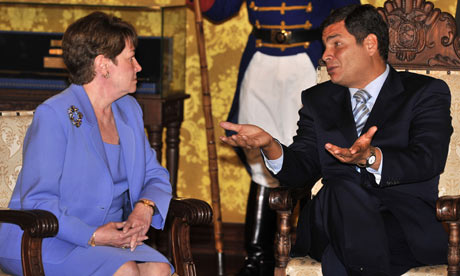
QUITO (Dow Jones)--Ecuador has declared the U.S. ambassador in Quito, Heather Hodges, persona non grata and asked her to leave the country immediately, over the release of diplomatic cables via WikiLeaks that discuss alleged police corruption in the Andean country.

Ecuadorian Foreign Affairs Minister Ricardo Patino said Tuesday the U.S. ambassador has been asked to leave the country as soon as possible.

"The government decided to declare Hodges as persona non grata. We have asked her to leave the country as quickly as possible," Patino said.

In Washington, the State Department said Ambassador Hodges is one of the U.S.'s most experienced and talented diplomats and that her "expulsion" is "unjustified."

"The Department will examine its options to respond to Ecuador's action," added the State Department.

Meanwhile, in the afternoon, according to Ecuador's state news agency, Andes, President Rafael Correa said his government expected the United States to take reprisal for the Hodges expulsion, and that the "intrusion" by the U.S. embassy into the internal affairs had been "very serious."

"The United States will retaliate," Correa said, adding that his government will respond at a regional level, through the Union of South American Nations, or UNASUR.

"I am sure that UNASUR will give Ecuador its total support in this case," Correa said.

Local analysts said the decision by Correa will affect the relationship between the U.S. and Ecuador.

Hodges told reporters in Quito the order "left me saddened tremendously, both personally and for this country."

In 2009, a secret diplomatic U.S. embassy cable said there was widespread corruption in Ecuador's police, and that former Commander General Jaime Hurtado Vaca had used his power "to extort cash and property, misappropriate public funds, facilitate human trafficking, and obstruct the investigation and prosecution of corrupt colleagues."

According the cable, the U.S. Embassy also said it had information from numerous sources that Hurtado Vaca received payments from police to give them protection so they could continue illegal activities.

Interviewed on Tuesday by Dow Jones, Hurtado Vaca denied any act of corruption and said the cable was not proof or evidence.

"Police chiefs generally always have people against them," he said.

The cable also said that some members of the embassy had speculated that Correa knew of the corruption allegations when he named Hurtado Vaca police commander, but that the president believed this would make him more easy to manipulate. Hurtado Vaca was police chief from April 2008 to mid-2009.

At a press conference, Patino said Ecuador's government had asked Hodges for an explanation, but the ambassador said the WikiLeaks documents are considered to be stolen goods and, therefore, would not comment.

Patino said the decision wasn't against the government of the U.S., "but against an official who made serious declarations."

He said the meeting with Hodges lasted only two minutes and called Hodges's answers to their questions "unacceptable, insufficient and unsatisfactory."

Hodges is a career foreign-service officer who became ambassador to Ecuador in 2008.

Declaring someone persona non grata means they are unacceptable to the host government.

Hodges is the third U.S diplomat to be expelled by Correa's administration since he took office in early 2007.

In February 2009, Correa ordered the expulsion of a top U.S. diplomat, Armando Astorga Jr., and the Embassy's first secretary, Mark Sullivan, accusing them of treating the country like a colony.

Ecuador's request for the U.S. ambassador to leave is the second diplomatic flap in Latin America due to WikiLeaks revelations.

Last month, the U.S. ambassador to Mexico resigned after publication of several WikiLeaks cables in which the U.S. envoy questioned Mexico's institutional capability to tackle organized crime.

Read More

http://online.wsj.com/article/BT-CO-20110405-714905.html

Monday, January 17, 2011

WikiLeaks promises new batch of banking documents


WikiLeaks founder Julian Assange has pledged that his latest leaked documents will reveal corruption and crime in the shadowy world of offshore banking, but observers eager for scintillating revelations about Canadian account holders may be in for a disappointment.

The latest WikiLeaks source to come forward, Rudolf Elmer, a former banker with Swiss financial institution Julius Baer, has previously disseminated confidential banking records from the bank’s offices in the Cayman Islands to media outlets, including The Globe and Mail.

Buried in Mr. Elmer’s first batch of leaked material – a labyrinth of file folders, spreadsheets and Microsoft Word files – were accounts linked to two Canadians: one, a Toronto businessman, and the second, former Hollinger executive David Radler.

At a packed press conference in London on Monday, Mr. Elmer and Mr. Assange were short on specifics about how much new information is in the latest data dump. In 2008, before WikiLeaks was a household name and driving the international news agenda, Mr. Elmer posted details on thousands of accounts that he had downloaded from Julius Baer’s Cayman Islands servers. Mr. Elmer was fired from the bank in 2002 after a long-standing dispute. The former banker has said he is trying to expose how offshore financial institutions use banking secrecy laws to facilitate wide-scale tax evasion, while his former employer has accused him of being “frustrated about unfulfilled career aspirations” and launching a campaign of intimidation.

On Monday, Mr. Radler said he was frequently in the Cayman Islands because of Hollinger’s stake in the island’s premier newspaper company, Cayman Free Press Ltd., and that the accounts were created to hold his directors’ fees. The documents in Mr. Elmer’s 2008 trove contain nothing that indicates wrongdoing by Mr. Radler. It isn’t illegal for a Canadian to have an offshore account, as long as the account holder declares the funds to tax collectors. The documents show that, as of 1999, the former newspaper executive held at least $200,000 in his Julius Baer accounts.

Mr. Radler said all of his Cayman-based funds – which were held in the names of entities such as Sunshine Investments and Rainy Day Trust – were declared to the Canada Revenue Agency.

“When I used to go down, I used to put money there and I used to take out money. And at one time I was considering buying a condo there. But it was always reported. There was never any nonsense,” said Mr. Radler, who famously broke ranks with his former business partner, Conrad Black, agreeing to co-operate with the authorities, plead guilty to one count of fraud and testify against Lord Black.

The Globe was unable to reach the other Canadian, a Toronto businessman, identified in Mr. Elmer’s cache.

If and when WikiLeaks releases the whistleblower’s latest banking details, Mr. Elmer may not be in a position to celebrate the disclosure. The former banker goes on trial later this week in his native Switzerland for allegedly violating that country’s rigid and sacrosanct banking secrecy laws.

Read More

http://www.theglobeandmail.com/news/world/wikileaks-promises-new-batch-of-banking-documents/article1873901/


Monday, January 3, 2011

Japan Pushed U.S. on Whale Group, Cables Show


In the first set of cables leaked by WikiLeaks that originate from the U.S. Embassy in Tokyo, Japan asked the U.S. to take action against an antiwhaling activist group for harassing Japanese whalers, including taking away the group's tax-exempt status.

The cables, which WikiLeaks posted online with a release date of Jan. 1, were sent two months before a Japanese harpoon vessel collided with one of the Sea Shepherd Conservation Society's boat, destroying it.

A total of four U.S. diplomatic cables—three originating from Tokyo, one from the State Department—show a push-and-pull effort from both countries, with the U.S. trying to get Japan to further restrict its controversial whale hunting. Japan's escalating problems with the U.S.-based Sea Shepherd group are repeatedly mentioned from the Japanese side as a thorn in negotiating efforts.

According to a cable dated January 27, 2010, Fisheries Agency Deputy Director General Masayuki Yamashita told U.S. officials that the Sea Shepherd confrontations could cause domestic political embarrassment for the Japanese government if they keep Japan from fulfilling its whaling quota.

Japan's troubles with the Sea Shepherd group were also referred to in a cable dated Nov. 2, 2009, describing a discussion with an official in the ministry handling fisheries matters.

"Yamada inquired about an investigation into the tax status of the U.S.-based NGO Sea Shepherd Conservation Society and repeated Japan's request for the U.S. to take action against the organization, which he said created a very dangerous situation on the seas," according to the cable written by John Roos, the U.S. ambassador to Japan, in reference to Shuji Yamada, the vice minister of international affairs in the Ministry of Agricultural Affairs, Forestry and Fisheries.

The State Department has repeatedly said it will not comment on the specific content of leaked cables.

The activist group's campaign against Japanese whalers has evolved into a high-seas drama of sorts in recent years. The group tails the large harpoon vessels during the whale hunts and hurls objects at the ships. The Sea Shepherd's increasingly aggressive tactics resulted in multiple confrontations during the 2009-2010 whale-hunting season. In January 2010, one of the Sea Shepherd's vessels crashed into a Japanese whaling ship in the Southern Ocean, destroying the activist group's boat, which prompted the skipper Paul Bethune to later board the vessel in an attempt to make a citizen's arrest of the ship's captain.

Japan has drawn international criticism for continuing whale-hunting missions despite a 1986 moratorium on commercial whaling set by the International Whaling Commission. Japan has said it is conducting "whale research," a crack in the ban that allows whales be caught for research purposes. Japanese whaling fleets depart for annual whaling hunts in the Southern Ocean in mid-November citing scientific research purposes. Critics say the real motive is to sell whale meat. The Japanese vessels kill over 500 whales each season.

Another cable sent from the Tokyo Embassy a week later—on Nov. 9, 2009—cites the director general of the Fisheries Agency of Japan as saying U.S. action regarding the Sea Shepherd group would "positively influence Japan's negotiating position in the Future of the IWC [International Whaling Commission] process," underscoring just how nettlesome the Sea Shepherd's presence on the high seas has become for Japan's whalers.

In response, the U.S. representative to the International Whaling Commission Monica Medina is cited as saying "she believes the USG can demonstrate the group does not deserve tax exempt status based on their aggressive and harmful actions."

It's unclear whether the U.S. government ever did anything to curtail Sea Shepherd's activities. Paul Watson, founder of Sea Shepherd, said "we have had our tax status since 1981, and we have done nothing different since then to cause the IRS [Internal Revenue Service] to change that," the Associated Press reported Monday.

At its June 2010 annual meeting, the IWC failed to reach a compromise that would have resolved a longstanding impasse between the pro-whaling nations that include Japan, Norway and Iceland, and those against it. The IWC launched negotiations three years ago to find consensus among the member states that was set to conclude at the June meeting in Morocco, determining the long-term future of whale conservation. An embassy cable dated November 14, 2009, originating from the U.S. State Department urges U.S. negotiators to press for some agreement to reduce Japan's catch levels.

A proposal to allow Japan to resume limited commercial whaling in its coastal waters in exchange for a reduced catch was floated in March. The commission decided to defer the proposal until 2011.


Read More

http://online.wsj.com/article/SB10001424052748704835504576059572077593268.html?mod=googlenews_wsj

Friday, December 10, 2010

WikiLeaks: Pope Helped Win Sailors' Freedom


The latest US embassy cables released by WikiLeaks suggest the Pope helped win the release of 15 British sailors captured by Iran and held for a fortnight in 2007.


Captive British sailors return home

Another cable reveals that the British ambassador to the Vatican said "Anglican-Vatican relations were facing their worst crisis in 150 years" after the Pope encouraged Anglicans to convert to Rome over the issue of women priests.

Evidence of apparent links between the head of the Roman Catholic church and religious fundamentalists in Tehran come from a "scene setter" for President Obama's then forthcoming visit to Rome, compiled in June 2009 by Julieta Noyes, deputy chief of mission to the Vatican.

Her dispatch explains that the Vatican claims "an ability to act as an intermediary" in international crises involving Iran.

Noyes tells Obama: "The Vatican helped secure the release of British sailors detained in Iranian waters in April 2007."

According to The Guardian, which has published the cables, British diplomats in London said he did issue a message but was not necessarily key to the release.

In other cables relating to the Pope, the British ambassador to the Vatican is said to have feared a backlash against Catholics in the UK after the Pope's message to Anglicans to convert over female priests.

Francis Campbell, the British ambassador to the Holy See, said: "Anglican-Vatican relations were facing their worst crisis in 150 years as a result of the Pope's decision."

His comments came after Archbishop of Canterbury Dr Rowan Williams was a guest of honour at a dinner with Vatican officials.

The cable, from US ambassador Miguel Diaz, said Mr Campbell believed Pope Benedict XVI had put the Archbishop in an "impossible position".

It said: "The Vatican decision seems to have been aimed primarily at Anglicans in the US and Australia, with little thought given to how it would affect the centre of Anglicanism, England, or the Archbishop of Canterbury.

"Benedict XVI, Campbell said, had put Williams in an impossible situation. If Williams reacted more forcefully, he would destroy decades of work on ecumenical dialogue; by not reacting more harshly, he has lost support among angry Anglicans.


Read More

http://news.sky.com/skynews/Home/World-News/latest-WikiLeak-Cables-Say-Pope-Helped-Secure-Release-Of-15-British-Sailors-Held-By-Iran-In-2007/Article/201012215851544?lpos=World_News_Top_Stories_Header_0&lid=ARTICLE_15851544_latest_WikiLeak_Cables_Say_Pope_Helped_Secure_Release_Of_15_British_Sailors_Held_By_Iran_In_2007