Wednesday, April 6, 2011

Mexicans protest drug war as more graves found


Thousands of Mexicans protested the country's raging drug war on Wednesday as dozens of bodies were found in graves near the country's border with the United States.

Demonstrators marched in cities across Mexico, holding signs condemning the wave of killing that has claimed more than 37,000 lives since President Felipe Calderon took office in December 2006 and launched a military-led crackdown against drug cartels.

"We are fed up with this war that nobody asked for," said protester Leticia Ruiz in the northern border city of Ciudad Juarez, where some businesses have closed because of gunbattles in the streets and rampant extortion by cartel members.

Although recent estimates suggest the violence may have peaked last summer, Mexicans are jarred by daily news stories of beheadings and executions as cartels war for control of cocaine smuggling routes. Most cocaine consumed in the United States goes through Mexico.

Prosecutors said on Wednesday they discovered 59 bodies in a series of graves in the northern state of Tamaulipas, not far from a ranch where 72 Central and South Americans were executed late last year by drug gangs preying on migrants traveling north through Mexico.

Authorities said one grave held 43 bodies, with the rest of the bodies spread among seven other graves.

Investigators believe the recently discovered victims may have been abducted from a bus on March 25, the state prosecutor's office said in a statement.

'NO MORE MURDERS'

Protest organizers said more than 10,000 people participated in the nationwide marches, but numbers could not be confirmed.

The bloodletting has hurt Calderon's conservative party and strained relations with the United States, which is providing Calderon with equipment and intelligence to fight drug gangs.

In Mexico City, several thousand protesters held signs saying: "No more murders" as they filed into the city's central plaza. Smaller protests were held in New York and Barcelona.

Body counts published by Mexican media indicate the death toll has fallen for two consecutive quarters for the first time since Calderon began his campaign.

The tallies point to about 3,220 murders in the first three months of 2011, down from 3,690 in the last quarter of 2010. The government has yet to publish an official estimate.

Demonstrators also marched through the northern business capital of Monterrey. But the impetus for the national protests came from the weekend getaway city of Cuernavaca.

Read More

http://in.reuters.com/article/2011/04/07/idINIndia-56175720110407

Genus Envy: The Cow Who Thinks It's A Horse


A horse is a horse, of course, of course -- unless it's a bovine.

A young German lass was told by her parents that she couldn't have a horse, but she wasn't ready to give up her yearnings to ride free throughout the Bavarian countryside atop a four-legged mammal. So the 15-year-old trained a cow named Luna to do the job.


The Associated Press article relaying the magical journey of Regina Mayer and her animal calls the two "soul mates" and recounts the years of acclimation it took to make Luna into the running, jumping, saddle-friendly cow she is today. Luna will obey commands to "go" and "gallop" and in turn gets the grooming and petting so often reserved for horses. Sometimes Luna gets a bit sassy and won't do as she's told, but to combat this tendency, Mayer got help from "a cow expert in Switzerland on how to deal with 'steering' problems." (See what they did there?)

The lesson being: Don't judge an animal by its hide. Though this open-mindedness really should have become standard the moment we saw that you can teach a squirrel to water ski.


Read more:
http://newsfeed.time.com/2011/04/06/genus-envy-the-cow-who-thinks-its-a-horse/#ixzz1IoHbdZZM

Sachin has been an amazing role model: Pollock


MUMBAI: Shaun Pollock is occupying the same dressing room at the Wankhede Stadium in Mumbai which the Indian team had used a couple of days back, working their way to World Cup glory.

Sitting there, watching the turf through the thick glass panelled viewing area, he tries recollecting what he saw of India's victory in the final over Sri Lanka on television.

"It was an amazing moment," he says. "A well-deserved victory for a very good team."

Pollock is here for the Indian Premier League, as a mentor for Mumbai Indians, the team he's been associated with for two of the three years and the idea of working with Sachin Tendulkar again has fascinated the former South African all-rounder. "He's been an amazing role model."

Pollock puts a lot of emphasis on the humility of Tendulkar. "From the media, from the public, there's so much pressure. I have travelled with him across the country in the same team bus. To see him keep his focus completely on the game despite the kind of adulation he receives is something."

Pollock says the senior batsman has a very good idea of how youngsters watch his every step and therefore, to be the right role model for growing cricketers is the biggest service Tendulkar might be doing.

He's hoping that Mumbai Indians will be a bigger draw than any time before because of Tendulkar's presence. Not that it wasn't the case earlier, but this time because Tendulkar will be playing the tournament as a World Cup winner.

"The Indian community has always been such a great fan of this game and I'm hoping they'll flock the stadiums to watch Tendulkar like never before," says Pollock.

Sadly, Pollock is yet to see his national team South Africa lay its hands on the Cup. But, he doesn't feel the Proteas are chokers as labelled. "The media, opposition teams add to the pressure when they keep repeating it. These things make a difference," insists Pollock.

But, with India's victory, he sees a ray of hope for South Africa shedding the chokers tag. "The Indian team also faced enough pressure but they managed to win the trophy and South Africa can do the same," he says.

Pollock is about to find the next 40 days in India interesting because it'll give him a good idea of how the frenzy post the World Cup victory has caught up with the whole country. In the process, he's looking forward to having a great time helping Mumbai Indians win their first IPL trophy, one that is yet to find its way into Tendulkar's growing trophy cabinet.

Read More

http://timesofindia.indiatimes.com/news/Sachin-has-been-an-amazing-role-model-Pollock/articleshow/7890792.cms

Tuesday, April 5, 2011

Japan Nuclear Plant Plugs Highly Radioactive Leak


Workers at Japan's tsunami-damaged nuclear power plant on Wednesday finally halted a leak that was sending a tide of radioactive water into the Pacific and exacerbating concerns over the safety of seafood, the operator said.

It was a rare bit of good news for the Fukushima Dai-ichi complex and the coastal areas surrounding it, where high levels of seawater contamination have angered fishermen and prompted the government to set limits for the first time on the amount of radiation permitted in fish.

But in a sign that workers still face several challenges before the overheating reactors are stabilized, Tokyo Electric Power Co. said it plans to inject nitrogen gas into one of the reactors. Nitrogen can prevent highly combustible hydrogen from exploding — as it did three times at the compound in the early days of the crisis.

There is no immediate possibility of an explosion, but the "nitrogen injection is being considered as a cautionary measure," said spokesman Hidehiko Nishiyama of Japan's Nuclear and Industrial Safety Agency.

TEPCO said the process could begin as early as Wednesday evening in Unit 1 — where pressure and temperatures are the highest — according to spokesman Junichi Matsumoto. The same measures will eventually be taken at the other two troubled reactors.

The 9.0-magnitude earthquake and tsunami that followed are believed to have killed as many as 25,000 people. Hundreds of miles (kilometers) of coastline have been destroyed and the country's fishing industry devastated.

Since the crush of water flooded the plant and knocked out cooling systems, workers there have been desperately trying to cool overheated reactors. The effort has required spraying large amounts of water and allowing it to gush out wherever it can escape, sometimes into the sea.

While officials have said the crack in a maintenance pit plugged early Wednesday was the only one found, they have not explicitly ruled out that radioactive water is leaking into the sea from another point.


Read More

http://abcnews.go.com/Business/wireStory?id=13305742

3rd UPDATE: Ecuador Asks US Envoy To Leave As Soon As Possible


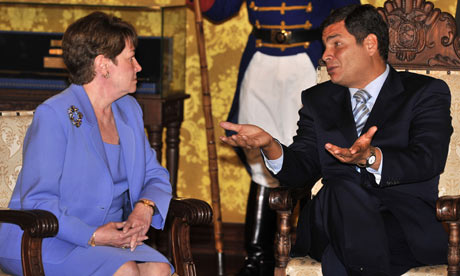
QUITO (Dow Jones)--Ecuador has declared the U.S. ambassador in Quito, Heather Hodges, persona non grata and asked her to leave the country immediately, over the release of diplomatic cables via WikiLeaks that discuss alleged police corruption in the Andean country.

Ecuadorian Foreign Affairs Minister Ricardo Patino said Tuesday the U.S. ambassador has been asked to leave the country as soon as possible.

"The government decided to declare Hodges as persona non grata. We have asked her to leave the country as quickly as possible," Patino said.

In Washington, the State Department said Ambassador Hodges is one of the U.S.'s most experienced and talented diplomats and that her "expulsion" is "unjustified."

"The Department will examine its options to respond to Ecuador's action," added the State Department.

Meanwhile, in the afternoon, according to Ecuador's state news agency, Andes, President Rafael Correa said his government expected the United States to take reprisal for the Hodges expulsion, and that the "intrusion" by the U.S. embassy into the internal affairs had been "very serious."

"The United States will retaliate," Correa said, adding that his government will respond at a regional level, through the Union of South American Nations, or UNASUR.

"I am sure that UNASUR will give Ecuador its total support in this case," Correa said.

Local analysts said the decision by Correa will affect the relationship between the U.S. and Ecuador.

Hodges told reporters in Quito the order "left me saddened tremendously, both personally and for this country."

In 2009, a secret diplomatic U.S. embassy cable said there was widespread corruption in Ecuador's police, and that former Commander General Jaime Hurtado Vaca had used his power "to extort cash and property, misappropriate public funds, facilitate human trafficking, and obstruct the investigation and prosecution of corrupt colleagues."

According the cable, the U.S. Embassy also said it had information from numerous sources that Hurtado Vaca received payments from police to give them protection so they could continue illegal activities.

Interviewed on Tuesday by Dow Jones, Hurtado Vaca denied any act of corruption and said the cable was not proof or evidence.

"Police chiefs generally always have people against them," he said.

The cable also said that some members of the embassy had speculated that Correa knew of the corruption allegations when he named Hurtado Vaca police commander, but that the president believed this would make him more easy to manipulate. Hurtado Vaca was police chief from April 2008 to mid-2009.

At a press conference, Patino said Ecuador's government had asked Hodges for an explanation, but the ambassador said the WikiLeaks documents are considered to be stolen goods and, therefore, would not comment.

Patino said the decision wasn't against the government of the U.S., "but against an official who made serious declarations."

He said the meeting with Hodges lasted only two minutes and called Hodges's answers to their questions "unacceptable, insufficient and unsatisfactory."

Hodges is a career foreign-service officer who became ambassador to Ecuador in 2008.

Declaring someone persona non grata means they are unacceptable to the host government.

Hodges is the third U.S diplomat to be expelled by Correa's administration since he took office in early 2007.

In February 2009, Correa ordered the expulsion of a top U.S. diplomat, Armando Astorga Jr., and the Embassy's first secretary, Mark Sullivan, accusing them of treating the country like a colony.

Ecuador's request for the U.S. ambassador to leave is the second diplomatic flap in Latin America due to WikiLeaks revelations.

Last month, the U.S. ambassador to Mexico resigned after publication of several WikiLeaks cables in which the U.S. envoy questioned Mexico's institutional capability to tackle organized crime.

Read More

http://online.wsj.com/article/BT-CO-20110405-714905.html

Cameron's £950m gamble to win Pakistani minds


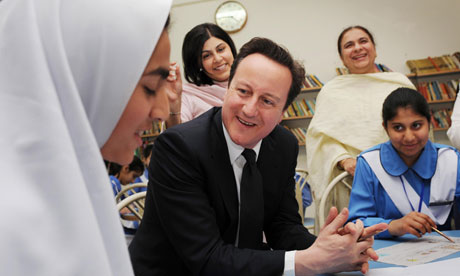
David Cameron has taken a calculated and expensive diplomatic gamble by agreeing to put his faith in the Pakistani security services to help Britain leave Afghanistan, in the hope of preventing the export of terrorism to Britain.

Nearly half of the terrorist plots against Britain come from Pakistan's lawless north-west frontiers.

On a visit to Islamabad, Cameron promised £950m in aid to fund 4m school places and 8,000 teachers, arguing that education is the best antidote to terror. Pakistan is now the largest beneficiary of UK aid.

Cameron said he could justify the move domestically only if the Pakistani elite paid more taxes. He said bluntly, in a speech, that Pakistan suffered from "weaknesses in terms of government capacity and waste".

But he revealed a new willingness to work with Pakistani intelligence agencies to secure a political settlement in Afghanistan before Britain leaves in 2015.

A year ago, Cameron put UK-Pakistan relations in deep-freeze by criticising the Pakistanis for facing both ways in the fight against terror.

On Tuesday he talked of a fresh start and a new era of co-operation.

British officials say they are now convinced that the growing internal Islamist terrorist threat inside the country has caused the intelligence service, the ISI, to take a tougher role in combating the Taliban and al-Qaida inside Pakistan. British officials said the Pakistani prime minister, Yusuf Raza Gilani, and the president, Asif Ali Zardari, recognised they were involved in "an existential battle" with terrorists.

During his one-day visit, Cameron offered the president unprecedented intelligence co-operation and agreed to set up a joint "centre of excellence" in Pakistan to exchange knowledge on improvised explosive devices.

He also sought to reassure his hosts that he does not see India as Britain's preferred partner in the region. He set a goal of Anglo-Pakistani trade rising from £1.9 bn to £2.5bn by 2015.

In a sign of the importance of the trip to UK national security, Cameron was accompanied by Sir Peter Ricketts, the national security adviser, Sir David Richards, the chief of the defence staff, and Sir John Sawers, head of MI6. The three were in Islamabad only a month ago to prepare the ground for what is being billed as an "enhanced security dialogue". The aim was to build a less transactional relationship, officials said, and to work on the basis of broader, long-term trust.

At a joint press conference, Gilani said: "I want to assure you that Pakistan has the resolve and the commitment to fight against extremism and terrorism. We've paid a heavy price for that."

He pointed out that 30,000 civilians had been killed and a similar number disabled.

He said: "The political leadership has been targeted. The bombs have gone off in girls' schools, hospitals, the malls, the police stations and even in the intelligence service headquarters."

Cameron praised his hosts: "What you see in Pakistan is a huge fight by the government taking place against terrorism."

He defended the size of the projected aid package, saying he would "struggle to find an example of a country" whose progress and success were more in Britain's national interest than were those of Pakistan.

But, unusually, he challenged Pakistan by pointing out that it currently spends only 1.5% of national income on education, and has one of the lowest tax revenues, relative to GDP, of any country in the world.

"You are not raising the resources necessary to pay for things that a modern state and people require," he said. "Too few people pay tax. Too many of your richest people are getting away without paying much tax at all. And that's not fair." British officials indicated that they had asked the Pakistan military as diplomatically as possible when it planned to enter North Waziristan, the tribal heartland and sanctuary from which many terrorist groups operate.

British intelligence and the CIA consider the region to be the place where suicide bombings and cross-border attacks originate.

Cameron made a partial reference in his speech, saying: "Neither the Pakistan army nor Nato forces must ever tolerate sanctuaries for people plotting violence."

The Pakistani army has suffered big losses as a result of clearing out other federally administered tribal areas, and seems to be holding back from tackling North Waziristan, partly due to a peace deal having been struck.

Pakistani troops moved into South Waziristan in 2009. Pakistan says it lacks military capacity to lead an assault on a mountainous area that could lead to a mass exodus of refugees.

In the absence of troops on the ground, Britain supports what it sees as the highly effective use of US unmanned drones to bomb terrorist targets in the area, a practice that Pakistani politicians regularly denounce as being counter-productive and in breach of their sovereignty, and leading to the slaughter of innocent tribal elders. Only last week, Pakistan pulled out of tripartite talks on Afghanistan in anger at the US attacks.

Since 2007, about 164 drone strikes have been carried out, killing almost 1,000 militants.

Read More

http://www.guardian.co.uk/politics/2011/apr/05/david-cameron-pakistan

Italy's Berlusconi sex trial gets underway


ROME, April 5 (Xinhua) -- The trial over Italian Prime Minister Silvio Berlusconi's sex scandal will begin Wednesday, but a top aide said Berlusconi would not appear in court.

Nor will television cameras, as Italian Attorney General Laura Bertole Viale and State Prosecutor Manilio Minale agreed to reverse a previous ruling that would have allowed state broadcaster RAI to film the trial. They said the ruling was changed to prevent the hearing from becoming a "circus."

But it seems impossible to prevent that. Protesters and supporters have both said they would gather in front of the Milan courthouse, where the trial will start at 9:30 a.m. (0730 GMT) Wednesday.

Hundreds of journalists have been reporting on every micro development from the case ever since it was announced in February. And the witness list includes American movie star George Clooney and his showgirl girlfriend, Elisabetta Canalis.

Berlusconi is charged with paying for sex with a minor, a then-17-year-old cabaret dancer called Karima el-Mahroug, known by her nickname "Ruby the Heart Stealer."

The leader is also charged with abusing his position as prime minister to cover up his connection with el-Mahroug by pressuring police to release her from custody after she was detained over separate theft allegations.

The trial seems to be a kind of drama compared to the two other Berlusconi trials, where he faces much more technical charges including tax evasion and bribery.

According to Cabinet Undersecretary Gianni Letta, Berlusconi's closest aide, the prime minister will not be present for Wednesday's opening hearing, which is expected to focus mostly on procedural matters.

There is a chance that the trial could be aborted before it really gets under way. Italian lawmakers started debate Tuesday on a measure that could slow or even halt the proceedings.

They will decide whether the Milan court is the appropriate venue for the hearing, with Berlusconi's lawyers arguing that he should be tried before a special minister's tribunal given that the abuse of power charges relate to Berlusconi's position as prime minister.

However, the Constitutional Court ruled in March that the Milan court had the authority to handle the case.

But if parliament contradicts that ruling, the Constitutional Court would be forced to rule again and confirm the tribunal members.

Regardless of the parliamentary vote, Wednesday's hearing will take place. But if legislators vote against the court's authority, it means the trial could be halted in the future.

Berlusconi, a billionaire media tycoon who controls three of Italy's seven national television networks, denied wrongdoing in the case involving el-Mahroug as well as the others and insisted that he is a victim of the corrupt Italian judiciary.

As the cases approached, his ruling coalition fractured and his popularity dropped to nearly a historical low, but at least so far, his grip on power does not seem at risk.

Since he entered public life in 1994, Berlusconi has faced at least 17 official criminal and civil allegations.


Read More

http://news.xinhuanet.com/english2010/world/2011-04/05/c_13814440.htm