Showing posts with label usa job market. Show all posts

Friday, March 4, 2011

U.S. jobless rate falls to 8.9%, California's dips


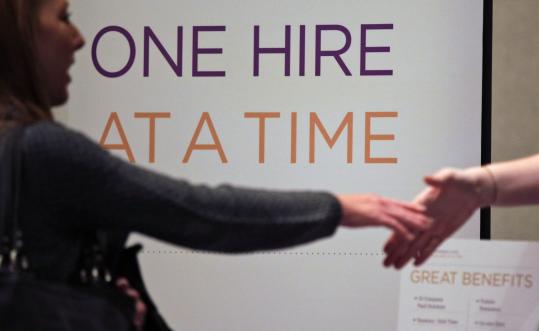
A man checks job listings in New York. U.S. employers have added 192,000 jobs


The U.S. jobless rate unexpectedly fell to 8.9 percent, the lowest in almost two years, and employers added 192,000 jobs in a sign of growing confidence in the recovery, the Labor Department reported Friday.

Meanwhile, California's unemployment rate dipped slightly to 12.4 percent in January, the state Employment Development Department said.

The state reported a 12.5 percent unemployment rate in December. California's jobless rate has been at or above 12 percent for 17 months.

California added 12,500 nonfarm jobs in January, bringing the state's total to nearly 14 million. Gains were seen in five of 11 sectors surveyed, including construction, manufacturing and government. Education and financial, health and business services reported job losses.

Even with the slight drop in the unemployment rate, more than 2.2 million Californians remain out of work.

The nationwide increase in payrolls partly reflected a return to more seasonable weather and followed a 63,000 gain in January, Labor Department figures showed. The median estimate in a Bloomberg News survey of economists was for an addition of 196,000 jobs last month.

Manufacturing, construction and transportation were among industries adding workers, underscoring Federal Reserve Chairman Ben Bernanke's testimony to Congress this week that there are "grounds for optimism" about improvements in the labor market. Employment growth is giving Americans the means to keep spending at retailers such as J.C. Penney Co. and Macy's Inc.

"The economy has been clawing its way back up the side of the mountain for the better part of a year and these numbers are consistent with that," Paul O'Neill, a special adviser to Blackstone Group LP and a former Treasury secretary, said in an interview with Bloomberg Television. "Where we are is the process of natural healing of our economy."

The unemployment rate was projected to rise to 9.1 percent from 9 percent, according to the survey median. The number of unemployed fell by 190,000, and those employed rose by 250,000. The size of the labor force increased by 60,000.

Some U.S. companies are ramping up hiring. Intel Corp. in Santa Clara and Home Depot Inc. announced plans last month to hire thousands of workers.

President Obama last week told the first meeting of his panel of outside economic advisers that the United States must deal with stubbornly high unemployment even as the recovery is well under way.

"We still have a ways to go," Labor Secretary Hilda Solis said in an interview Friday with Bloomberg Television. "We still have a lot of people who need jobs."

Last month's increase in payrolls was the biggest since May. If sustained, that pace would reduce the unemployment rate to 6.9 percent by November 2012, when Obama faces re-election, said Guy LeBas, chief fixed-income strategist at Janney Montgomery Scott LLC. The rate was 7.8 percent when Obama took office in January 2009.

Read more:

http://www.sfgate.com/cgi-bin/article.cgi?f=/c/a/2011/03/04/BU3G1I48UC.DTL#ixzz1FhQJPoyd

Tuesday, December 7, 2010

In hopeful sign, number of job openings up


WASHINGTON Employers posted a sharp increase in job openings in October, raising hopes that hiring could pick up in the coming months.

Businesses and government advertised nearly 3.4 million jobs at the end of October, up about 12 percent from the previous month, the Labor Department said yesterday. That reverses two months of declines and is the highest total since August 2008, just before the financial crisis intensified.

Overall, the number of advertised jobs has increased by about 1 million, or 44 percent, since the low point of July 2009, a month after the recession ended. But openings are still far below the 4.4 million advertised in December in 2007, when the recession began.

The latest job openings data follows last week’s disappointing employment report for November. That showed the economy added a net total of only 39,000 jobs, a steep drop from the previous month, and the unemployment rate rose to 9.8 percent from 9.6 percent.

But some economists consider yesterday’s report, known as the Job Openings and Labor Turnover survey, to be a signal of how much hiring might take place one to three months after the period covered by the survey.

Jonathan Basile, an economist at Credit Suisse, said the JOLTS report echoes other recent data showing that the economy is improving. That improvement will likely translate into more hiring soon, he said.

Last week’s employment report “should turn out to be just a bump in the jobs recovery road,’’ Basile said.

Separately yesterday, the Federal Reserve reported that consumer borrowing rose in October by the largest amount in more than two years, led by a big rise in the category that includes student loans.

The Fed said consumer credit rose at an annual rate of $3.4 billion in October, the largest increase since a $5.7 billion gain in July 2008. Consumer credit was also up in September.

But the strength in both September and October is being heavily influenced as the result of a recently enacted law that makes the government the primary lender to students.

The increase of $3.4 billion in overall credit surpassed the flat reading that economists had expected. The gain translated into a 1.7 percent rise and followed a 0.6 percent increase in September. Those were the first back-to-back monthly gains since mid-2008.

Read More

http://www.boston.com/business/articles/2010/12/08/in_hopeful_sign_number_of_job_openings_up/

Thursday, December 2, 2010

U.S. dollar, stocks poised to gain on jobs recovery


The U.S. dollar was steady on Friday ahead of payrolls data for November that could show more evidence of a strengthening recovery and give investors a reason to push benchmark U.S. Treasury yields above 3 percent and put more money in equities.

The euro slipped against the dollar after two days of gains, supported overnight by talk that the European Central Bank of was buying bonds of peripheral countries such as Ireland and Portugal, even though no new policy was formally announced.

With the euro little changed this week at $1.3211 and holding above its 200-day moving average despite the euro zone fiscal crisis, investors ahead of the U.S. payrolls report put cash to work in stock markets, lifting Japan's Nikkei share average to its highest since May.

"It is clear that the labor situation is improving and with consumption demand -- the final demand that drives all else -- strengthening by the day, hiring should continue to improve," economists at DBS Group in Singapore said in a note.

The Nikkei rose 0.6 percent .N225, driven higher mainly on buying of technology stocks.

For a second day, the technology sector also outperformed in the MSCI index of Asia Pacific stocks outside Japan .MIAPJ0000PUS. The index was up 0.5 percent and extended a 3.5 percent gain in the week, on track to exceed weekly returns of Japanese stocks for the first time in three weeks.

MACRO OUTLOOK

The U.S. economy is forecast to have generated 140,000 new jobs in November, with signs of a sustained recovery in private sector hiring combined with solid auto sales and continued industrial growth boding well for the macro outlook.

The improving U.S. economic picture has been a factor lifting the entire U.S. government bond yield curve higher.

The benchmark 10-year U.S. Treasury yield edged down to 2.98 percent compared with a four-month high of 3.03 percent reached on Thursday. Since Monday, the yield has risen 16 basis points, half of the entire rise since November.

Though the U.S. labor market report will be center stage on Friday, investors will also been watching for follow-through on Thursday's unexpected narrowing in the spread of higher risk European government bond yields over German bond yields.

Market chatter about the European Central Bank stepping into the market to buy bonds of at-risk countries such Spain and Portugal caused the Spain/Germany 10-year yield spread to narrow to 230 basis points, the least in two weeks.

The Portugal/Germany 10-year yield spread was at 344 basis points, the narrowest since Oct 28.

Read More

http://www.reuters.com/article/idUSTRE69K04L20101203

Tuesday, November 30, 2010

Before Business Leaders, Bernanke Discusses Unemployment’s Toll on Americans


Ben Bernanke, right, the Fed chairman, with I.B.M.'s chief executive, Samuel Palmisano, in Ohio.


COLUMBUS, Ohio — The Federal Reserve chairman, Ben S. Bernanke, found some respite on Tuesday from the second-guessing the central bank has faced since it announced a $600 billion effort to stimulate the slow recovery.

During a 75-minute discussion here with five business leaders, including the chief executives of I.B.M. and Ford Motor as well as the founder of a local chain of ice cream stores, inflation and monetary policy were not even mentioned, much less debated.

Mr. Bernanke did, however, emphasize the toll high unemployment was taking on families and on the share of the unemployed — more than 40 percent — who have been jobless for at least six months.

“At the pace of growth that we’re seeing now, we’re not growing fast enough to materially reduce the unemployment rate,” he said. The economy needs to grow at an annualized rate of 2 to 2.5 percent just to accommodate new workers coming into the labor force, he said. Mr. Bernanke has made this point repeatedly this year.

At 9.6 percent, the unemployment rate is about where it was when the recession officially ended in June 2009, Mr. Bernanke said, and only about a million of the 8.5 million jobs lost since the peak of the last economic expansion have been restored.

“Part of the barrier to faster growth and recovery is confidence in households that they will be financially secure and that they can make purchases and take chances in changing careers and changing locations,” Mr. Bernanke said. “With unemployment so high, that confidence is hard to come by.”

The discussion, organized by the Federal Reserve Bank of Cleveland and held at the Fisher College of Business at Ohio State University, was part of an effort by Mr. Bernanke to reach out more.

“We spend a lot of time, of course, looking at data, sitting in Washington, looking at the screen, but there’s only so much you can learn from that,” he said.

Sandra Pianalto, the president of the Cleveland Fed, who moderated the discussion, referred obliquely to the firestorm the Fed has faced in recent weeks. “Through my interactions with Ben, I’ve learned that extreme circumstances often require very creative and aggressive policy responses, and that the right decisions sometimes aren’t the most popular decisions,” she said.

While none of the executives criticized the Fed, Samuel J. Palmisano, the chief executive of I.B.M., said that uncertainty, particularly over regulations, was holding back businesses, not financial constraints.

“Clearly, there’s tons of liquidity, as you know,” he told Mr. Bernanke, who was seated to his left. “There’s probably more than we could consume. It’s not a credit issue. It’s not the financial system or a banking issue. I think at the end of the day it’s clarity.”

But two of the three local business owners on the panel said financial conditions were still tight. “Credit is much more tight today than it was in past years,” said Dwight E. Smith, founder of Sophisticated Systems, a provider of information technology services.

Curtis J. Moody, co-founder of Moody Nolan Architects, said, “The lines of credits are more difficult to get, and they’re lower.”

The business leaders agreed that the partisan climate in Washington was not helping matters. “Exports aren’t partisan, competitive tax policies aren’t partisan,” Mr. Palmisano said. “Economic expansion, job creation, isn’t political at the end of the day.”

Alan R. Mulally, the chief executive of Ford, said the government needed “a laser focus on creating an environment where businesses can grow.” He said that “currencies need to be set by the market” and “not manipulated,” and added, “We need to have trade agreements that actually allow us to export.”

That appeared to be a reference to a free trade agreement with South Korea that was negotiated by the Bush administration and is opposed by Ford. The Obama administration wants to complete the deal and submit it to Congress, but negotiations with South Korea have become stuck over restrictions on American auto and beef exports.

Mr. Bernanke said he took away from the discussion the need for clarity on regulatory, trade and fiscal matters. He also emphasized the importance of government support for technological innovation and the need to improve public education, community colleges and work force training.

Several M.B.A. students in the audience said that they had hoped Mr. Bernanke would discuss the Fed’s decision to buy bonds to reduce long-term interest rates, a topic they had debated in class. The students were generally skeptical about the strategy’s effectiveness.

“If you inflate the economy without doing anything about growth, you’re just printing money,” said one of the students, Jyotisko Sinha, 27.

Read More

http://www.nytimes.com/2010/12/01/business/economy/01fed.html?partner=rss&emc=rss

Monday, November 22, 2010

Lack of Hiring to Restrain U.S. Economy in 2011, Survey Shows


The economy in the U.S. will fail to strengthen in 2011 as companies limit hiring and consumers curb spending, a survey showed.

Gross domestic product will increase 2.6 percent next year after growing 2.7 percent in 2010, according to the median forecast of 51 economists surveyed by the National Association for Business Economics from Oct. 21 to Nov. 4.

“Growth is expected to be moderate,” Richard Wobbekind, president of the group and associate dean of the Leeds School of Business at the University of Colorado-Boulder, said in a statement. “Panelists remain concerned about high levels of federal debt, a continuing high level of unemployment, increased business regulation and rising commodity prices.”

A diminishing need to replenish inventories, the winding down of government stimulus and households’ drive to pay off debt will restrain growth, the survey showed. The economists polled said the world’s largest economy will add fewer jobs than they predicted last month.

Employment next year will climb by 136,000 a month on average, down from the 153,000 they projected in October, the survey showed. This month’s canvass was completed before the Labor Department reported on Nov. 5 that employers added 151,000 workers to payrolls last month, beating the median estimate of economists surveyed by Bloomberg News.

The unemployment rate will be 9.4 percent or higher through the middle of 2011 before dropping to 9.2 percent by the end of next year, according to economists surveyed.

Consumer spending will expand 1.7 percent in 2010 and 2.4 percent in 2011, the survey showed. Median projections in October for this year and next were 1.5 percent and 2.3 percent, respectively.

Inflation Forecast

Respondents also said inflation in 2011 will remain below the Federal Reserve’s estimates. Economists forecast the central bank’s preferred inflation gauge, the personal consumption expenditures price index excluding food and energy, will rise 1.3 percent next year after a 1.1 percent gain in 2010. Fed policy makers have a long-run inflation forecast of 1.7 percent to 2 percent, the level they see as consistent with achieving legislative mandates for maximum employment and stable prices.

About one-third of those surveyed said a Fed decision to buy more Treasury securities could diminish the risk of deflation, and another third said the action could increase the risk of “undesirable” inflation. Policy makers on Nov. 3 announced a plan to buy another $600 billion in government debt through June.

The Fed’s so-called quantitative easing program will not prevent borrowing costs from rising, the survey showed. The yield on the 10-year Treasury note will increase every quarter next year, finishing at 3.25 percent by the end of 2011. The yield at the end of the third quarter this year was 2.51 percent.

The biggest threat to the economy was “excessive federal debt,” according to those surveyed, exceeding concern over unemployment and either inflation or deflation, the report said.

The U.S. deficit will narrow to $1.1 trillion in 2011 from $1.3 trillion this year, according to the median forecast.

Read More

http://www.bloomberg.com/news/2010-11-22/lack-of-hiring-to-limit-growth-in-u-s-next-year-economists-survey-shows.html