Showing posts with label libya protests. Show all posts

Thursday, June 16, 2011

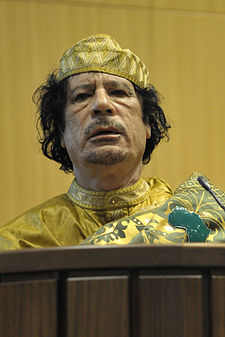
Colonel Gaddafi wants Libyans to vote for him as leader meets rebels


MUAMMAR Gaddafi's regime is in direct talks with Libya's rebels, a Russian envoy indicated today, as the strongman's son said the way out of a months-long conflict is the staging of elections.

Russia's Mikhail Margelov, in Tripoli for one day after visiting the rebels in their Benghazi stronghold last week, made the remarks following a meeting with Libyan Prime Minister Baghdadi al Mahmudi.

"I was assured at today's negotiations that direct contacts between Benghazi and Tripoli are already underway," Mr Margelov said, according to Russia's ITAR-TASS news agency.

"The Libyan prime minister told me that a round of such contacts concluded yesterday in Paris," he said, adding that French President Nicolas Sarkozy "has been informed of the outcome of these contacts".

He did not disclose the nature of the talks, which could not be confirmed by the rebels' Transitional National Council.

Mr Mahmudi said Colonel Gaddafi's departure from power was a "red line" that cannot be crossed, despite growing international calls for him to quit and the armed insurrection against his 41-year rule.

"Of utmost concern to us in any dialog is the unity of Libya," Mr Mahmudi told a news conference in Tripoli.

Read More

http://www.heraldsun.com.au/news/breaking-news/colonel-gaddafi-wants-libyans-to-vote-for-him-as-leader-meets-rebels/story-e6frf7jx-1226077079165

Monday, May 16, 2011

War crimes prosecutor calls for arrest of Gaddafi


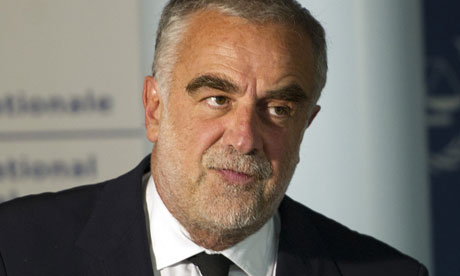
ICC prosecutor Luis Mareno Ocampo believes he has a strong case for the arrest of Gaddafi, one of his sons and his intelligence chief

PETER CAVE: The chief prosecutor at the International Criminal Court is calling for the arrest of Moamar Gaddafi, his son and his brother-in-law. The three are wanted on charges of crimes against humanity.

Saif al Islam was long considered the future face of Libya but the ICC says it now has firm evidence that Colonel Gaddafi's second son was closely involved in the mass killing of civilians.

Europe correspondent, Emma Alberici.

EMMA ALBERICI: The International Criminal Court in The Hague claims that members of the Libyan regime have secretly handed over evidence that proves without doubt that Colonel Gaddafi has been systematically killing his own people with the close assistance of his second son and his brother-in-law, who acts as his intelligence chief.

Luis Moreno Ocampo is the ICC's chief prosecutor

LUIS MORENO OCAMPO: Shot demonstrators with live ammunitions, use of heavy weaponry against participants in funeral processions and placed snipers to kill those leaving mosques after the prayers. The crimes are crimes against humanity.

EMMA ALBERICI: But the history of the world's first permanent tribunal to prosecute war crimes, crimes against humanity and genocide doesn't augur well for the prosecutor's efforts.

It was created in 2002 in response to the genocide in the former Yugoslavia and Rwanda, but its credibility has long suffered from the refusal of some of the world's most powerful countries to recognise its jurisdiction.

The US, Russia, China, India and all Middle Eastern countries, and Libya, are among those who have not signed the ICC treaty which has been ratified by 114 of the 193 recognised states.

The Libyan government issued a statement, claiming that the ICC was merely a baby of the EU that only targets African leaders.

Read More

http://www.abc.net.au/am/content/2011/s3218734.htm

Thursday, April 28, 2011

NATO airstrike mistakenly kills 12 Libyan rebels


Reporting from Benghazi, Libya—
A NATO airstrike in the besieged rebel-held city of Misurata mistakenly killed 12 Libyan rebels, an official with the transitional government confirmed Thursday, while new fighting was reported on Libya's western border with Tunisia.

The strike Wednesday was at least the third reported friendly fire incident since North Atlantic Treaty Organization fighter jets began pounding forces loyal to Moammar Kadafi more than five weeks ago in a mission to protect Libyan civilians.

Leaders of the anti-Kadafi forces have labeled the incidents unfortunate accidents in a worthy cause, reflecting wide support in rebel ranks for the NATO strikes.

Nonetheless, both NATO and the rebels have said additional precautions — such as marking rebel vehicles and reporting precise positions to NATO — have been employed to avoid further tragedies.

"It is regrettable, but we know the people of Misurata understand," said Shamsiddin Abdulmolah, a press liaison with the transitional council, who confirmed the death toll. "We know NATO didn't do this on purpose."

There was no immediate response from North Atlantic Treaty Organization officials.

NATO's bombing campaign is widely seen as having prevented Kadafi forces from retaking rebel-held territory, including the eastern city of Benghazi, de facto capital of the opposition. Despite the deadly friendly fire episodes, rebel officials have urged their international allies to step up the air campaign against the Kadafi regime.

Two previous inadvertent NATO strikes on anti-Kadafi forces left at least 18 rebels dead and many injured.

Reports from the scene indicated that Wednesday's strike occurred near Misurata's port, which has been a lifeline for supplies into the city and refugees going out. NATO has been bombarding loyalist forces shelling the port area.


Read More

http://www.latimes.com/news/nationworld/world/la-fg-libya-fighting-20110429,0,2078877.story

Thursday, April 14, 2011

U.S., allies say they remain firm on Libya mission


The United States, France and Britain said Thursday that they "remained united" in their determination to see Moammar Kadafi relinquish power in Libya, even as a meeting of the North Atlantic Treaty Organization in Berlin heard a top commander appeal for more ground attack aircraft to bolster the alliance's efforts against Kadafi's forces.

Secretary of State Hillary Rodham Clinton sought to smooth over tensions among NATO members, saying that Kadafi "is testing our determination.... As our mission continues, maintaining our resolve only grows more important."

Her words were backed by a joint declaration issued hours later by President Obama, British Prime Minister David Cameron and French President Nicolas Sarkozy, promising to sustain their military operations in Libya.

Clinton said the United States was "especially concerned about the atrocities unfolding in Misurata," according to news accounts. "We are taking actions to respond, and those responsible will be held accountable."

But NATO chiefs say they need more ground attack aircraft to be more effective.

U.S. Navy Adm. James G. Stavridis, NATO's supreme allied commander, Europe, said at the meeting of foreign ministers that eight additional, specific warplanes were necessary for precision strikes against Kadafi's units without causing civilian casualties, according to U.S. and NATO officials.

It was unclear which nations within the alliance might respond to the request. The U.S., which has far more ground attack planes than any other country, withdrew them last week when it shifted to a support role. And no other countries have so far pledged to meet Stavridis' request, the officials said.

Britain and France have openly insisted over the last few days that more action from the U.S. is needed.

Libyan forces have continued to attack opposition-held areas in the last week, but many have shed their uniforms and hidden their armored vehicles to avoid being targeted by NATO's high-flying and fast-moving fighter jets.

Only the U.S. Air Force has A-10s or AC-130s, planes that fly lower and slower to carry out precision attacks on ground targets.

Several other NATO members have fighters that have been modified to conduct such attacks, including the Netherlands and Britain, a U.S. officer said. Britain has already provided several Tornado ground attack fighters and said it would modify two Typhoon aircraft for a ground attacks.

But "many countries have ground-strike assets that have not been offered to the Libya campaign," the NATO officer said.

There was no sign that the United States was considering making its A-10s and AC-130s available.

Canadian Air Force Lt. Gen. Charlie Bouchard, commanding the Libyan campaign, has not asked for the U.S. warplanes and would do so only in an "emergency," the NATO officer said.

Read More

http://www.latimes.com/news/nationworld/world/la-fg-libya-nato-20110415,0,5499350.story

Wednesday, March 30, 2011

U.S. wants other nations to pitch in on Libya


President Obama has touted his emphasis on multilateralism in the U.S. military intervention in Libya, but — for political, operational and legal reasons — his “coalition of the willing” is smaller than any major multilateral operation since the end of the Cold War.

The Cable compiled a list of the countries that contributed at least some military assets to the five major military operations in which the United States participated in a coalition during the past 20 years: the 1991 Persian Gulf War (32 countries participating), the 1995 Bosnia mission (24 countries), the 1999 Kosovo mission (19 countries), the 2001 invasion of Afghanistan (48 countries) and the 2003 invasion of Iraq (40 countries), at the height of the size of each coalition.

As of today, only 15 countries, including the United States, have committed to a military contribution to the war in Libya.

Experts quickly point out that all of these military interventions happened in different contexts. However, they added that the reason Obama’s Libya war coalition has less international involvement than all the others was also because of his administration’s behavior in the lead-up to the war, its approach to multilateralism, the speed at which it was put together, and the justifications for the war itself.

Michael O’Hanlon, a senior fellow at the Brookings Institution, said the administration’s effort to build the coalition was hampered by its stated desire to hand off the leadership of the Libya intervention to NATO.

“Obama, in his deference to [getting out of the lead], has not only wanted other countries to do as much as they could, he has essentially forgone his responsibility to build the coalition,” he said.

The mission in Libya is, by definition, smaller in scale than those in Iraq or Afghanistan, and a no-fly zone doesn’t require as many countries as a full-on invasion, O’Hanlon pointed out. However, the relatively few Arab countries contributing military assets — three so far — could pose a problem for the mission’s legitimacy.

Although the Libya intervention was endorsed by the Arab League, the endorsement doesn’t require any Arab countries to contribute materially to the effort, said David Bosco, an assistant professor at American University.

“At a certain point, the administration is going to have to decide whether just to say this is a coalition of willing countries,” he said. “That’s not the end of the world.”

Read More

http://www.washingtonpost.com/politics/us-wants-other-nations-to-pitch-in-on-libya/2011/03/30/AFh2IY6B_story.html

Monday, March 28, 2011

President Obama defends U.S. role in Libya


President Obama fended off criticism from both the right and left last night as he sought to justify the first war launched by his administration — saying air strikes in Libya prevented massive slaughter while cautioning that inaction would carry “a far greater price for America.”

Obama sought to defend the intervention while insisting that the United States is pulling out of the Libya operation, handing control to NATO after halting Moammar Gadhafi’s brutal attacks. But he took fire from the left last night while getting mocking attaboys from the right.

“For those who doubted our capacity to carry out this operation, I want to be clear: the United States of America has done what we said we would do,” said Obama in his 25-minute address delivered last night to midcareer military officers at the National Defense University in Washington.

U.S. Rep. Michael E. Capuano (D-Somerville), said, “How do you win when you don’t know what the objective is?” He said Congress should have been allowed to vote on the intervention. “I still believe that Congress has a role to play, a constitutionally mandated role. There was nothing that explained his ability to take direct action.”

University of Tennessee law professor Glenn Reynolds, the conservative blogger known as Instapundit, declared, “Eerily like a Bush speech, but without the conviction.”

William Kristol of the Weekly Standard, meanwhile, said, “You’ve come a long way, baby. That was a pretty unapologetic, freedom-agenda-embracing, no-shrinking-from-the-use-of-force, presidential speech.”

But Boston College law professor Richard Albert said, “He hasn’t articulated in a compelling or coherent fashion the organizing logic that frames his administration’s foreign policy.”

Obama said, “To brush aside America’s responsibility as a leader and — more profoundly — our responsibilities to our fellow human beings under such circumstances would have been a betrayal of who we are. Some nations may be able to turn a blind eye to atrocities in other countries. The United States of America is different. And as president, I refused to wait for the images of slaughter and mass graves before taking action.”

“The democratic impulses that are dawning across the region would be eclipsed by the darkest form of dictatorship, as repressive leaders concluded that violence is the best strategy to cling to power,” Obama said. But he added, “Broadening our military mission to include regime change would be a mistake.”

Citing Iraq, he said, “Regime change there took eight years, thousands of American and Iraqi lives and nearly a trillion dollars. That is not something we can afford to repeat in Libya.”

Read More

http://www.bostonherald.com/news/us_politics/view/2011_0329obama_defends_us_role_in_libya/

Wednesday, March 23, 2011

Fears grow of humanitarian crisis in besieged Libyan city


Aid organizations scrambled Wednesday to prepare for large-scale relief operations in Libya, as fears grew of a potential humanitarian crisis in a key city besieged by government forces.

International military forces on Wednesday stepped up attacks on government troops in Misurata, 131 miles east of Tripoli. The airstrikes seemed to bring a temporary respite from the fighting that had raged for six days between forces loyal to Moammar Gaddafi and rebels, as pro-government tanks retreated from the city center.

But after nightfall, the tanks returned and resumed their attacks, according to a doctor at the city’s main hospital. “They are shelling everywhere,” he said by telephone.

Patients were being treated on the floor, and medical supplies were falling short. Fuel for the generator was running low, and water had been cut off, said the doctor, who spoke on the condition of anonymity because he feared retaliation by Libyan forces.

Humanitarian agencies and the U.S. government have been stockpiling supplies in eastern Libya and in nearby countries in case of emergency. “I am now worried about a humanitarian crisis in Misurata,” said Mark Ward, a top official with the U.S. Agency for International Development.

Read More

http://www.washingtonpost.com/world/middle-east/fears-grow-of-libyan-humanitarian-crisis/2011/03/23/ABJA8PLB_story.html

Tuesday, March 22, 2011

Airstrikes slow Gadhafi's forces


AJDABIYA, Libya — The road to this city that has been a battle between rebels and government forces is strewn with burned wreckage of military vehicles and numerous unexploded munitions. And dozens of charred bodies.

"The airstrike plan was very perfect for us," said Yasser Hassel, 33, a rebel fighter.

"We trapped them. Their support lines are cut," he said on the road to Ajdabiya. "The French struck accurately, and there were no civilian casualties. Our plan now is to wait for airstrikes against those tanks."

The rebellion against Libyan leader Moammar Gadhafi was almost at an end last week when his forces had reached this city. Just 100 miles south of the rebel stronghold of Benghazi, soldiers loyal to Gadhafi and the foreign soldiers paid to fight for him had chased off the rebels in Ajdabiya and were ready to move north.

The weekend airstrikes by France, Britain and the United States have stopped the advance here. But they have not vanquished the pro-Gadhafi forces.

They remain outside the city and holed up inside it as well. When rebels who had retreated to Benghazi rushed out to take the town after the airstrikes they were met with mortar and tank fire from the remaining government forces.

Read More

http://www.usatoday.com/news/world/2011-03-23-libyafront23_ST_N.htm?csp=34news

Monday, March 21, 2011

Obama faces growing criticism for Libya campaign


Reporting from Washington—
President Obama is facing growing criticism at home and abroad over whether the military campaign in Libya is the wrong policy — or the right policy at the wrong time.

Obama, on a five-day tour of Latin America, defended his administration's muscular approach in Libya, saying it was "very easy to square our military actions and our stated policies."

Speaking in Chile, Obama said U.S. military forces would focus on the goal approved by the U.N. Security Council last week, preventing longtime leader Moammar Kadafi's army from attacking Libyan civilians. But he also reiterated that Kadafi should be removed.

He said the United States also would use nonmilitary means, including economic sanctions and an arms embargo, to try to end Kadafi's four-decade rule.

Obama sent a letter to congressional leaders Monday attempting to assure them that the administration was seeking a "rapid but responsible transition" of military command to other members of the United Nations-backed coalition. The letter followed complaints that he had failed to consult Congress before launching military action.

Political analysts say Obama could benefit if Kadafi is quickly ousted, or if there is another quick and relatively bloodless resolution. But if the conflict becomes a stalemate, criticism is likely to mount.

Complaints have already started to escalate. Some early advocates of military intervention, including Sen. John McCain (R-Ariz.), said Obama may have waited too long to help the opposition in Libya.

A contingent of liberal Democrats, normally allied with the president, condemned the use of military force. Some conservatives, as well as foreign policy experts, said Libya is not a vital U.S. interest.

An antiwar group announced plans for protests in Los Angeles, Chicago and nine other cities this week.

"The president seems to have angered almost every major group: He's either done too much or too little or he's done it too slowly," said James Lindsay, a former official in the Clinton White House who is now with the Council on Foreign Relations. "There's a very real political risk for Barack Obama in all of this."

Among the critics Monday was Sen. Richard G. Lugar (R-Ind.), ranking minority member of the Senate Foreign Relations Committee, a widely respected voice on foreign policy who has often sided with the administration.

"There needs to be a plan about what happens after Kadafi," Lugar said. "Who will be in charge then, and who pays for this all? President Obama, so far, has only expressed vague hopes."

Read More

http://www.latimes.com/news/nationworld/world/la-fg-us-libya-20110322,0,7678106.story

Wednesday, March 9, 2011

Gaddafi offers $400,000 bounty for Libyan opposition leader


The embattled Libyan leader Muammar Gaddafi, facing protests against his 41-year regime, has announced a reward of more than $400,000 for capturing the country's top opposition leader, a media report said. According to a Libyan TV channel, Gaddafi offered a half million-dinar ($410,900) for the capture of former justice minister Mustafa Abdul-Jalil.

The bounty would be paid "to whoever captures and hands over" the "agent spy" Abdul-Jalil, and "200,000 Libyan dinars ($164,300) to whoever offers information leading to his actual arrest".

Inspired by the recent overthrow of long-term regimes in Tunisia and Egypt, Gaddafi's opponents are demanding his immediate removal.

International human rights organisations have estimated about 6,000 people have been killed since the anti-Gaddafi protests began February 14. The UN said the toll ranged from 1,000 to 2,000 people.

Gaddafi said Wednesday in an interview with the Turkish TRT media holding that Libya is confronting an attempt by the Al Qaeda terrorist network to destabilise the situation there and in another Arab countries.

Gaddafi also blamed the current unrest in the country on Al Qaeda and its leader Osama bin Laden, who he said were seeking to turn Libya into a state resembling Afghanistan or Somalia.

The UN Security Council adopted a resolution Feb 26 on "targeted measures" against the current Libyan government. The sanctions include a total arms embargo, travel bans and freezing of accounts held by the country's leadership.

A UN resolution on the imposition of a no-fly zone over Libyan airspace is to be debated by NATO defence ministers later this week. Russia has said it is against all military intervention.

Read More

http://www.hindustantimes.com/Gaddafi-offers-400-000-bounty-for-Libyan-opposition-leader/Article1-671572.aspx

Monday, March 7, 2011

A million Libyans need aid as UK, France seek no-fly zone


(Reuters) - Britain and France said they were seeking U.N. authorization for a no-fly zone over Libya, as Muammar Gaddafi's warplanes counter-attacked against rebels and aid officials said a million people were in need.

Al Jazeera television said rebels had rejected an offer by Gaddafi to hold a meeting of parliament to work out a deal under which he would step down.

With civilians surrounded by forces loyal to Gaddafi in two western towns, Misrata and Zawiyah, fears grew of a rising humanitarian crisis if the fighting continued.

U.N.aid coordinator Valerie Amos said more than a million people fleeing or inside the country needed humanitarian aid.

"Humanitarian organizations need urgent access now," she said. "People are injured and dying and need help immediately."

The U.N. appealed for $160 million to fund an operation over the next three months to get shelter, food and medicines ready.

MILITARY OPTIONS

"We are working closely with partners on a contingency basis on elements of a resolution on a no-fly zone, making clear the need for regional support, a clear trigger for such a resolution and an appropriate legal basis," British Foreign Secretary William Hague said on Monday.

A French source said France was "working with our partners in New York on a no-fly zone resolution." Gulf states called for a no-fly zone and an urgent Arab League meeting.

U.S. Defense Secretary Robert Gates, in Afghanistan where foreign forces have struggled for a decade, warned action should be taken only with international backing. The White House said all options were on the table, including arming rebels.

Russia, a permanent member of the U.N. Security Council with veto powers, said it opposed foreign military intervention.

NATO Secretary-General Anders Fogh Rasmussen stressed the need for U.N. authorization. "I can't imagine the international community and the United Nations would stand idly by if Gaddafi and his regime continue to attack their own people," he said.

"We have asked our military to conduct all necessary planning so that we stand ready at short notice," he added.

NATO has launched 24-hour surveillance of Libya with AWACS reconnaissance aircraft, the U.S. ambassador to NATO said.

Ivo Daalder added NATO representatives were discussing other possible moves ahead of a meeting of NATO ministers on Thursday.

Read More

http://www.reuters.com/article/2011/03/08/us-libya-protests-idUSTRE71G0A620110308

Friday, March 4, 2011

37 dead as Gaddafi regime hits back


Muammar Gaddafi's regime has struck back at its opponents with a powerful attack on the closest opposition-held city to Tripoli and a barrage of tear gas and live ammunition to smother new protests in the capital.

At least 37 people died in fighting and in an explosion at an ammunitions depot in Libya's rebellious east.

The bloodshed signalled an escalation in efforts by both sides to break the deadlock that has gripped Libya's 18-day upheaval, which has lasted longer than the Egyptian revolt that led to the ousting of President Hosni Mubarak and inspired a wave of protests across the region.

So far, Gaddafi has had little success in taking back territory, with several rebel cities repelling assaults and the entire eastern half of the country under rebel control. But the opposition forces have seemed unable to go on the offensive to march on pro-Gaddafi areas.

Meanwhile, in Tripoli - Gaddafi's most important bastion - his loyalists have waged a campaign of terror to ensure that protesters do not rise up in significant numbers.

Friday's assault on the rebel city of Zawiya, about 30 miles west of Tripoli, appeared to be the strongest yet by Gaddafi's forces after repeated earlier forays against it were beaten back.

In the morning, troops from the elite Khamis Brigade - named after the Gaddafi son who commands it - bombarded the city's western edges with mortar shells, heavy machine guns, tanks and anti-aircraft weapons, several residents said. By the evening, another brigade had opened a front on the eastern side. Armed Zawiya citizens backed by allied army units were fighting back.

The commander of the rebel forces, Hussein Darbouk, was killed by fire from an anti-aircraft gun, said Alaa al-Zawi, an activist in the city. Darbouk was a colonel in Gaddafi's army who defected along with other troops in Zawiya early in the uprising.

A witness in Zawiya's hospital said at least 18 people were killed and 120 wounded. Libyan state TV reported the attackers had retaken the city but Mr al-Zawi, the witness and other residents said it remained in rebel hands, with skirmishes continuing after nightfall.

A doctor on the scene said pro-Gaddafi fighters would not allow medics to treat the injured, opened fire on ambulances and hauled away the bodies of some of the dead in an apparent effort to keep death toll reports low. The gunmen killed a wounded rebel with three shots as a medic tried to pull him to safety, even threatening to shoot the medic, the doctor said.


Read More

http://www.google.com/hostednews/ukpress/article/ALeqM5him4w0y98m5FOipHoGD_Ft7VXRDQ?docId=N0288861299219872635A

Tuesday, March 1, 2011

Libya suspended from U.N. Human Rights Council


This is the first time that a country has been suspended from the General Assembly of the U.N. Human Rights Council.

The United Nations General Assembly has unanimously voted to suspend Libya from the U.N. Human Rights Council in the wake of continuing attacks on pro-democracy protesters there by Muammar Qadhafi’s regime.

“Expressing deep concern about the human rights situation” in Libya, the General Assembly “decides to suspend the rights of membership in the Human Rights Council” of the African nation, the brief resolution said.

U.S. ambassador to the U.N. Susan Rice pointed that this is for the first time a country has been suspended by the General Assembly. “This is a harsh rebuke, but one that Libya’s leaders have brought down upon themselves. When the only way a leader can cling to power is by grossly and systematically violating his own people’s human rights, he has lost any legitimacy to rule,” she said. “He (Qadhafi) must go, and he must go now.”

Last week, U.N. Human Rights Council in Geneva decided to suspend Libya’s membership from the 47-nation body.

However, this decision was needed to be approved by two-thirds of the 192-member General Assembly.

While it did not vote against the resolution, Venezuela was the only country to express reservations about the suspension.

“A decision such as this one could only take place after a genuine investigation,” Jorge Valero Briceno, Venezuelan envoy for the U.N., told the General Assembly.

On Saturday, the Security Council unanimously passed a resolution ordering an arms embargo, a travel ban and assets freeze against Qadhafi and his supporters. The 15-member body also referred the recent events in Libya to the International Criminal Court.

The United States and European Union have also approved sanctions against Qadhafi.

In his speech, Mr. Briceno accused the U.S. of having “imperialistic” designs in Libya.

“The Security Council resolution, however, has not authorized military intervention,” he said. “Yet an imperialist country is unilaterally and visibly deploying its military and nuclear machinery in order to carry out an armed attack against Libya.”

In response, Ms. Rice called Briceno “delusional.” “The Venezuelan Perm Rep’s comments were ugly and reprehensible and I think I dealt with them emphatically in the chamber,” she told journalists. “And, you know, he can live in the fantasy world that he apparently does.”

Read More

http://www.thehindu.com/news/international/article1503043.ece


Oil moves back above $100 a barrel


Production at Libya's Brega oil complex has dropped by almost 90 percent amid the country's crisis because many employees have fled and few ships are coming to offload the product.

SYDNEY – Oil futures again broke through the $100 a barrel mark in electronic trading on Wednesday, as violence in Libya and the surrounding region sparked fears that unrest will spread.

Benchmark Nymex light sweet crude oil futures rose 72 cents or 0.7% to $100.25 a barrel.

Oil prices climbed nearly 3% in regular New York trading on Tuesday amid ongoing political uncertainty in the Middle East and North Africa.

“As Libyan oil supplies and exports remain severely disrupted, market sentiment remains on a precarious edge, as fears of contagion remain widespread,” analysts at Barclays Capital said.

Protests in Oman and fears about the exit of foreign oil-producers, as well as a recent reported attack on a major Iraqi refinery, are also expected to worry investors.

“While Oman is not a large oil producer, the involvement of foreign oil companies is substantial and on the rise. Any severe outbreak of violence may lead to a similar exit of the international oil companies as witnessed in Libya, thereby threatening the long-term production profile of Oman,” analysts at Barclays Capital said.

“Iraq is also facing increasing domestic violence, with the attack on the Baiji refinery likely to curtail domestic product supplies for some time,” they added.

The analysts also pointed to potential longer-term implications for the region from the recent turmoil.

“We see the unrest in this region as being particularly negative for foreign investment in the longer term, which could effectively result in the loss of incremental volumes and a slowdown in exploration drilling,” the Barclays Capital analysts said.

Read More

http://www.marketwatch.com/story/oil-moves-back-above-100-a-barrel-2011-03-01

Monday, February 28, 2011

Global call for Libya 'no-fly zone'


David Cameron has raised the prospect of more aggressive international action against Colonel Muammar Gaddafi in an effort to prevent him carrying out further attacks on his own people.

The Prime Minister has ordered government officials to draw up plans with Britain's allies for a no-fly zone over Libya. He also suggested that anti-regime forces could be armed to help oust the dictator.

The intervention came as Col Gaddafi again dismissed demands to quit, insisting his people "loved" him and blaming al Qaida for the uprising.

Speaking in the Commons on Monday, Mr Cameron said the international community could not tolerate the "illegitimate" regime using military force on the civilian population and warned that they needed to be ready to act if the repression worsened.

"We do not in any way rule out the use of military assets. We must not tolerate this regime using military force against its own people," he told MPs. "In that context I have asked the Ministry of Defence and the Chief of the Defence Staff to work with our allies on plans for a military no-fly zone."

Asked whether Britain would be willing to arm rebel groups, Mr Cameron said: "If helping the opposition would somehow bring that about it is certainly something we should be considering."

The Prime Minister spoke to French president Nicolas Sarkozy on the telephone on Monday night, and agreed that their experts would work together on "the range of possible options for increasing pressure on the regime", according to Downing Street.

US secretary of state Hillary Clinton, attending the United Nations Human Rights Council in Geneva, said that America was also actively looking at the possibility of a no-fly zone. "The no-fly zone is an option we are actively considering. I discussed it with allies and partners," she said. "All options are on the table. That of course includes a no-fly zone."

The Libyan deputy permanent representative to the United Nations, Ibrahim al-Dabashi - one of a number of diplomats to desert the regime - said it was "very important" to have a no-fly zone to "prevent the dictator using helicopters to terrorise people in the streets". "He uses these helicopters to shoot on people," he told BBC Radio 4's PM programme. "People are afraid to go to the streets whenever they see the helicopters."

Meanwhile, in an interview with the BBC on Monday night, Col Gaddafi insisted his people "loved" him. "They love me, all my people love me," he said. "They would die to protect me." Asked why so many appeared to be rebelling, he blamed al Qaida fighters. "This is al Qaida, not my people," Col Gaddafi said. "They come from outside."

Read More

http://www.google.com/hostednews/ukpress/article/ALeqM5jiR8GvGATAwbXGncnlF9D0VN3Vlw?docId=N0218741298949061323A