Showing posts with label nasa. Show all posts

Thursday, July 7, 2011


Lawmakers working on next year's federal finances have taken the ax to the James Webb Space Telescope.

That's right, NASA's next-generation space telescope, the successor to Hubble and the space agency's biggest post-shuttle project, may be killed.

To be clear, there are many more steps in the budget process before this is final -- lawmakers are working on next year's budget despite a stalemate between the White House and Republican leadership, so a lot could change in the next couple weeks. And odds are decent that at least some lawmakers will fight to preserve this enormous technological marvel (and the jobs associated with its construction). But this is not good news for astronomy, to put it mildly.

Read More

http://www.foxnews.com/scitech/2011/07/06/house-subcommittees-budget-bill-puts-most-powerful-space-telescope-on-chopping/?test=faces

Tuesday, April 19, 2011

NASA: Final Launch of Space Shuttle Endeavour Set for April 29


NASA's space shuttle Endeavour is ready to launch on its final voyage April 29, top mission managers decided today (April 19).

Shuttle officials approved the launch plan after a day-long meeting called the Flight Readiness Review (FRR), which allowed mission managers to discuss Endeavour's mission plan in detail and consider any possible issues that might delay liftoff.

officials decided to move forward with the target date of April 29 at 3:47 p.m. EDT for Endeavour's final blast off from NASA's Kennedy Space Center in Cape Canaveral, Fla

"The team was unanimous and we're ready to go fly," NASA's associate administrator for space operations, Bill Gerstenmaier, said during a press conference following the meeting.

Endeavour is slated to carry six astronauts, a cargo bay full of spare supplies, and a $2 billion astrophysics experiment to the International Space Station.

"The potential science that it can return to understand the dark matter that lives in the universe and understand these unique high-energy particles that are out there in space, it's going to be tremendously important," Gerstenmaier said. "This is a pretty unique mission to close out Endeavour's career."

Read More

http://www.space.com/11432-nasa-space-shuttle-launch-date-endeavour.html

Sunday, March 6, 2011

Discoverer of alien bacteria says life probably exists "everywhere"


NASA scientist Richard B. Hoover has sparked controversy with claims that he has identified bacterial microfossils in several meteorites. If proved correct, the implications are that life is common throughout the universe, and that life on Earth may have come from other planets.

Hoover's paper is set to be published in The Journal of Cosmology this week after the journal's editors took the unusual step of inviting 100 cosmologists and 5,000 scientists from various disciplines to review the paper and to offer their critical analysis. "No other paper in the history of science has undergone such a thorough analysis, and no other scientific journal in the history of science has made such a profoundly important paper available to the scientific community," crowed Dr. Rudy Schild, Editor-in-Chief of The Journal of Cosmology.

Hoover is not the first scientist to claim to have found evidence of alien life in meteorites. In 1996, another NASA scientist, David McKay, argued for the existence of nanofossils in ALH84001, a meteorite found in Antarctica that originated from Mars. The announcement of possible extraterrestrial life caused considerable controversy at the time and even prompted president Bill Clinton to make a televised announcement to mark the event.

McKay's claims faced great scrutiny at the time and the arguments of his detractors centered on whether the nanofossils he had identified were in fact the remains of biological organisms or simply mineral deposits formed by crystallization. Such arguments have plagued the concept of nanobacteria generally, and there is no scientific consensus about whether plain old terrestrial nanobacteria exist, let alone extraterrestrial nanobacteria. In 2009, however, a NASA team reexamined McKay's samples using more advanced analytical instruments and concluded that there is "strong evidence that life may have existed on ancient Mars."

Hoover's new claims are unlikely to attract the same sorts of criticism that greeted McKay. This is chiefly because Hoover's microfossils are several orders of magnitude larger than McKay's nanofossils. Additionally, Hoover's fossils resemble well recognized Earth-bound trichomic cyanobacteria and other trichomic prokaryotes such as filamentous sulfur bacteria. The Achilles' heel of Hoover's work is demonstrating that the fossils were indigenous to the meteorite and not formed after the meteor crashed to Earth.

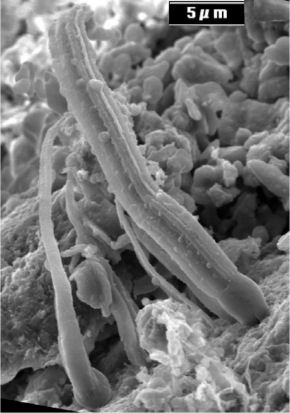
In compiling his paper, Hoover used Environmental Scanning Electron Microscopy and Field Emission Scanning Electron Microscopy to investigate the internal surfaces of the meteorites. Images from these scans show large complex filaments that resemble known genera and species of trichomic cyanobacteria and other trichomic prokaryotes.

Additionally, Hoover also detected filaments that exhibited structures consistent with the specialized cells and structures used by cyanobacteria for reproduction, nitrogen fixation and attachment or motility.

To test whether the bacterial remains were truly indigenous to the meteorites, Hoover used energy dispersive X-ray spectroscopy (EDS) to measure nitrogen content. He found that the nitrogen content of the meteorite filaments was almost always below the detection limit of the EDS detector. This is significant as EDS analysis of terrestrial minerals and biological materials indicate that nitrogen remains detectable for thousands of years. Since nitrogen is undetectable in the meteorite fossils, Hoover argues they are indeed indigenous, rather than modern terrestrial biological contaminants that entered the meteorites after arrival on Earth.

"This finding has direct implications to the distribution of life in the cosmos," Hoover concluded.


Read More

http://www.scienceagogo.com/news/20110206212725data_trunc_sys.shtml

Friday, March 4, 2011

NASA's Glory satellite launch fails


The Taurus XL rocket built by Orbital Sciences failed to lift NASA's Earth-observation satellite into orbit and plummeted into the Pacific Ocean. The failed mission cost $424 million.

A rocket, standing more than nine stories tall, blasted off from Vandenberg Air Force Base but failed to lift a NASA Earth-observation satellite into orbit and plummeted into the Pacific Ocean. The failed mission cost $424 million, the space agency said.

It is the second consecutive time that NASA has encountered the problem with the Taurus XL rocket built by Orbital Sciences Corp. of Dulles, Va.

NASA scientists believe the launch on Friday failed because the satellite's protective cover, which opens like a clamshell, did not separate as expected.

"Obviously, this is a terrific disappointment and we feel bad for letting NASA … down," said Barron Beneski, an Orbital Sciences spokesman. "People have dedicated years of their lives into this."

NASA's Glory satellite was designed to help scientists understand how the sun and particles of matter in the atmosphere called aerosols affect the Earth's climate. It was also built by Orbital in Virginia.

Everything seemed to go as planned from Vandenberg, located northwest of Santa Barbara, shortly after the 3:09 a.m. PST liftoff. Three minutes later, the cover was supposed to separate and the satellite was expected to enter orbit. That didn't happen.

"We failed to make orbit," Omar Baez, NASA's launch director, said at a news conference. "All indications are that the satellite and the rocket are in the southern Pacific Ocean somewhere."

It marks the second time in a row that NASA has encountered a problem with the protective shell separating from the satellite. The space agency's previous Taurus XL launch attempt on Feb. 24, 2009, carrying another Earth science spacecraft, dubbed the Orbiting Carbon Observatory, also failed to reach orbit because of lack of separation.

Orbital Sciences and NASA investigated the matter and believed that they had identified the problem. On Friday, Orbital Sciences said it was too early to tell whether the latest failure was linked to the issue they previously encountered.

"Understandably, people are thinking this is the same problem all over again," Beneski said. "It's too early to tell. We have to evaluate all the data before we can say that's true."

Although the satellite probably will never be recovered, sensors on the spacecraft captured enough information for engineers to identify a problem, Beneski said.

Since 1994, Orbital Sciences has attempted to launch a Taurus XL rocket a total of nine times. It has been successful in six of those attempts.

"That's not a great record," said Marco Caceres, senior space analyst for research firm Teal Group Corp. "Part of the problem is that the Taurus just doesn't launch enough. It's hard to develop a launch rhythm if the rocket is only going up once every few years."

Both Orbital Sciences and NASA plan to create investigation boards made up of engineers and scientists to evaluate the cause of Friday's failure.

NASA has another Earth sciences satellite slated to launch on a Taurus rocket in 2013. The space agency plans to wait and see the results of the investigation board before it goes forward with the launch.

Orbital Sciences shares lost 30 cents, or about 2%, on Friday, closing at $18.17.

Also Friday, the launch attempt of the U.S. Air Force's X-37B Orbital Test Vehicle from Cape Canaveral, Fla., was scrubbed because of bad weather. The launch was rescheduled for Saturday at 1:09 p.m. PST.


Read More

http://www.latimes.com/business/la-fi-satellites-20110305,0,1035837.story

Wednesday, February 2, 2011

NASA finds dozens of planets that might support life


The Kepler mission has discovered 1,235 possible planets, including 54 in the 'Goldilocks range' — just far enough from their stars to be neither too hot nor too cold for liquid water.

A catalog of possible planets discovered far out in space includes more than 50 candidates that could possibly support life, NASA scientists said Wednesday. If, as expected, most of the planets are confirmed as real, the Kepler mission — now finishing its second year — would nearly triple the number of planets discovered over the last decade and a half.

With 1,235 planetary candidates surrounding a collective 997 stars in an area 500 to 3,000 light-years away, the tally to date provides a wealth of data for scientists to sift through in search of Earth-like planets.

"This is the first step in understanding the possible distribution of life in our galaxy," said William Borucki, principal investigator for the Kepler mission at NASA Ames Research Center in the Bay Area's Moffett Field.

He noted that of the candidate planets, 54 reside in the so-called Goldilocks range — in a "just right" distance from its star to be neither too hot nor too cold to permit liquid water and therefore the presence of life as we know it. Five of those 54 are close to Earth's size.

The space-based Kepler telescope, which circles the sun trailing Earth's orbit, observes more than 155,000 stars and every half-hour measures the amount of light they give off. If a planet is orbiting a star, it is detectable because it temporarily blocks a bit of light each time it crosses in front of its star.

By measuring how much of a star's light a planet blocks during such transits, scientists can deduce what the planet's radius must be. By tracking how frequently each planet transits, they can determine how closely it orbits its star.

And in the case of very massive planets, researchers can estimate a planet's mass based on how much a star "wobbles" in response to the planet's gravitational pull.

Prior to Kepler, scientists had confirmed the existence of more than 500 planets outside our solar system, which are known as exoplanets. Among the 1,235 new candidates, 68 are Earth-sized, 288 are super-Earth-sized (up to about 10 times the Earth's mass), 662 are Neptune-sized and 165 are about the size of Jupiter, the largest planet within our solar system, Borucki said. Nineteen are up to twice the size of Jupiter.

UC Santa Cruz planetary scientist Jonathan Fortney, one of dozens of scientists on the Kepler team, helped identify a particularly rare find — six planets orbiting around an 8-billion-year-old star named Kepler-11, which is about 2,000 light-years away and much like our sun in size.

The findings were reported Wednesday in the journal Nature.

Unusually, five of the six planets were closer to Kepler-11 than Mercury is to the sun. Even stranger, the six planets orbit the star on the same plane, Fortney said; the star system, he said, is "flatter than a CD."

This flatness allowed all six planets to be seen crossing Kepler-11. It also helped the scientists to measure how the planets' gravitational tugs affected each other's orbits, and thus to determine the mass of each one. There may be many more planets in this system that have not been detected, scientists said.

Because having multiple planets in one system provides a richer detail on a solar system, the Kepler-11 system "tells us something very fundamental about planet formation, about the kind of galaxy we live in, the kind of planets around us," Fortney said.

The Kepler mission is scheduled to continue for another year and a half, and is expected to cost about $600 million.

Daniel Apai, an astronomer at the Space Telescope Science Institute in Baltimore, called the Kepler-11 system's known structure and dynamics "amazing."

"Kepler is in many ways pushing us to rethink planet formation," Apai said.

Read More

http://www.latimes.com/news/science/la-sci-kepler-planets-20110203,0,814122.story


Tuesday, December 14, 2010

'Ice volcano' identified on Saturn's moon Titan


Scientists think they now have the best evidence yet for an ice volcano on Titan, the largest moon of Saturn.

The Cassini probe has spotted a 1,500m-high mountain with a deep pit in it, and what looks like a flow of material on the surrounding surface.

The new feature, which has been dubbed "The Rose", was seen with the probe's radar and infrared instruments.

Titan has long been speculated to have cryovolcanoes but its hazy atmosphere makes all observations very difficult.

Researchers are now wondering how active this mountain might be, and what sort of lava it could spew.

"Much of Titan's outer material is water-ice and ammonia, and so that's certainly one possible material that could melt at low temperatures and flow on the surface," explained Dr Randy Kirk, a Cassini radar team-member from the US Geological Survey (USGS).

"But there's a lot of organic material in the atmosphere, and deposited from the atmosphere, and maybe coming up from the interior in the form of these volcanoes. [This material could be] waxy or even plasticy," he told BBC News.

Dr Kirk was speaking here at the American Geophysical Union (AGU) Fall Meeting, the largest gathering of Earth scientists in the world.

There have been previous claims for ice volcanoes at Titan, but these have never won universal support. Scientists have continued to look however because it is considered an excellent candidate given its frigid conditions: the surface temperature is about minus 180 Celsius.

Dr Kirk and colleagues hope their new data will convince even their sternest critics that a positive identification has now finally been made.

The putative volcano is sited just south of Titan's equator in a sea of sand dunes referred to as Sotra Facula.

The radar instrument on Cassini is able to see through the moon's haze and establish the local topography - scientists can build a 3D model of the ground. The infrared instrument on the probe, on the other hand, can gather some information on the variation in composition of the surface materials. Taken together, Dr Kirk's team says, the two views put forward a compelling case.

"We've seen a mountain that has a crater in, that flows of material coming out and spreading across the surface at some time in the past; and in fact when we looked in more detail in 3D we found that there was more than one volcano in this area. And that's actually very common in volcanic areas of the Earth and other planets."

Jeffrey Kargel, a planetary scientist at the University of Arizona, Tucson, is not connected with the Cassini mission. He told the meeting The Rose was the most likely volcano he had yet seen on Titan.

He said that if the lavas were rich in hydrocarbons, they could have the look of softened asphalt, candle wax or even polyethylene.

"There are many unanswered questions and intriguing possibilities," he told reporters.

"Is Sotra the source of Titan's atmospheric methane? Is cryovolcanism still active at Sotra or elsewhere on Titan? What is the cryovolcanic substance? Is cryovolcanism there explosive or quietly effusive? Might cryo-lavas have dredged up indications of fossils or chemical remains of sub-surface life?"

The Cassini-Huygens mission is a co-operative project of Nasa, the European Space Agency (Esa) and the Italian space agency (Asi).

Read More

http://www.bbc.co.uk/news/science-environment-11996621

Thursday, December 9, 2010

Commercial rocket launch, splashdown a success


The first of what NASA hopes will become a fleet of privately built rockets and capsules successfully launched from Cape Canaveral on Wednesday morning in a major test for the commercial space industry. After twice circling the globe, the capsule landed in the Pacific as planned three hours later.

The successful splashdown marks the first time that a commercial company launched a rocket and capsule into space and brought the spacecraft safely back to Earth.

The landing was announced on the Twitter account of Space Explorations Technologies Inc., or SpaceX, the start-up company that has pioneered the new era of commercial space travel. A recovery team was at the capsule - built to be reusable - within 20 minutes of splashdown, suggesting that it was on target for its landing.

The Falcon 9 rocket built by SpaceX was on its first full test flight. Its Dragon capsule was empty and unmanned, but plans are to fill it in the months ahead with cargo - and ultimately with astronauts - to transport to the International Space Station.

NASA's deputy administrator, Lori Garver, said after the splashdown that the administration was delighted by the success and that "the path to and from the space station is going to be this: a partnership between private companies and government to get the job done most effectively."

The flight is an important moment for President Obama and his administration's hopes to expand commercial space efforts in low-Earth orbit as a way to free up NASA funds for missions to send astronauts much deeper into space and ultimately to Mars.

SpaceX, founded in 2002 by Elon Musk and run from California, successfully launched a Dragon 9 rocket in June, but that test was done without a real capsule. Musk, who founded and sold the online payment company PayPal and is also behind development of the Tesla electric car, said before launch that he rated the chances for a successful mission at about 60 percent.

After the splashdown, Musk said he was in "semi-shock."

"There's so much that can go wrong and it all went right," Musk said. His next challenge is a Dragon capsule rendezvous with the space station that is scheduled for next year.

The Falcon 9 rocket is a pipsqueak compared with the space shuttle it will partially replace - measuring 157 feet with the capsule and weighing 735,000 pounds. The much larger shuttle was needed to fly parts up to the $100 billon international space station, but the fleet is being retired because of its age and because its job is largely done. Each shuttle flight costs about $1 billion, while the entire NASA contribution so far to SpaceX has been $253 million, according to NASA officials.


Read more:
http://www.sfgate.com/cgi-bin/article.cgi?f=/c/a/2010/12/08/MN0G1GNUHS.DTL#ixzz17bNf5g6y

Tuesday, November 30, 2010

Secret Military Mini-Shuttle Headed Back to Earth


A miniature robotic space shuttle launched from Cape Canaveral in April has completed a nine-month classified mission for the military and will be headed for a landing as early as Friday, Air Force officials said on Tuesday.

The vehicle, known as the Orbital Test Vehicle or X-37B, is expected to land at Vandenberg Air Force Base in California between Friday and Monday, depending on weather and technical considerations, the Air Force said in a statement.

The project, started by NASA in the late 1990s and later adopted by the military, is intended to test technologies for a next-generation space shuttle.

The military is looking at the space plane as a way to test new equipment, sensors and material in space, with the intention of incorporating successful technologies into satellites and other operational systems.

The Air Force imposed a news blackout on the X-37B's activities while in orbit, though it was tracked by amateur satellite-watchers throughout its nine-month mission.

The X-37B looks like a space shuttle orbiter, with a similar shape and payload bay for cargo and experiments.

But it measures 29 feet, 3 inches in length and has a 15-foot (4.5-meter) wing span, compared to the 122-foot (37-meter) orbiters with wing spans of 78 feet.

Unlike NASA's space shuttles, which can stay in orbit about two weeks, X-37B is designed to spend as long as nine months in space, then land autonomously on a runway.

The Air Force plans to fly its second X-37B vehicle this spring. The vehicles were built by Boeing Co's advanced research lab, Phantom Works.

Read More

http://abcnews.go.com/Technology/wireStory?id=12280571

Wednesday, November 24, 2010

Discovery launch pushed to Dec. 17 or later


Discovery's final launch will not be before Dec. 17 after NASA decided more tests were needed before launching the shuttle into space for one last mission.

The decision to push the launch closer to Christmas came Wednesday after the agency reviewed repairs and engineering evaluations associated with cracks on two U-shaped aluminum brackets on the shuttle's external tank.

"The managers decided the analysis and tests required to launch Discovery safely are not complete," it said. "The work will continue through next week."

As a result, the agency rescheduled its launch status meeting to Dec. 2. It was originally planned for Nov. 29.

NASA also said that if the Discovery is cleared for launch on Dec. 17, the preferred time is approximately 8:51 p.m. ET.

The flight was grounded earlier this month after a hydrogen gas leak was initially discovered during fuelling.

The 39th and final flight of Discovery was originally due to launch on Nov. 1, but several technical delays and one weather-related delay forced NASA to push the flight back.

The shuttle will carry seven astronauts and space station supplies during its mission


Read more:
http://www.cbc.ca/technology/story/2010/11/24/discovery-launch-delay.html#ixzz16GVxtZFb

Tuesday, November 2, 2010

NASA’s Quest to Send a Robot to the Moon

For $150 billion, the National Aeronautics and Space Administration could have sent astronauts back to the Moon. The Obama administration judged that too expensive, and in September, Congress agreed to cancel the program.
NASA
I, ROBOT A rendering of a Robonaut 2. A NASA team says that it could have it on the Moon within a thousand days. 

For a fraction of that — less than $200 million, along with about $250 million for a rocket — NASA engineers at the Johnson Space Center in Houston say they can safely send a humanoid robot to the Moon. And they say they could accomplish that in a thousand days.

The idea, known as Project M, is almost a guerrilla effort within NASA, cooked up a year ago by Stephen J. Altemus, the chief engineer at Johnson. He tapped into discretionary money, pulled in engineers to work on it part time, and horse-traded with companies and other NASA units to undertake preliminary planning and tests. “We’re doing impossible things with really very little, if any, money whatsoever,” Mr. Altemus said.
A humanoid dextrous robot — at least the top half — already exists: Robonaut 2, developed by NASA and General Motors, is packed on the shuttle Discovery, scheduled for liftoff on Wednesday.

Bound for the International Space Station, it will be the first humanoid robot in space. It is to help with housekeeping chores at the space station as NASA learns how astronauts and robots can work together. Eventually, an upgraded Robonaut is to take part in spacewalks. 

Project M also draws on other NASA projects that were already under way, including rocket engines that burn liquid oxygen and methane — a cheap and nontoxic fuel combination — and an automated landing system that could avoid rocks, cliffs and other hazards. 

Integrating the technologies into working prototypes sped up development. “That’s the magic,” Mr. Altemus said. “A lot of times technologies end up in the lab cooking, and then there’s this valley of death where they never get to maturation or to flight.” 

Project M’s planners say that a robot walking on the Moon would capture the imagination of students, just as the Apollo Moon landings inspired a generation of scientists and engineers 40 years ago.
“I think that’s going to light a few candles,” said Neil Milburn, vice president of Armadillo Aerospace, a tiny Texas company working on Project M. 

But as NASA’s attention turns away from the Moon — “We’ve been there before,” President Obama declared in April — the prospects for sending a robot there are at best uncertain.The quandary over Project M encapsulates many of the continuing debates over the future of the space agency: What should NASA be told to do when there is not enough money to do everything? What is the best way to spur advances in space technologies? And given the costs and dangers, how important is it to send people into space at all? 

“The tricky part is whether it fits in the agency’s framework for exploration,” Mr. Altemus said.
Last year, a blue-ribbon panel was reviewing NASA’s human spaceflight program, in particular an ambitious project called Constellation to send astronauts back to the Moon. Although NASA has spent $10 billion on Constellation, most of the program is to be canceled when Congress finishes work on the 2011 budget.

Mr. Altemus, for one, was frustrated by criticism of NASA that emerged during the Constellation debate and elsewhere. “I always felt like our organization was a Ferrari, and we were never allowed to drive with our foot on the gas,” he said. “We were kind of at idle speed all the time.”

Talking to his son at his kitchen table, Mr. Altemus wanted something that was exciting but not so big that it would require years of deliberation. The idea popped into his head: a walking robot on the Moon, one that could send back live video, in a thousand days.

Mr. Altemus took it to his staff the next day, telling them, “Let’s do something amazing.”
He recalled: “I said, ‘Will you get behind me if I put this into the organization? I don’t know if we can do it. I don’t know if we’ll get the money for it or will get approved — let’s try.’ And so we just started, and it caught like wildfire.”

Sending a robot to the Moon is far easier than sending a person. For one, a robot does not need air or food. And there is no return trip.