Showing posts with label disaster news. Show all posts

Tuesday, December 14, 2010

Dozens feared dead in Christmas Island asylum-seeker boat crash


WITNESSES on Christmas Island have told of a "major tragedy" after an asylum-seeker boat crashed into cliffs this morning, with many feared dead.

Government sources told The Australian Online they believed about 70 people were aboard the boat.

Sky News reported that 41 had been confirmed rescued so far but the rest were unaccounted for.

It is understood that most of those on board were Iranians and Iraqis.

Locals have told The Australian that the boat came into local waters some time this morning without being detected by authorities.

But it was smashed into rocks in heavy seas at about 6am near Flying Fish Cove.

Witnesses said people were being washed up on the jagged cliffs near the island’s old hospital and police station.

Local electrician Michael Foster described the surging water at the bottom of the cliffs as being like the inside of a washing machine.

He speculated the boat may have lost power as it approached Flying Fish Cove, at the northern end of the island, in the pre-dawn light - with rough seas then smashing the vessel against the jagged cliff face.

"I would suggest I saw about 30 [people] who didn't make it," he said. "The mood on the island is a bit disarrayed - there are people who have never seen a body before."

Witness Phillip Stewart told Sky News that he saw the boat being dashed by waves and that while some people survived he believed up to 50 people had died.

Locals have told The Australian that the boat came into local waters some time this morning without being detected by authorities.

Dramatic pictures show the vessel, with women and children on board, being picked up by the waves and smashed into cliffs near Flying Fish Cove earlier today.

Navy ribs were used to pick up some survivors from the heavy seas after the vessel broke up.

The Australian Federal Police have released a statement on the boat crash, revealing that they are responding to a “maritime incident involving a suspected illegal entry vessel on Christmas Island”.

One local resident who lives nearby, but who did not want to be named, said she heard screams at 6am and went down to the cliffs where she saw people hanging on to the boat as it was being pushed towards the cliff in huge seas.

"It almost tipped,” the woman said. “One woman was holding a small child.” The boat broke up soon after that, she said.

Phone calls went out around the island and hundreds of people went to the cliffs, throwing life jackets, ropes and anything else that floated out to the asylum-seekers.

Teacher Robyn Stephenson said it was impossible to swim to swim to shore there.

“They were being washed into the cliffs, the really sharp cliffs,” Ms Stephenson said.

“There were phone calls all around to people to get down and help. As soon as the people in the water saw the people on the cliffs they started trying to get into the cliffs and the people on the land were saying move out because three’s huge waves at the moment.”

Local resident Allison Millcock said she arrived at the cliffs at 8am, by which time she could only see wood chips floating in the water. “I’ve been told the refugees got into trouble around 6am . At around 8am there were only woodchips in water. I’m told about 20 were rescued. It’s only rough number."

A contractor with the council, manning a roadblock, said only federal police, hospital staff other emergency personnel and staff from security contractor Serco were being allowed down to the scene.

He said the navy was trying to bring survivors 6km around the other side of the island to calmer waters at Lilly Beach.

Pamela Curr, campaign coordinator at the Asylum Seeker Resource Centre, told The Australian Online she had received a text message from someone on the island saying that at least 30 people had been saved.

She said she was informed that people had been in the water since early this morning in 3m swell.

“What happened that they allowed this boat to come in the rough seas?” she asked. “We need answers.”

Mr Stewart told Sky that waves of 4-5 metres were washing over the steep limestone cliffs today. It is the height of storm season for the area off Australia's northwest coast.

"They were in a surge zone," he said, "one of the most dangerous places to be.”

He said many people were being struck by flotsam and jetsam.

Christmas Island shire president Gordon Thomson told The West Australian he understood it was a “very bad situation” but he was unclear of the details.

Opposition immigration spokesman Scott Morrison told The Australian Online: “If this is indeed true it highlights once again how very dangerous this business is of people coming by boat and why it is so important again that we do everything possible to ensure that these boats don’t come in this way.

“It’s extremely important that the government make a statement at the earliest opportunity to confirm what has taken place. Because I mean naturally there’ll be all sorts of unofficial reports.

“I think it’s important that some clarity is given to the events as soon as possible. This is a very upsetting event and potentially a very significant tragedy.”

The AFP has stressed that its response is ongoing and its priority is to ensure the safety of “all involved” in the incident.

“The AFP and partner government agencies on Christmas Island are coordinating the immediate response to this incident”.

It will release a more detailed statement shortly.

A spokesman for Customs and Border Protection issued a brief statement a short time ago.

“There is an ongoing situation which involves a rescue of people off Christmas Island. Our paramount priority is the safety of all involved. A further statement will be provided later in the day,” he said.

Read More

http://www.theaustralian.com.au/news/dozens-feared-dead-in-christmas-island-asylum-seeker-boat-crash/story-e6frg6n6-1225971549420

Sunday, December 12, 2010

5 dead, 20 rescued, 17 missing after ship sinks in Antarctic waters


Five people died and 20 were rescued after a South Korean fishing vessel sank Monday in frigid ocean waters about 1,000 nautical miles north of McMurdo Station in Antarctica, a spokesman from a New Zealand maritime organization said.

A time-sensitive search was underway for another 17 people who were missing, said Maritime New Zealand spokesman Ross Henderson. While the ship sank in the Southern Hemisphere's late spring, water temperatures are just 2 degrees Celsius (35.6 degrees Fahrenheit), meaning crew members likely could only survive no more than 10 minutes before succumbing to hypothermia, authorities said.

The 58-meter (190-foot) fishing trawler, the No. 1 Insung, went down about in a remote swatch of the Antarctic Ocean some 1850 km (1150 miles) north of McMurdo, a U.S. research center on the tip of Ross Island.

Two New Zealand fishing vessels nearby were at the scene, with three South Korean trawlers closing in to lend assistance, Henderson said from Wellington, New Zealand. Authorities called on all other nearby ships likewise to go to the area to help.

There was no emergency radio call before the incident, and it is still not clear what happened, Henderson said.

The seas in the area were relatively calm, with one meter (about three feet) high swells and a light westerly wind, he added.


Read More

http://edition.cnn.com/2010/WORLD/asiapcf/12/12/antarctica.ship.sinks/

Wednesday, November 24, 2010

Could take months to recover bodies of NZ miners


New Zealand held a national day of mourning Thursday for the 29 victims of its worst mining disaster in decades, while officials said it could be weeks or months before their bodies are recovered from deep underground.Recovery teams were prevented from entering the mine by high levels of potentially explosive methane and other toxic gases that are blamed for two huge blasts inside the Pike River Coal mine.

The first explosion last Friday left the 29 men missing up to 1 1/2 miles (2 kilometers) underground, and officials insisted there was hope for them. After Wednesday's second blast, police and mine officials said no one could have survived.New Zealand's mining industry is small and generally considered safe. The tragedy deeply shocked the country and devastated families who — buoyed by the survival tale of Chile's 33 buried miners — had clung to hope that their relatives could emerge alive.Mine operators said Thursday they were determined to bring out the men's bodies.

"I still want them back and their families want them back and we'll be doing everything we can to make that happen. My love and support are with those guys," said Peter Whittall, the CEO of Pike River Coal.But testing showed gas levels surged again soon after Wednesday's explosion and that another explosion was possible. Methane is leaking from the coal seam, and a smoldering fire somewhere in the mine is producing other toxic gas and a potential ignition source, officials say.

Mining experts were planning on expelling oxygen from the mine that could fuel a further explosion. One option was to pump inert gas into the mine to push the oxygen out, another was to seal the mine up to stifle any burning then enter when it was safe, Whittall said.The recovery effort could take weeks, he said.

Prime Minister John Key said previous experience overseas suggests the operation could take months.Key met again with relatives of the victims on Thursday, and promised them a thorough investigation."They have accepted that their loved ones are gone — but they want answers," Key told reporters.Flags flew at half-staff across New Zealand, and special church services were held for people wanting to show respect for the miners.

In Parliament, lawmakers wearing black passed a condolence motion.It emerged Thursday that a rescue team was readying to go into the mine on Wednesday for the first time shortly before the second blast. A team was in full gear and ready to begin searching when gas levels suddenly spiked and the mission was called off. The explosion followed soon after, with no warning."She was all go" for the rescue effort, said Geoff Valli, whose brother Keith was among those killed.

"They explained just how close they were to going in. It was bloody scary. It could have been so much worse," he told National Radio.Laurie Drew, whose son Zen died in the mine, said the families wanted their loved ones' remains to help grieve."Hopefully it doesn't drag on too long to get the closure that all the families really need," he said.

A series of inquiries, including a formal Commission of Inquiry and police and coroner's investigations, are being launched into the mining disaster, one of New Zealand's worst.The country has had 210 deaths in 114 years in mines. New Zealand's worst mine disaster was in 1896, when 65 died in a gas explosion at a mine on the same coal seam as the latest tragedy.

The most recent was in 1967, when an explosion killed 19 miners in a mine near the Pike River site. A fire in a mine in 1914 killed 43.

Read More

http://ibnlive.in.com/generalnewsfeed/news/could-take-months-to-recover-bodies-of-nz-miners/515711.html

Tuesday, November 23, 2010

New blast: all miners feared dead


Family members in tears after being told the miners are dead.


A second explosion has rocked the NZ mine where 29 men are trapped and authorities have told their families that none of them would have survived.

The man in charge of the rescue operation, Superintendent Gary Knowles, said that he was at the mine when the blast occurred, and it was ‘‘horrific’’.

"Unfortunately I have to inform the public of New Zealand that there was another massive explosion underground and based on that explosion no one survived,’’ Superintendent Knowles said.

Superintendent Knowles has broken the news to the families, who were ‘‘distraught’’.

‘‘It is our belief that no one has survived,’’ Superintendent Knowles said.
He said the men had ‘‘perished’’.

"We are now going into recovery mode."


Earlier, it was reported that the possibility that no mine or rescue teams will ever enter the New Zealand mine where 29 men remain trapped is being considered by authorities.

Superintendent Gary Knowles, who is in charge of the rescue operation in Greymouth, said a fire continued to burn inside the Pike River Coal mine and there were concerns about the high levels of methane and carbon monoxide.

Asked whether it would ever be safe for rescue workers to enter the mine, where the miners have been trapped since Friday, Superintendent Knowles conceded that "it may never reach that point".

He also said: "While I can understand [the families'] frustration, we are doing everything possible to go underground. Obviously over time, hopes diminish."

Abandoned mines on New Zealand's west coast continue to burn for decades after they were closed to mining.

The mine's chief executive, Peter Whittall, said the gases that escaped from the bore hole contained carbon monoxide, methane and very little oxygen.

"As we expected, although not as families hoped ... the air that came out of the hole was extremely high in carbon monoxide, very high in methane and fairly low in oxygen," he said.

Sending a rescue team down the mine at this stage would only endanger the lives of rescuers as well as the trapped miners, Mr Whittall added.

"I think everyone in the room knows we’re going to get as many guys out as we can," he said.

"If it’s 29 that’s great, if it’s not, we’ll deal with that."

Drill breaks through

Drilling of a small vertical bore shaft broke through earlier today and hot air and gas rushed up the hole.

"It had hot gas rushing up it and a lot of hot air as well," New Zealand Energy Minister Gerry Brownlee confirmed.

"It will give a very good picture of ... the heat state. They are looking for a heat source.

"It is very significant information to the rescue planning," he told NewstalkZB,

Hat found

A robot sent down into the mine captured footage of a miner's hat with the light still on, Superintendent Knowles said.

"It's pretty amazing that it was still working underground," he said.

A second robot from New Zealand Defence is still in the tunnel but did not have much functioning time left.

A third robot from Australia arrived this morning and would be tested later today, Superintendent Knowles said.

Mr Whittall said officials had a "sobering" meeting with families today.

"There's obviously a very large understanding among the group that the gases we are finding from this borehole ... the length of time ... is making their hopes diminish and making it more difficult for them to hold out that hope that all 29 of those are waiting for us as we have hoped from day one," Mr Whittall, who appeared haggard and drawn, said.

"I certainly hope they're waiting for us down there. I certainly hope I see them again."

After three days of drilling through rugged terrain and dense rock, crews finally broke through to the mine at 7am (5am AEDT) today.

Officials had yet to determine whether a camera could be sent down the bore hole, Mr Whittall said.

Mr Whittall said footage from the first robot had not shown any sign of the miners.

"It doesn't show you anyone is there, it doesn't show you that anyone was there," he said.

Reports four of the miners were in a safer area were not true, Superintendent Knowles stressed.

"A lot of comments you have made are not helpful and distressing for the families," Superintendent Knowles said during a heated exchange with reporters.

Read More

http://www.smh.com.au/world/new-blast-all-miners-feared-dead-20101124-1862p.html


Monday, November 15, 2010

China police chief calls for Shanghai fire inquiry


The apartment block continued to smoulder throughout the night

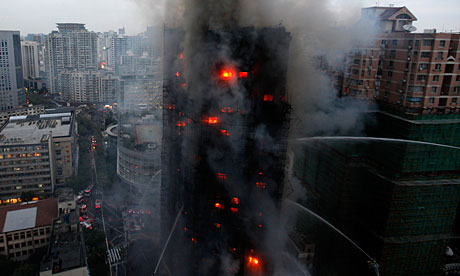
China's police chief has called for a thorough inquiry into the cause of a fire in a Shanghai high-rise building that killed at least 49 people.

Public Security Minister Meng Jianzhu said those responsible would be punished, state media reported.

The 28-storey block of flats which housed teachers, many of them retired, was being renovated when it caught fire on Monday afternoon.

Firefighters battled for several hours to bring the blaze under control.

More than 80 fire engines were brought in and hoses had to be set-up on top of a nearby building to reach the flames.

Chinese TV showed people clinging to bamboo scaffolding surrounding the building as they waited to be rescued.

Mr Meng flew into Shanghai from Beijing in the early hours of Tuesday to guide rescue and relief work.

He urged local authorities to help find those still missing and to ensure the public received up-to-date information about what happened, Xinhua news agency reported.

Mr Meng said lessons should be learned to prevent similar accidents and announced that an investigation team would report directly to the Chinese cabinet.

BBC Shanghai correspondent Chris Hogg says the minister appeared to be trying to pre-empt concerns of a cover-up or an attempt by those responsible to escape justice.

According to one witness the fire started in a pile of construction materials.

It spread quickly up the bamboo scaffolding and then set the building alight.

Flames could be seen licking the sides of the building, and a thick pall of smoke was visible several miles away.

Some survivors escaped by clambering down the scaffolding, while others struggled down smoke-filled stairwells.

Blazing apartment building. Image: Nick Garrett
More than 80 fire engines were brought in

Witnesses reported distressing scenes at hospitals where relatives desperately searched for missing loved ones.

At Jing'an hospital, Wang Zhiliang, 65, scoured a list of survivors for his daughter's name.

"She called her husband and said: 'It's on fire! I have escaped from the 22nd floor to the 24th floor', but then the phone got cut off and that was the last we heard from her," he said.

More than 150 families lived in the block. Officials said more than 100 people had been rescued.

Local hospitals said they had treated at least 90, some of them seriously injured.

The number of casualties may increase as rescuers and investigators search the ruins of the apartment block, our correspondent says.

Jing'an district government is housing residents affected by the fire in nearby hotels, Xinhua reported.

One of China's commercial hubs, Shanghai has some 20m residents and has seen a frenzy of construction work in recent years.


Read More

http://www.bbc.co.uk/news/world-asia-pacific-11762817

Thursday, November 4, 2010

Continued Blasts From Mount Merapi Close Shops, Schools

An Indonesian man watches as Mount Merapi erupts in Kepuharjo, Yogyakarta, 3 Nov. 2010.
An Indonesian man watches as Mount Merapi erupts in Kepuharjo, Yogyakarta,
Ash from Indonesia's Mount Merapi has forced schools and restaurants to shut as eruptions grow more powerful. People say they are used to living with the volcano, but continued blasts are wearing them down.

Thick ash blankets trees and roads far from the summit of Mount Merapi. The volcano has belched hot gas and debris for more than a week, and increasingly forceful eruptions have sent ash raining down on communities up to 25 kilometers away.

Many of those who live on the volcano's slopes are used to sweeping ash from their floors and washing thick, grey soot from their crops and trees. But people who live in Jogjakarta say they have never seen ash this thick come this far.

Budi Utomo runs his family's guesthouse in Slemen. He says some foreign visitors have cancelled reservations, and he worries what will happen if the volcano's remains so active.

He says he sees that now in Jogjakarta it is too dusty and disturbing to people on holiday. For local and foreign tourists, and the people who live here, everyone is uncomfortable.

Utomo says the people of Jogjakarta understand Merapi's history and are not too afraid of its eruptions, which come every three or four years. The people in his neighborhood help each other sweep out the ash, and inquire about the health of friends and family.

But the ash is something they cannot avoid. Daily weather reports refer to ash rain, which hits different sections of the city depending on the wind direction. When a neighborhood gets hit, children get a break from school since the thick dust clouds can lead to eye infections and respiratory problems.

Utomo is not sure how badly the eruptions will hurt businesses, because while some tourists stay away, others have come to see the exploding volcano. He says a few visitors have asked him to help arrange trips up Merapi so they can get a closer look.

At his guesthouse the ash has put pressure on the staff cleaning the pool and dinning area. Everyone wears green surgical masks.

The masks are a staple at the evacuation camps as well. Doctors and relief workers worry that people will start to become sick if they breathe the dusty air for too long.

Children are the most vulnerable, and volunteers have started daily check-ups to make sure those in the camps stay healthy. Dr. Ai Alam, from the Indonesian Red Crescent Society, runs the health post at the Kepuharjo shelter.

The doctor says most people here have been suffering from respiratory infections, coughs, fevers, and eye infections and irritation. Around 100 people a day are getting sick or seeking treatment.

The 2,000 evacuees at Kepuharjo were living closest to the crater. Aside from the physical effects of the eruptions, doctors also worry about whether they suffered longer lasting psychological trauma.

Wednesday's blast, the biggest since eruptions began October 26, spewed out ash that quickly covered shelves in the open-air shops. Vibrant markets open one day are quiet the next. But aside from markets and restaurants most businesses are running as usual.

Government officials say they do not expect the volcano to affect the economy. And airlines that were grounded on Tuesday have resumed regular flight schedules.

The Ministry of Tourism's Web site says it is monitoring the volcano and warns visitors that it remains on high alert. But it also assures them that Jogjakarta is still safe and open for tourists.

Wednesday, November 3, 2010

Indonesia Races to Evacuate Mount Merapi After Biggest Eruption


Indonesian rescuers raced to evacuate hundreds of people around Mount Merapi in central Java as they extended the minimum safety distance from the volcano following its biggest eruption since the Oct. 26 blast.

The safety distance has extended to 15 kilometers (9.3 miles) from 10 kilometers, with around 3,000 people still trapped inside the new danger zone, Oka Hamid, a spokesman at Red Cross Indonesia’s Yogyakarta branch said. Heavy rain and fog obscure the direction the hot ash cloud is moving, making it difficult to identify which area to evacuate first, he said.

“We have to work fast,” Hamid said by telephone today. “We’re using trucks, motorcycles, anything that can move people to a safer distance.” Indonesian soldiers are helping with the evacuation, he said.

Merapi, which means mountain of fire, may release clouds of hot ash for about two months, Subandriyo, an official at the country’s Volcanology and Geology Disaster Mitigation Center, said. The death toll from the eruptions since Oct. 26 reached 42, Agam Ferdhatama, an official the National Disaster Management Agency said today.

Indonesia is battling to recover from two disasters that struck the Southeast Asian nation within a day apart of each other. On Mentawai Islands off the west coast of Sumatra, relief workers are focusing on nursing and providing shelter for the survivors of a magnitude 7.5 earthquake and tsunami that struck the island chain Oct. 25, Ade Edward, operational head at the West Sumatra Regional Disaster Management Agency, said.

“Military and police personnel are already at villages with good transportation access,” Edward said by phone today from the West Sumatra provincial capital, Padang. “They will start building non-permanent houses there.”

The death toll from the Oct. 25 tsunami in Mentawai was revised down to 427 today from 431 yesterday, with 75 missing, Ferdhatama said.

Monday, November 1, 2010

Tropical Storm Tomas triggers $12.8 million insurance payout


The disaster pooling facility, launched several years ago with the support of the World Bank and other donors, will pay insurance losses to Barbados, Saint Lucia, St Vincent and the Grenadines and Grenada.

Preliminary calculations based on CCRIF's modeled losses will see the facility pay out $8.5 million for Barbados, $3.2 million for Saint Lucia, and $1.1 million for St Vincent and the Grenadines.

"Under the terms of CCRIF policies, a final loss and payout calculation will be undertaken on 13 November, with the National Hurricane Center data available at that time used as input to the loss models. Payouts will be made as soon thereafter as possible," CCRIF said in a statement.

Tomas remains an active storm and could further impact CCRIF-covered countries, the facility said.

Tomas was downgraded to a tropical storm from a Category 1 hurricane, but the National Hurricane Center said it may regain strength early this week as it passes south of the Dominican Republic and Haiti, where more than one million survivors of a January 12 earthquake are living in sprawling tent camps.

As Tomas churned over the open Caribbean sea, officials appealed to Haitians in tent camps to start evacuating, encouraging them to travel to the homes of family or friends.

In January, CCRIF paid $8 million to Haiti after the devastating earthquake triggered the country's earthquake coverage.