Showing posts with label wildlife. Show all posts

Sunday, March 20, 2011

Mystery surrounds death of Knut the celebrity polar bear at Berlin Zoo


Knut, the polar bear cub, has its first public appearance with his keeper Thomas Doerflein in the Berlin zoo and (inset), is seen floating in the pond on his enclosure after dying of unknown causes at the weekend.


BERLIN - Germany was in mourning yesterday for Knut, the celebrity polar bear that died mysteriously in Berlin Zoo on Saturday.

Hundreds of people, including many children, made their way to the zoo yesterday to leave flowers at the compound of Knut, 4, a bear that became a posterboy for global warming.

The news spread across the world through Twitter and Facebook. "We have had condolences from Australia, New Zealand and Honolulu," said Heiner Kloes, the zoo's chief bear keeper. He added that many German children had collapsed on hearing the news and that newspapers devoted pages advising parents how to break the news.

"Everyone is just in shock here," said Claudia Bienek, a spokeswoman for the zoo.

Visitors had watched on Saturday as Knut writhed in the moat of his compound, and then lay half submerged in the water.


"It had been a completely normal day," said Mr Kloes. "He had just been with the female bears. After they had been shut away, he strolled around the enclosure, appeared to suffer a spasm and slipped into the water, where he died."

A post-mortem examination is to be held today and authorities are considering holding a formal funeral to allow Berliners to say farewell. Whatever the cause of Knut's early death, it is expected to lead to a fierce debate about animals in zoos.

"Knut's short and distressed life shows us again that polar bears do not belong in zoos," said Wolfgang Apel, of the German animal protection association. Peta, another animal welfare group, said last year that Knut was suffering from severe behavioural disorders, and was unable to relate to other bears. There was even a suspicion that the bear could have depression or bipolar disorder.

Knut was rejected at birth by its mother, an East German circus bear, and hand reared at the zoo. The animal's popularity was used to highlight the disappearance of polar bears because of the melting Arctic ice caps. The bear made the cover of Vanity Fair, and generated millions for the zoo.

"He was a star," said Klaus Wowereit, the Mayor of Berlin last night (Sunday). "A star who died too early."

Read More

http://www.theaustralian.com.au/news/world/mystery-surrounds-death-of-knut-the-celebrity-polar-bear-at-berlin-zoo/story-e6frg6so-1226025378763

Monday, February 14, 2011

Malaysia tiger mauling stopped by wife with soup ladle


Tigers do not usually attack humans - nor they do often have to fend off soup ladles


A man has been rescued from a near-fatal attack by a tiger in northern Malaysia by his wife.

She entered the fray wielding a wooden soup ladle at the tiger - which fled.

Tambun Gediu, now badly lacerated and recovering in hospital, had tried hitting the tiger away in vain and says his wife saved his life.

Wildlife rangers plan to track the tiger and send it further into dense, unpopulated jungle in the the northern state of Perak.

"I was trailing a squirrel and crouched to shoot it with my blowpipe when I saw the tiger.

"That's when I realised that I was being trailed," Mr Gediu said after surgery.

The tiger pounced not far from the Gediu home in a jungle settlement of the Jahai tribe.

Mr Gediu had tried climbing a tree to escape the animal, but was dragged down by the tiger.

His wife, 55-year old Han Besau, rushed out of the kitchen on hearing his screams and used the kitchen implement to good effect.

"I was terrified and I used all my strength to punch the animal in the face, but it would not budge," the New Straits Times newspaper quoted him as saying.

"I had to wrestle with it to keep its jaws away from me, and it would have clawed me to death if my wife had not arrived."

It was the first time anyone in the village had been attacked by a tiger.

The director of the Department of Wildlife and National Parks in the state, Shabrina Mohd Shariff, estimated that there were about 200 tigers in the jungles of Perak.

She added that five had been spotted near the major East-West Highway in the region.

Read More

http://www.bbc.co.uk/news/world-asia-pacific-12446232

Friday, February 4, 2011

Whales stranded again


New Zealand residents rush to try and save pilots whales stranded at Puponga Point in Golden Bay

At least 14 whales from a pod of more than 80 beached on the New Zealand coast have died, with officials fearing others may be stranded elsewhere after freeing themselves on Saturday.

Department of Conservation staff were searching beaches west of the South Island tourist city of Nelson looking for survivors.

"We don't know whether they have managed to swim safely (out to) sea or whether they may have stranded somewhere else along the coast," department spokeswoman Trish Grant said.

Residents at Farewell Spit, 150 kilometres from Nelson, said the whales began beaching themselves early on Friday afternoon.

Conservation staff rushed to the area to keep the whales cool and hydrated in the afternoon sun but 14 had died before they refloated themselves on a midnight high tide.

"Some, even though they are refloated, do wash up dead later on because they've been through such an ordeal so they are considerably weakened by it," Grant said.

Whale strandings are not uncommon in the area and Grant said there were various theories as to why the animals beached themselves.

"It's something that has occurred reasonably often in Golden Bay with pilot whales, and just even the shape of the bay could mean they kind of get a bit caught with the spit coming round, so it could just be navigational error."

Pilot whales up to six metres long are the most common species of whale seen in New Zealand waters.

Last month, 24 died after stranding near Cape Reinga in the far north of the country.

In December 2009, more than 120 whales died in two separate beachings at Farewell Spit and Colville Bay in the North Island.

Thursday, January 20, 2011

Plastic adorns the nests of birds fit for a fight


A seven-day-old black kite nestling seeks the cover of its mother in a decorated nest

It might not seem de rigueur but for a black kite furnishing one's nest with white plastic is a major statement.

Spanish scientists have documented how this bird of prey will decorate its nest with large amounts of rubbish.

It is a symbol of success, apparently - the biggest collections of plastic are displayed by the black kites with the most chicks and the best territory.

The research, conducted in Donana National Park, is reported in this week's edition of Science magazine.

The Spanish team behind the study says the strips, mostly from old bags, are a signal to other birds that the incumbent will put up a fierce fight if any rival tries to move in on the local patch.

"People who've worked with black kites and even red kites, their cousins, had noted these birds' nests were often littered with rubbish, but this is the first time the function of this decoration has been studied," said Dr Fabrizio Sergio.
Continue reading the main story
“Start Quote

"It is not only white plastic - they surely prefer that - but they can actually use a wide range of materials, including cloth and paper," he told BBC News.

The 500-sq-km Donana National Park, a Unesco World Heritage Site, is famed for its wildlife, which numbers the Iberian lynx and imperial eagle among its inhabitants.

It is also home to hundreds of pairs of black kites (Milvus migrans), which are medium-sized migratory raptors.

These birds are known to fill their nests with man-made rubbish, and a breeding pair will start scavenging for the litter about 20 days before laying eggs.

Dr Sergio and colleagues from the Donana Biological Station wanted to establish if this activity represented a form of communication and, if so, what it was saying.

Over a period of five years, they observed the behaviour of the kites and the nature of their nest decoration.

They even intervened on occasions to change the adornment to see how the birds would react.

The team found that the strongest birds in a middle age bracket were the ones with the most plastic. The very young and the very old had hardly any at all.

The birds with the most white plastic were also the best at defending their territory and monopolised the food bait laid by the researchers.


"These aggressive birds are probably the ones in best body condition and this probably coincides with the age class which we defined as the prime age, which is between seven and 12 years old," explained Dr Sergio.

"This is the age class that shows the best reproductive success and the best survival. They are the most viable individuals.

"The white plastic clearly functions as a threat to other individuals of the same species - to other kites. It's basically a 'keep away, no trespassing' signal. A comparison with humans would be the notices placed on the gates of certain nice houses which say 'beware, guard dog'.


To test its ideas, the team made additions to the nests of kites that had hardly any plastic.

Almost immediately the owners of those nests started stripping out the plastic.

The birds knew that to make an extravagant display would invite challenges, said Dr Sergio, and very young or elderly birds would not risk picking fights they could not win. "Cheating is punished," he added.

Other species in nature will add objects into their nests. Examples include not just man-made items, but stones, green plants, snake skins, and even dung.

The signalling function of such activity may not have been fully appreciated, the Spanish team believes.

The Donana Biological Station is funded by Spanish National Research Council (CSIC).

Read More

http://www.bbc.co.uk/news/science-environment-12231819


Monday, January 17, 2011

Coalition of Alaska Native groups to sue federal government over polar bear protection


ANCHORAGE, Alaska — A coalition of Alaska Native groups put the federal government on notice Monday that they intend to sue over a recovery plan for polar bears faced with diminishing sea ice and climate change.

The groups contend that the Department of Interior ignored their concerns when the agency designated coastal areas of the North Slope as critical habitat for polar bears.

The Arctic Slope Regional Corporation and the North Slope Borough are leading the coalition in sending a letter to Interior Secretary Ken Salazar and providing 60-days notice of intention to sue.

The letter says critical habitat designation will not mitigate or remove climate change, which is the primary threat to polar bears. However, the designation will impair Alaska Natives' ability to benefit from their own resources, and that will cause Native communities to suffer, it says.

Polar bears were declared threatened in 2008 under the federal Endangered Species Act.

More than 187,000 square miles (484,000 square kilometres) in and near the Beaufort and Chukchi seas have been designated as polar bear critical habitat. The designation is required as part of a recovery plan.

North Slope Borough Mayor Edward S. Itta said the designation will restrict normal community growth in villages and threatens access to traditional subsistence hunting areas.

"The critical habitat designation does not get at the problem of melting sea ice, so it won't help the polar bear," he said. "As a solution, this completely misses the mark."

The state of Alaska has made similar arguments against the listing and also is suing to overturn it.

The state claims that climate models are unreliable and that polar bear populations have not crashed. It says the critical habitat designation will increase costs or even kill resource development projects that are important to Alaska.

The Interior Department, however, has looked at numerous peer-reviewed scientific U.S. Geological Survey reports. The most ominous says that changes in sea ice could result in the loss of two-thirds of the world's current polar bear population by 2050, including all of Alaska's.

Read More

http://www.google.com/hostednews/canadianpress/article/ALeqM5igKAs9QrWDYc__yGWcWBNVlDhnGg?docId=5680701

Wednesday, November 24, 2010

Nations band together to save tigers, eye comeback by 2022


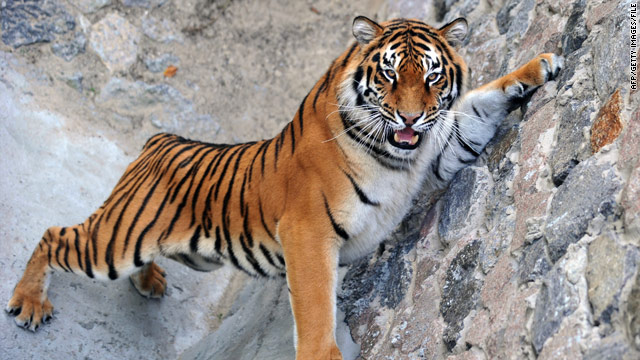
The wild tiger population is less than 4 percent of what it was a century ago, and leaders in 13 nations are taking a stand against the poaching and habitat destruction that have decimated the majestic predators' numbers.

This time around, actions will speak louder than words, they say.

With the conclusion of a high-profile summit, attracting guests as notable as actor Leonardo DiCaprio and Russian Prime Minister Vladimir Putin, governments and conservation groups pledged $327 million with the goal of doubling the wild tiger population by 2022.

The four-day International Forum on Tiger Conservation, which ended Wednesday, was billed as a last chance for the wild tiger, Its numbers have dropped from 100,000 to 3,600 over the past 100 years.

Poaching, illegal trade and habitat destruction have forced the animal to the brink of extinction, according to the Global Tiger Initiative, which estimates that wild tigers exist today in less than 7 percent of their historic range.

"I am confident that we will look back on this day as a turning point in the effort to save one of the world's best-loved animals," World Wildlife Fund Director Jim Leape said.

The St. Petersburg, Russia, summit featured leaders from all 13 countries where tigers still live in the wild: Bangladesh, Bhutan, China, India, Indonesia, Cambodia, Laos, Malaysia, Myanmar, Nepal, Russia, Thailand and Vietnam.


It also enjoyed some celebrity backing as DiCaprio not only attended the summit, he committed $1 million to the cause.

"Illegal poaching of tigers for their parts and massive habitat loss due to palm oil, timber and paper production are driving this species to extinction," the actor said in a statement. "If we don't take action now, one of the most iconic animals on our planet could be gone in just a few decades. By saving tigers, we can also protect some of our last remaining ancient forests and improve the lives of indigenous communities."


While a substantial portion of the funding comes from the so-called tiger countries, the international community provided the majority of the money. The WWF, the Wildlife Conservation Society and the World Bank have pledged a collective $200 million.

"The lineup of international support is critical. Poorer tiger range countries face different challenges. Some countries just can't afford it, and at the end of the day, you cannot save tigers unless you protect them," said Barney Long, head of the WWF's Tiger Program in the U.S.

Michael Baltzer, of the fund's Tigers Alive Initiative, said the effort depends heavily on wealthier nations doing their part.


"We hope rich countries will mirror our funding efforts, or ultimately we're going to keep losing tigers," he said.

Among the richer nations already promising contributions are Germany, which has pledged an additional $17.2 million, and the U.S., which will donate $9.2 million to tiger-conservation efforts.

Experts say an additional $350 million is needed from the international community to protect and monitor the last remaining habitats for tigers.

Even as the Tiger summit was coming to a close, the International Fund for Animal Welfare reported that yet another tiger had been poisoned in north India. It was the third tiger slain in two weeks, according to the group.


"These tiger deaths highlight how critical it is to translate talk into action," fund President Fred O'Regan said in a statement.

O'Regan applauded the St. Petersburg summit and said he hopes the conference proves successful in "mobilizing the political will needed to save this charismatic and critically endangered species."

"But it's what we do after the meetings to bring the right resources to the people and communities on the front lines of tiger conservation that will make the difference -- or not -- to the fate of wild tigers," he said.

Read More

http://edition.cnn.com/2010/WORLD/europe/11/24/tiger.summit.goals/

Sunday, November 21, 2010

Tiger summit aims to double numbers


Governments of the 13 countries where tigers still live aim to agree moves that could double numbers of the endangered big cats within 12 years.

The International Tiger Conservation Forum in St Petersburg will discuss proposals on protecting habitat, tackling poaching, and finance.

About 3,000 tigers live in the wild - a 40% decline in a decade.

There are warnings that without major advances, some populations will disappear within the next 20 years.

Five prime ministers are due to attend the summit, including China's Wen Jiabao and Vladimir Putin of Russia.

"Here's a species that's literally on the brink of extinction," said Jim Leape, director general of conservation group WWF.

"This is the first time that world leaders have come together to focus on saving a single species, and this is a unique opportunity to mobilise the political will that's required in saving the tiger."

Double trouble

The draft declaration that leaders will consider acknowledges that "Asia's most iconic animal faces imminent extinction in the wild".

Tiger skin being used
Reducing demand for skins and body parts is key - but largely missing from the draft declaration

Measures aimed at doubling numbers include making core tiger areas "inviolate", cracking down on poaching and smuggling, making people aware of the importance of tigers, and setting up cross-boundary protected areas where necessary.

A recent report by Traffic, the global wildlife trade monitoring organisation, said that body parts from more than 1,000 tigers had been seized in the last decade.

But there is acknowledgement that some of the smaller nations will need help, in the form of money and expertise.

Earlier this year, scientists calculated the price of effective global tiger conservation at $80m (£50m) per year, but said only $50m was currently on the table.

However, campaigners say financial concerns should not be an excuse for inaction.

The Environmental Investigation Agency (EIA) points out that by comparison, it is estimated that "China spent $31bn on the Olympic Games in 2008, while India spent a total of $2.6bn on the 2010 Commonwealth Games".

"This is the big question," said EIA's campaigner Alasdair Cameron.

"The draft deal has a lot of positive stuff in it, but a lot of the stuff has been around for years - what we need is the political will to make it happen."

He identified two elements missing in the draft deal: measures to reduce the demand for tiger skins and bones and body parts for traditional medicine, and any discussion of tiger farms.

Both are sensitive topics in China, where it is estimated there are more tigers in captivity than exist globally in the wild.

The World Bank has given substantial backing to moves aimed at saving the tiger, and its president Robert Zoellick also referred to the need to reduce demand, especially in China and Vietnam.

"There's no question everyone recognises this as a core issue - the challenge is how we get at it," he said.

Film star Jackie Chan recently voiced some public service announcements in China asking people not to use tiger parts, which Mr Zoellick said was playing a part in "chaning public attitudes".

Small is ugly

From a scientific perspective, one of the most worrying aspects of the tiger's plight is that many populations are very small - fewer than 100 animals.

Tiger crossing the path of tourists' vehicles
The declaration would see core tiger habitat put off limits from any other usage

This means that incidents such as disease can prove particularly severe.

Of the nine sub-species recognised to have been in existence 100 years ago, at least three have since disappeared.

The Bali tiger was last seen in the 1930s, while the Javan and Caspian sub-species were wiped out in the 1970s. All are officially listed as extinct.

The South China tiger may also have disappeared from the wild, with no sightings for nearly 40 years.

Jean-Christoph Vie, deputy head of the species programme with the International Union for the Conservation of Nature (IUCN), suggested the tiger could be seen as a test-case for whether countries are really serious about saving biological diversity.

"Some people are saying 'well, doubling the tiger population is good, but we have no room' - I've heard that said [in preliminary meetings]," he told the BBC.

"It needs to be done everywhere - especially we need to see a doubling where you have significant populations.

""If you leave tigers alone and don't kill them and don't poach them, then naturally they will double in 10 years."


Read More

http://www.bbc.co.uk/news/science-environment-11791105