Showing posts with label religion. Show all posts

Sunday, January 9, 2011

Thousands demonstrate in support of Pakistan's blasphemy law


Thousands of people turned out in Karachi Sunday to show their support for Pakistan's current blasphemy laws and warn the government against changing the laws.

The rally, called by the leaders of several hard-line Islamic groups, closed main roads and markets throughout the city. Demonstrators demanded Pakistan leave its blasphemy laws untouched. They make it a crime punishable by death to insult Islam, the Quran or the Prophet Mohammed.

A number of banners at the rally stated support for Muhammad Mumtaz Qadri, accused of shooting the governor of Punjab province earlier this month. Qadri was a bodyguard for Gov. Salman Taseer, a liberal lawmaker who spoke out against

the blasphemy laws. Qadri told police he assassinated Taseer because "he did blasphemy of the Prophet Mohammed."

A bill is now before the Pakistani parliament that would change the current blasphemy laws. It calls for a tighter definition of the term, to avoid cases like that of Asia Bibi, a Christian woman who was sentenced to death under the law. A court found the 45-year-old woman guilty of defiling the name of the Prophet Mohammed during a 2009 argument with fellow Muslim field workers.

Read More

http://edition.cnn.com/2011/WORLD/asiapcf/01/09/pakistan.protests

Sunday, November 21, 2010

For the faithful, fear of Aids comes second to fear of God

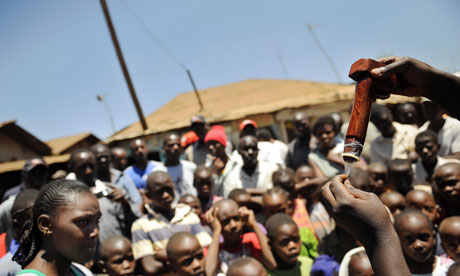
Residents of Africa's largest slum watch

An Aids educator in a Nairobi slum shows how to remove a condom.

Before evening mass at downtown Johannesburg's Holy Trinity Catholic church, a group of Congolese students were today trying to decode and digest the pope's apparent break from traditional doctrine on the use of condoms.

Africa is the global centre of HIV/Aids infections. It is also home to an estimated 158 million Catholics. By 2025, it is predicted, one-sixth of the world's Catholics – about 230 million – will be African. The church's sphere of influence includes Angola, Cameroon, the Democratic Republic of the Congo, Kenya, Mozambique, Nigeria, Uganda and Zimbabwe.

Condoms were acceptable "in certain cases" such as male prostitution, Benedict XVI had said. What did the people gathered at the Holy Trinity, which sits above an HIV clinic, make of that?

Djoscky Bindusa Mongenda Tapo, 38, was wrestling with contradictions between religion and science. "The pope, as the leader of the church and as a Christian, is wrong to say this," he said. "But scientifically he is also the leader of many people, and he is right to protect them.

"As a Christian, as a spiritual fact, we cannot accept the use of condoms because to us marriage is between one man and one woman. The church has forbidden the use of condoms even if you are officially married because, if it allowed them, it also allows people to go around with prostitutes. Scientifically, the condoms are helping to protect people from the spread of many sicknesses and prevent premature pregnancies. Sex without condoms is a risk to people's health and their families."

He concluded: "Both sides are good but, as Christians, we are not afraid of sickness or to die, but we are afraid of the law of God. As God said one man is for one woman, we cannot go against God for other reasons. But if you are not Christian, you can use condoms if you have partners outside marriage."

Aids activists have condemned the Vatican's stance for legitimising ignorance about safe sex, resulting in countless needless deaths.

The Pope fanned the flames last year when, on his first visit to Africa, he asserted that condoms were not the solution to HIV and could in fact make the problem worse.

South Africa has the world's biggest HIV caseload and a death toll of nearly 1,000 people a day. But Catholics gathering at the 72-year-old Holy Trinity – a traditional church of pink stone, stained glass, arched doorway and antique bell – had mixed views on the pope's apparent U-turn and its implications for the continent.

Frank Lessaka, a student from the Democratic Republic of the Congo, where about half the population is Catholic, said the pope had a duty to put doctrine first: "The medical side is right, but he is contradicting the religious side. Legally he must emphasise the religious side. The danger is that people will misunderstand what the pope is saying. He is trying to explain the use of condoms to stop HIV, but in a religious way he's wrong."

Lessaka, 23, added: "Ask first of all why use a condom, who with, which moment? In a marriage, it is advisable if you are sick. But if the pope is urging people to use condoms outside a marriage, the pope is wrong. Abstinence and fidelity are the most advisable. Even a doctor in a hospital will tell you that."

But Alain Mupundu, 30, another Congolese Catholic, strongly disagreed. "In 1998, the prevalence of HIV in my country was 0.8%. Now it is 8% – 10 times greater. We are not all doing abstinence and fidelity. We want to be safe now. It is time to change.

"The pope has talked to the cardinals and I think this was the result of that consultation. After saying we can't use condoms, we lost too many friends, but now we can change and save some of them. The pope has said the right thing at the right time."

Elsewhere at the church, bathed in spring sunshine near the Nelson Mandela Bridge in Braamfontein, a group of gay and lesbians were also meeting. "For the sake of reducing HIV, it's the right thing to use protection, especially in Africa," said Tendai Maposa, 30, who has Catholic friends who are HIV-positive. "The Catholic church's ignorance has been damaging. It must now educate people about HIV so they practise safe sex. I'd like to see the pope go further."

Bongani Mtlhavani, 21, a PR and media consultant, agreed: "This statement has been long overdue – it's about time. The Catholic church has got a huge following in Africa. Its ignorant position has caused followers to be infected with HIV. It contributed to the infections big time."

Another member of the group, Dutchman Peter van den Akker, cautioned that while papal teachings doubtless influenced hearts and minds in Africa, not every Catholic blindly obeyed the Vatican's strictures.

He outlined a more fluid situation: "My experience of working in Africa is that although the Catholic church has been negative about condoms, I meet priests and nurses in Uganda who have a typical Catholic attitude: the pope says this, but I do that because my conscience tells me to.

"On the other hand, the black clergy I know in west Africa, for example in Ghana, are even more Roman than the pope himself. They refused to participate in an educational programme because they did not want to discuss this as even a problem."

Van den Akker, 64, a freelance journalist, expressed frustration that the pope, who cited the example of male prostitution for acceptable condom use, had left his overall position vague. "I would like to see the pope say more," he said. "From a man of his status and influence this statement is quite remarkable, but it's one small step. The longer he waits, the bigger the problem will be."

The sentiment was echoed today by Aids activists in South Africa. Caroline Nenguke, a spokeswoman for the Treatment Action Campaign, said: "Historically the Catholic church has been in denial with regard to condom use. For the pope to say they can be used in certain circumstances is a step in the right direction.

"But we still have thousands of steps before he stands on a proper platform and says condom use is an effective way of preventing HIV."

Read More

http://www.guardian.co.uk/world/2010/nov/21/african-catholics-fear-of-aids-second-fear-of-god

Monday, November 15, 2010

British Muslims join the pilgrims at a record-breaking hajj

British Muslims join the pilgrims at a record-breaking hajj

Some 25,000 visitors from the UK join the millions pouring into Arafat to spend the day in prayer

    Muslim pilgrims at Jabal al-Rahman

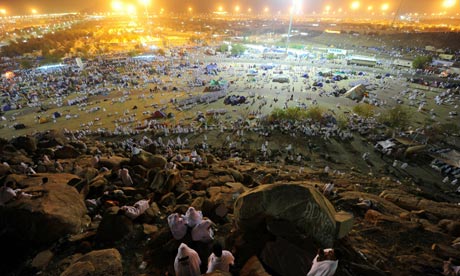
    Pilgrims arrive before dawn yesterday to pray at Jabal al-Rahman, where Muhammad is said to have given his final sermon.

    Tucked away from the intensity of the crowds and traffic today, some of the 25,000 Britons who are performing the hajj this year were taking a welcome respite in Arafat.

    In modest canvas tents, strewn with sleeping bags and sleeping bodies, pilgrims settled in for prayer and reflection, ahead of the gruelling physical and mental challenges that lay ahead.

    Dr Faatimah Esmail, a surgical trainee from Leicester, arrived in Saudi Arabia on Wednesday. It was her first time on the pilgrimage. "You can't imagine what it's going to be like. It's overwhelming. You might think it's difficult to have a spiritual experience with so many people around but the concept of the hajj is that you're here to worship your creator. It's between him and you. Nobody else."

    The 31-year-old has travelled extensively – North America, east Africa, the Middle East, the Indian subcontinent – but said nothing compared to the holy city.

    "I've been to several Arab countries and yes, Saudi is another Arab country, but it's completely different. The peace and tranquillity you achieve here can't be found anywhere else."

    The tent was home to many first-time pilgrims. Another, Halima Bhayat, said she was preparing a PowerPoint presentation for her students at Maria Fidelis convent school, north London. The 27-year-old teacher said her pupils were interested in what she was doing and why. "I'm taking pictures to show what people are doing. I want to talk to them about what I've learned and what it's like. They think I'm going to be living in a desert in a tent. I've never done camping, maybe I should have done to get some practice."

    Millions of pilgrims poured into Arafat today to spend the day in prayer, enduring temperatures of more than 35C (95F) to seek penance for their sins. Many spent the night on its famous mountain in vigil.

    Islamic tradition says Jabal al-Rahman, a rocky 70-metre-high hill, is where Muhammad gave his final sermon 1,400 years ago, and for many it is the highlight of the pilgrimage.

    The Saudi government estimates that this year there are 2.5m pilgrims, but despite security measures – including 8,000 officials drafted in to crack down on squatters and unauthorised pilgrims – as many as a million extra are thought to be performing the hajj without the necessary paperwork.

    Another Briton in Mecca this year is the Conservative peer Lady Warsi, who is undertaking hajj at the invitation of King Abdullah of Saudi Arabia. A statement from the Cabinet Office said: "Baroness Warsi will conduct Hajj in a private capacity as part of an annual international delegation of Muslim politicians and leaders. Although predominantly a private visit, Baroness Warsi will participate in some official engagements after completing the pilgrimage."

    Throughout the day, and into the evening, Arafat was proof that 2010 is a record-breaking hajj. Tonight it was clear serious issues of crowd control remained, as pilgrims spilled out onto the Al Jawhara Road, chaotically and frantically, in a bid to reach the next destination of Muzdalifah.

    A government convoy, attempting to leave a compound, threatened to cause injury as it shuddered through the teeming masses, alarming both pilgrims and passengers as they brushed past. Police officers, attempting to clear a way for the official vehicles, tried to hold pilgrims back. But many reacted angrily, breaking their way through, banging on the doors of the vehicles and clambering over them in frustration.

    There has not been a stampede for several years, but there is still plenty of potential for chaos. The much-lauded Mecca metro, with a maximum capacity of 72,000 passengers an hour, will go some way to alleviating the pressure on the roads, but with the Saudi authorities striving for bigger hajj numbers, more work will need to be done on managing the millions.

    Some Muslims are also still taking risks with their hajj by handing over thousands of pounds to rogue agents, according to one tour operator. Mohammed Patel, a 38-year-old from London, has performed the hajj every year since 1998. He said the single most important thing for would-be pilgrims to do was to check the credentials of the tour operator.

    "Use a registered company. If you don't you could be throwing your money away. You hear stories of people who never make it here, they lose all their money. They think that because the tour operator is Muslim and the hajj is a Muslim event, that nothing bad will come of it. There are definitely trust issues.

    "The company needs to be licensed with the ministry of hajj – you won't get your visa if they're not – and they should also be Abta and Atol protected."

    Horror stories of ripped-off, stranded or duped pilgrims persist, in spite of campaigns from the British government and pilgrim-interest groups, such as non-existent hotels, or sub-standard and overcrowded accommodation.

    Patel recommended that aspiring pilgrims use a service such as hajjbuddy.com, a US-based site rating hotels and travel companies. It also has a quick tips section – with information on mobile phone usage and how men can avoid friction and chafing while wearing their hajj clothing.

    "It's a bit like TripAdvisor but specific to the hajj and with a bit more stuff on it," said Patel.

    Read More

    http://www.guardian.co.uk/world/2010/nov/15/hajj-british-pilgrims-muslims

Friday, November 12, 2010

Christian woman sentenced to death for blasphemy in Pakistan

A Christian woman has been sentenced to hang in Pakistan after being convicted of defaming the Prophet Mohammed


Asia Bibi, a 45-year-old mother-of-five, denies blasphemy and told investigators that she was being persecuted for her faith in a country where Christians face routine harassment and discrimination.

Christian groups and human rights campaigners condemned the verdict and called for the blasphemy laws to be repealed.

Her supporters say she will now appeal against the sentence handed down in a local court in the town of Sheikhupura, near Lahore, Pakistan.


Read more: