Showing posts with label palestines. Show all posts

Monday, January 24, 2011

Palestinians Offered to Give Up Parts of East Jerusalem, Al-Jazeera Says


Palestinian negotiators had agreed to give up claims to parts of east Jerusalem and swap some Jewish settlements in the West Bank for territory within Israel in 2008 talks, according to classified documents.

Al-Jazeera television said it had been given access to thousands of pages of memos, e-mails and minutes of private meetings that show Palestinian negotiators were also prepared to make concessions on the right of return for Palestinian refugees and detail the level of security cooperation with Israel. Al- Jazeera didn’t say how it obtained the correspondence, which covered the period from 1999 to 2010.

Chief Palestinian negotiator Saeb Erakat called the reports “unfounded, twisted and taken out of context” in a telephone interview with Bloomberg News. Palestinian Authority President Mahmoud Abbas said that he didn’t “know where al-Jazeera got secret things from,” according to Egypt’s state-run Middle East News Agency.

Peace talks between Israel and the Palestinians broke down in September after Israeli Prime Minister Benjamin Netanyahu refused to extend a 10-month partial construction freeze in West Bank settlements. Abbas has refused to negotiate as long as the building continues.


U.S. State Department spokesman Philip J. Crowley said on Twitter late yesterday that the U.S. was reviewing what he called “the alleged Palestinian documents released” and said he “cannot vouch for their veracity.”

Peace Treaty

Netanyahu spokesman Mark Regev declined to comment. Israeli Foreign Minister Avigdor Lieberman said the documents show there’s no way for Israel to reach a comprehensive peace treaty with the Palestinians.

“Even the Olmert government didn’t reach an arrangement despite their far-reaching concessions,” Lieberman said in an interview with Israel Radio, referring to former prime minister Ehud Olmert.

Lieberman who heads the second-largest party in Netanyahu’s coalition, has said it may take “a few decades” to establish the trust needed for a permanent peace settlement. Netanyahu, who took office in 2009, has distanced himself from some of Lieberman’s positions.

The spokesman for the Islamic Hamas movement, which controls the Gaza Strip, said the documents were “clear evidence that the Palestinian Authority colluded with the occupation and it reflects its role in eliminating the just Palestinian cause.” Sami Abu Zuhri commented in an e-mailed statement.

Full Control

Hamas seized full control of Gaza in 2007 ending a partnership government with the Palestinian Authority after winning parliamentary elections a year earlier. Hamas, which is considered a terrorist organization by the U.S., the European Union and Israel, refuses to recognize Israel or any agreements signed with it.

“Hamas is already using this material to incite against the Palestinian Authority,” Mkhaimar Abusada, a political scientist at Gaza City’s al-Azhar University, said by phone. “That’s going to inflame a lot of people in Gaza, but I don’t think it’s going to hurt them with their supporters.”

The documents showed that Erakat and his team agreed in 2008 to allow Israel to keep most of the neighborhoods it has built in east Jerusalem. It also showed the team agreeing to exchange some settlements near Bethlehem for other territory.

Holiest Site

According to al-Jazeera, the Palestinians were also willing to hand over Haram al-Sharif, Islam’s third holiest site, to international control. The compound is known to Jews as the Temple Mount, the site of the ancient temple destroyed by Romans.

The area lies in east Jerusalem, sought by Palestinians as the capital of a state. Israel captured the area in the 1967 Middle East war and annexed it in a move never internationally recognized.

“We have already said that we have accepted the principle of land swaps, but this is totally out of context,” Erakat said.

Jonathan Spyer, a political scientist at the Interdisciplinary Center Herzliya, said “the fallout could actually be useful on the international stage because it makes the Palestinians look more flexible than Israel.” He spoke in a telephone interview.

Read More

http://www.bloomberg.com/news/2011-01-24/al-jazeera-report-of-palestinian-concessions-is-unfounded-erakat-says.html

No time to lose in the Middle East peace process


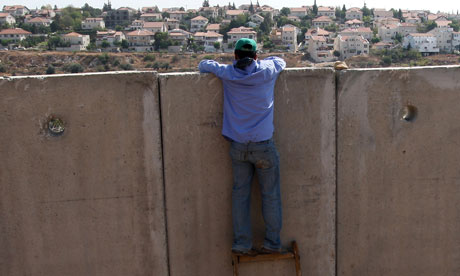
The Jewish settlement of Hashmonaim, dating from the mid 1980s, in the West Bank.


During the last two years, Israelis and Palestinians have not marked an inch of progress towards the hoped for two-state solution. It is high time the international community mobilised serious efforts in that direction.

Israelis and Palestinians spent years negotiating the intertwined core issues of Jerusalem, the holy sites, the refugees, territory, borders and settlements, and security. I believe that we know what a final agreement will ultimately look like. Since President Clinton's parameters were laid down in December 2000, every political initiative to ending the conflict has led to the same fundamental solutions. The recent leak of Palestinian documents proves it.

It seems that there has never been a shortage in ideas, plans and initiatives. Moreover, the convergences between the parties throughout this period have been apparently more substantive than publicly revealed to date.

In Israel, time is running out for those who want to secure a Jewish and democratic state within recognised boundaries alongside a demilitarised Palestinian state. True, polls consistently demonstrate that Israelis overwhelmingly support the two-state solution. But this majority has not been heard politically. Israelis are starting to realise that, and are getting their act together to change this discourse. They say: we are proud to be Israeli, Jewish and Zionist, and refuse to apologise for it. We would like to secure this identity for generations – and, for that purpose, a Palestinian state living side by side with Israel is imperative.

In the absence of a capable leadership in the Middle East, a series of conditions should be considered by the US and its allies in this endeavor in order to reverse the course of the process for the benefit of all parties concerned.

First, there is a need to combine the bilateral approach with a regional one, thus establishing a supportive Arab coalition for a possible Israeli-Palestinian agreement, and providing further opportunities for negotiations and trade-offs. To the detriment of the PLO, Israel's interlocutor since Oslo in 1993, Gaza is governed by Iranian-backed Hamas, a brutal terrorist organisation, dedicated to the destruction of Israel. It is only under a regional framework that the Gaza timebomb could possibly be addressed. The 2002 Arab Peace Initiative represents a significant and strategic shift in the Arab League's approach to resolving the dispute. It should serve as a basis for further negotiations.

Second, it is crucial to win the individual and collective hearts and minds of the peoples in the region. We need to prepare the ground ahead of time for tough decisions to be taken towards peaceful co-existence. It is essential gradually to change the public's mindset by creating a new vocabulary, a fresh discourse, even if that means tackling what were once taboos. Until today, little thought was given to the preparation of public opinion. Media coverage focused on what the respective parties are likely to be giving up, rather than on the benefits of peace. And so mutual hostility continued unchecked.

Third, the architecture of the Oslo process must be reframed. It seems essential to change the "nothing is agreed until everything is agreed" paradigm of Camp David, Taba and Annapolis – into "what has been agreed should be implemented". Such an approach would open the way for an agreement on boundaries, security, statehood and the economy. Subsequently, the negotiations over Jerusalem and the refugees will continue in a state-to-state fashion.

Fourth, seeking the end of the Israeli-Palestinian conflict cannot be based anymore on falsified grounds, distorted truths and double standards vis-à-vis Israel, thus encouraging anti-Israel terrorism. Pursuing Israeli settlement relocation, within a final territorial agreement, should follow 1967 United Nations security council resolution 242. The resolution was drawn up by Lord Caradon, UK representative at the UN who stated:

"We didn't say there should be a withdrawal to the [19]'67 line; we did not put the 'the' in, we did not say all the territories, deliberately … We did not say that the '67 boundaries must be forever; it would be insanity."

The British foreign secretary at the time, George Brown, said:

"I have been asked over and over again to clarify, modify or improve the wording, but I do not intend to do that … Before we submitted it to the council, we showed it to the Arab leaders. The proposal said 'Israel will withdraw from territories that were occupied', and not from 'the' territories, which means that Israel will not withdraw from all territories."

And finally, tangible coordination on the ground should be promoted, enabling the bottom-up progress to sustain a political dialogue. Since 2007, we have seen in the West Bank a genuine Israeli-Palestinian security cooperation. In that climate, self-interest starts to supersede mistrust between the parties, as has been demonstrated in steady economic growth, rapid institutional development and improved welfare.

It is essential that President Obama should find without delay a mechanism to resume negotiations between Prime Minister Binyamin Netanyahu and Chairman Mahmoud Abbas. Yes, all three face a different set of domestic problems, but the US president should insist on maintaining a rigid negotiation framework with a binding agenda from which the parties cannot be allowed to depart. There is a reasonable chance of reaching a partial agreement on territory, security and the establishment of the Palestinian state within the president's remaining effective term.

The two-state solution is not only in the interest of Israel: it is clearly in the interest of the United States, Europe and the moderate Arab world to enhance global peace and stability.

Read More

http://www.guardian.co.uk/commentisfree/2011/jan/25/palestine-papers-two-state-solution