Showing posts with label japan earthquake. Show all posts

Sunday, April 24, 2011

Japan launches massive search for tsunami bodies


TAGAJO, Japan (AP) — Some 25,000 Japanese troops are fanning out on the wreckage-strewn northeastern coast Monday in a massive search for thousands of bodies still missing from last month's earthquake and tsunami.

Backed by dozens of boats and aircraft, the soldiers are scouring the region for remains swept to sea or buried under masses of rubble.

The operation is the third intensive military search for bodies since the disaster that killed up to 26,000 people. Some 12,000 remain missing and are believed dead. Monday's search is an all-out effort to recover any remains for their families.

The soldiers are combing through the rubble and navy boats and divers are searching the waters up to 12 miles (20 kilometers) off the coast.

Read More

http://www.google.com/hostednews/ap/article/ALeqM5hKSa_f4B-YmqkNFTir81z0iPuDYw?docId=2d89252c0ac4494599fef88ae276458d&index=0

Thursday, April 21, 2011

Japan earmarks first $50 billion for post-quake rebuild


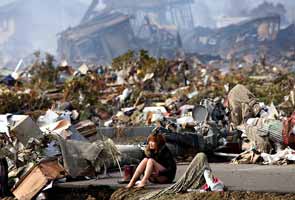
Wakana Kumagai, 6, waits for her mother Yoshiko after visiting the grave of her father, who was killed by the March 11 tsunami

Japan's cabinet approved on Friday almost $50 billion of spending for post-earthquake rebuilding, a downpayment on the country's biggest public works effort in six decades.

The emergency budget of 4 trillion yen ($48.5 billion), which is likely be followed by more reconstruction spending packages, is still dwarfed by the overall cost of damages caused by the March 11 earthquake and tsunami, estimated at $300 billion.

"With this budget, we are taking one step forward toward reconstruction ... and toward restarting the economy," Finance Minister Yoshihiko Noda told reporters after a cabinet meeting.

The magnitude 9.0 earthquake and 15 meter tsunami that followed caused Japan's gravest crisis since World War Two, killing up to 28,000 people and destroying tens of thousands of homes.

It also smashed a nuclear power plant which began leaking radiation, a situation the plant's operator says could take all year to bring under control.

Read More

http://www.reuters.com/article/2011/04/22/us-japan-idUSTRE72A0SS20110422

Wednesday, April 13, 2011

In Japan, Aftershocks Are Also Felt From Within


TOKYO — Aguri Suzuki, a 44-year-old real estate agent, says she sometimes thinks the ground is shaking even when it is not. When she sees a tree branch swaying in the wind, she worries there has been an earthquake.

Doctors here say they are seeing more people who are experiencing such phantom quakes, as well as other symptoms of “earthquake sickness” like dizziness and anxiety.

And it is no wonder. As if the threat of radiation from a crippled nuclear power plant were not enough, Tokyo and the region to its northeast have been under a constant barrage of aftershocks since the magnitude 9.0 earthquake that set off a devastating tsunami on March 11. Two earthquakes were felt in Tokyo on Wednesday morning, three on Tuesday, a large one on Monday and a very large one of magnitude 7.1 last Thursday.

Over all, there have been 400 aftershocks of magnitude 5.0 or greater in northeastern Japan since March 11. That is as many sizable quakes in one month as Japan typically experiences in two and a half years, according to the Japan Meteorological Agency.

The quakes are complicating efforts to control the Fukushima Daiichi nuclear power plant. For instance, the quake on Monday knocked out cooling at the Fukushima plant for nearly an hour.

Every time a sizable quake occurs, the first question on many people’s minds is whether the nuclear plant has been further damaged and whether a new cloud of radiation is on the way. A spokesman for the Tokyo Electric Power Company, the plant’s owner, is then hustled onto television to reassure viewers.

Government officials are becoming concerned that in the rush to cool the reactors and prevent hydrogen explosions, the plant’s vulnerability to another tsunami has been overlooked.

“A week ago we thought the major risk was a hydrogen explosion,” a senior official in the office of the prime minister said Tuesday. “I think the major risk at the moment is an aftershock and tsunami.”

Read More

http://www.nytimes.com/2011/04/14/world/asia/14quake.html?src=mv#h[]

Sunday, March 27, 2011

Japan earthquake: strong quake prompts tsunami warning for disaster zone


The earthquake, measuring 6.5 on the Richter Scale, was pinpointed to 50 miles east of Oshika peninsula in Miyagi prefecture, an area still recovering from the devastation of the March 11 earthquake and tsunami.

Following the new earthquake, the Japanese authorities issued a 20 inch tsunami warning for the Pacific coastal region which was later lifted, with no reports of immediate casualties or further damage.

Japan's weather agency said that the strong tremor was believed to be the latest in a string of aftershocks to hit the region following the massive earthquake just over two weeks ago.

A large clean-up and restoration project remains in place across the northeast of Japan following widespread devastation and the loss of more than 27,000 lives.

Fears of radiation contamination are continuing to hamper procedures and are causing widespread unease following damage to the Fukushima Daiichi nuclear plant.

Teams of workers at the nuclear plant located 150 miles north of Tokyo are continuing a tense battle around the clock to stem radiation leaks and restore control inside four of its six reactors.

Tokyo Electric Power Co (TEPCO), the operators of the plant, caused confusion on Sunday when they erroneously reported that radiation levels in water within one of the reactors was 10 million times higher than normal.

After correcting this to 100,000 times higher the government strongly criticised TEPCO for the "absolutely unacceptable" mistake.

The highly contaminated water has now been attributed to the partial melting of the Number 2 reactor's fuel rods after it was hit by the March 11 earthquake and subsequent tsunami.

Yukio Edano, the chief cabinet secretary, said: "The radiation seems to have come from the fuel rods that were partially melted down and came into contact with the water used to cool the reactor.

"Steam may have condensed [ ] carrying water from within the containment vessel."

Rolling blackouts to cut back on electricity use in the Kanto region of Japan were resumed today to help counter the energy shortages caused by damage to the nuclear plant.


Read More

http://www.telegraph.co.uk/news/worldnews/asia/japan/8410322/Japan-earthquake-strong-quake-prompts-tsunami-warning-for-disaster-zone.html

Monday, March 21, 2011

Japan relief roundup: League of Legends and a special Final Fantasy Tactics


Companies, organizations and individuals connected to the games industry continue to come forward with offers of support for the ongoing rescue and relief operations in Japan. We'll be collecting the latest opportunities to lend a hand in end-of-day roundups like this one as they're announced.

Head past the break for details on the today's happenings. If you'd prefer to donate to the efforts directly, you can always do so through the American Red Cross (www.redcross.org).
  • From now through noon PST on Sunday, March 27, League of Legends studio Riot Games will be donating 100 percent of the profits from purchases of Nurse Akali or Riot Points spent on the summoner Akali to the Red Cross relief effort. Riot Games is placing Akali and her nurse skin on sale for 50 percent off during the period as well.

  • Play for Japan is auctioning off a rare signed copy of Final Fantasy Tactics for PS One featuring cover autographs by character designer Akihiko Yoshida and art director Hideo Minaba. The high big as of this writing is just over $100, with the auction set to close on Sunday, March 27 at 4:34PM PST.

Sunday, March 20, 2011

Japan's disaster toll rises with 18,000 deaths


FUKUSHIMA, Japan -- The toll of Japan's triple disaster came into clearer focus Monday after police estimates showed more than 18,000 people died, the World Bank said rebuilding may cost $235 billion and more cases of radiation-tainted vegetables and tap water turned up.

Japanese officials reported progress over the weekend in their battle to gain control over a nuclear complex that began leaking radiation after suffering quake and tsunami damage, though the crisis was far from over, with a dangerous new surge in pressure reported in one of the plant's six reactors.

The announcement by Japan's Health Ministry late Sunday that tests had detected excess amounts of radioactive elements on canola and chrysanthemum greens marked a low moment in a day that had been peppered with bits of positive news: First, a teenager and his grandmother were found alive nine days after being trapped in their earthquake-shattered home. Then, the operator of the overheated nuclear plant said two of the six reactor units were safely cooled down.

"We consider that now we have come to a situation where we are very close to getting the situation under control," Deputy Cabinet Secretary Tetsuro Fukuyama said.

Still, serious problems remained at the Fukushima Dai-ichi nuclear complex. Pressure unexpectedly rose in a third unit's reactor, meaning plant operators may need to deliberately release radioactive steam. That has only added to public anxiety over radiation that began leaking from the plant after a monstrous earthquake and tsunami devastated northeastern Japan on March 11 and left the plant unstable. As day broke Monday, Japan's military resumed dousing of the complex's troubled Unit 4.

The World Bank said in report Monday that Japan may need five years to rebuild from the catastrophic disasters, which caused up to $235 billion in damage, saying the cost to private insurers will be up to $33 billion and that the government will spend $12 billion on reconstruction in the current national budget and much more later.

The safety of food and water was of particular concern. The government halted shipments of spinach from one area and raw milk from another near the nuclear plant after tests found iodine exceeded safety limits. Tokyo's tap water, where iodine turned up Friday, now has cesium. Rain and dust are also tainted.

Early Monday , the Health Ministry advised Iitate, a village of 6,000 people about 30 kilometers (19 miles) northwest of the Fukushima plant, not to drink tap water due to elevated levels of iodine. Ministry spokesman Takayuki Matsuda said iodine three times the normal level was detected there - about one twenty-sixth of the level of a chest X-ray in one liter of water.

In all cases, the government said the radiation levels were too small to pose an immediate health risk.

But Tsugumi Hasegawa was skeptical as she cared for her 4-year-old daughter at a shelter in a gymnasium crammed with 1,400 people about 80 kilometers (50 miles) from the plant.

"I still have no idea what the numbers they are giving about radiation levels mean. It's all so confusing," said Hasegawa, 29, from the small town of Futuba in the shadow of the nuclear complex. "And I wonder if they aren't playing down the dangers to keep us from panicking. I don't know who to trust."

All six of the nuclear complex's reactor units saw trouble after the disasters knocked out cooling systems. In a small advance, the plant's operator declared Units 5 and 6 - the least troublesome - under control after their nuclear fuel storage pools cooled to safe levels. Progress was made to reconnect two other units to the electric grid and in pumping seawater to cool another reactor and replenish it and a sixth reactor's storage pools.

But the buildup in pressure inside the vessel holding Unit 3's reactor presented some danger, forcing officials to consider venting. The tactic produced explosions of radioactive gas during the early days of the crisis.

"Even if certain things go smoothly, there would be twists and turns," Chief Cabinet Secretary Yukio Edano told reporters. "At the moment, we are not so optimistic that there will be a breakthrough."

Growing concerns about radiation add to the overwhelming chain of disasters Japan has struggled with since the 9.0-magnitude quake. The resulting tsunami ravaged the northeastern coast. All told, police estimates show more than about 18,400 died. More than 15,000 deaths are likely in Miyagi, the prefecture that took the full impact of the wave, said a police spokesman.

"It is very distressing as we recover more bodies day by days," said Hitoshi Sugawara, the spokesman.

Police in other parts of the disaster area declined to provide estimates, but confirmed about 3,400 deaths. Nationwide, official figures show the disasters killing more than 8,600 people, and leaving more than 13,200 people missing, but those two lists may have some overlap.

The disasters have displaced another 452,000, who are living in shelters.

Fuel, food and water remain scarce. The government in recent days acknowledged being caught ill-prepared by an enormous disaster that the prime minister has called the worst crisis since World War II.

Bodies are piling up in some of the devastated communities and badly decomposing even amid chilly rain and snow.

"The recent bodies - we can't show them to the families. The faces have been purple, which means they are starting to decompose," says Shuji Horaguchi, a disaster relief official setting up a center to process the dead in Natori, on the outskirts of the tsunami-flattened city of Sendai. "Some we're finding now have been in the water for a long time, they're not in good shape. Crabs and fish have eaten parts."

Contamination of food and water compounds the government's difficulties, heightening the broader public's sense of dread about safety. Consumers in markets snapped up bottled water, shunned spinach from Ibaraki - the prefecture where the tainted spinach was found - and overall expressed concern about food safety.

Experts have said the amounts of iodine detected in milk, spinach and water pose no discernible risks to public health unless consumed in enormous quantities over a long time. Iodine breaks down quickly, after eight days, minimizing its harmfulness, unlike other radioactive isotopes such as cesium-137 or uranium-238, which remain in the environment for decades or longer.

High levels of iodine are linked to thyroid cancer, one of the least deadly cancers if treated. Cesium is a longer-lasting element that affects the whole body and raises cancer risk.

Rain forecast for the Fukushima area also could further localize the contamination, bringing the radiation to the ground closer to the plant.

Edano tried to reassure the public for a second day in a row. "If you eat it once, or twice, or even for several days, it's not just that it's not an immediate threat to health, it's that even in the future it is not a risk," Edano said. "Experts say there is no threat to human health."

No contamination has been reported in Japan's main food export - seafood - worth about $1.6 billion a year and less than 0.3 percent of its total exports.

Amid the anxiety, there were moments of joy on Sunday. An 80-year-old woman and her teenage grandson were rescued from their flattened two-story house after nine days, when the teen pulled himself to the roof and shouted to police for help.

Other survivors enjoyed smaller victories. Kiyoshi Hiratsuka and his family managed to pull his beloved Harley Davidson motorcycle from the rubble in their hometown of Onagawa. The 37-year-old mechanic said he knows it will never work anymore. "But I want to keep it as a memorial."

Yamaguchi reported from Tokyo, as did Associated Press writers Elaine Kurtenbach, Kelly Olsen, Charles Hutzler and Jeff Donn. Associated Press writer Jay Alabaster contributed from Natori, Japan.

Read More

http://www.forbes.com/feeds/ap/2011/03/20/general-as-japan-earthquake_8366181.html

Thursday, March 17, 2011

Japanese student learns family is alive thanks to YouTube video


Kosaka's sister held up a sign stating "we are all safe" in hopes that a news crew would catch the message on video.


Akiko Kosaka's family resides in Minamisanriku, a fishing village where half the residents are feared to be dead as a result of last week's tsunami, but thanks to a YouTube video, she knows that her relatives are alive and safe.

CNN reports that Kosaka — who is a student from Japan attending the University of California at Riverside — scoured the Internet for days in hopes of finding something that suggests that her family survived the aftermath of the recent earthquake and tsunami in Japan.

She breathed a bit easier when she received an e-mail explaining that her youngest sister "was likely safe in her middle school's shelter." But there was no word about the rest of her family — until late Sunday night:

[S]he received word Sunday night from a friend in Japan of the existence of a 45-second YouTube video showing her family home as the only one standing amid the rubble. The video highlighted her older sister holding a sign to a TV news crew saying in Japanese "we are all safe."

Kosaka expressed relief upon hearing of the video, but became distraught after she couldn't find it online, despite staying up all night looking for it.

Then a contact through a Japanese social network e-mailed her the link Monday morning.

Kosaka watched the video over and over — she suggests that she'd seen it at least 50 times in 24 hours — and cried in joy and worry. She is still concerned about the health of her family members and wishing that she could get a message to them — just as they got one to her.

Read More

http://digitallife.today.com/_news/2011/03/17/6288110-japanese-student-learns-family-is-alive-thanks-to-youtube-video?chromedomain=technolog

Monday, March 14, 2011

Changes in Earth's rotation by Japan quake have no impact on human life: U.S. scientist


LOS ANGELES, March 14 (Xinhua) -- The changes in Earth's rotation and figure axis caused by Japan's 9-magnitude earthquake should not have any impacts on people's daily lives, NASA's Jet Propulsion Laboratory (JPL) said on Monday.

"These changes in Earth's rotation are perfectly natural and happen all the time," JPL scientist Richard Gross said in a press release.

Using a U.S. Geological Survey estimate for how the fault responsible for the earthquake slipped, Gross applied a complex model to perform a preliminary theoretical calculation of how the Japan earthquake affected Earth's rotation, according to the release.

His calculations indicate that by changing the distribution of Earth's mass, the Japanese earthquake should have caused Earth to rotate a bit faster, shortening the length of the day by about 1.8 microseconds (a microsecond is one millionth of a second).

The calculations also show the Japan quake should have shifted the position of Earth's figure axis (the axis about which Earth's mass is balanced) by about 17 centimeters (6.5 inches), towards 133 degrees east longitude, said JPL in Pasadena, Los Angeles.

This shift in Earth's figure axis will cause Earth to wobble a bit differently as it rotates, but it will not cause a shift of Earth's axis in space -- only external forces such as the gravitational attraction of the sun, moon and planets can do that, according to JPL.

Both calculations will likely change as data on the quake are further refined, JPL said.

"People shouldn't worry about them (the changes)," Gross said.

"Earth's rotation changes all the time as a result of not only earthquakes, but also the much larger effects of changes in atmospheric winds and oceanic currents," Gross said.

"Over the course of a year, the length of the day increases and decreases by about a millisecond, or about 550 times larger than the change caused by the Japanese earthquake. The position of Earth's figure axis also changes all the time, by about 1 meter (3.3 feet) over the course of a year, or about six times more than the change that should have been caused by the Japan quake."

Gross said that while scientists can measure the effects of the atmosphere and ocean on Earth's rotation, the effects of earthquakes, at least up until now, have been too small to measure.

The computed change in the length of day caused by earthquakes is much smaller than the accuracy with which scientists can currently measure changes in the length of the day, he said.

However, since the position of the figure axis can be measured to an accuracy of about 5 centimeters (2 inches), the estimated 17-centimeter shift in the figure axis from the Japan quake may actually be large enough to observe if scientists can adequately remove the larger effects of the atmosphere and ocean from the Earth rotation measurements, Gross added.

Read More

http://news.xinhuanet.com/english2010/sci/2011-03/15/c_13779106.htm

Sunday, March 13, 2011

Survivors return to confront all that was lost


Natori, Japan: One couple rode out the tsunami on top of an irrigation tower, crammed in with three other people. A man had to abandon his car in a field and run for it. Another couple simply got lucky, riding out the torrents in their house, one of the few in a swath of destruction that inexplicably held together.

They began streaming back to this stricken rice farming town on Monday morning, long lines of people returning to see what, if anything, was left of their lives after the waves came. They walked slowly, gazing in bewilderment at a scene that they could only struggle to comprehend.

Officials said the death toll in Friday's tsunami was certain to exceed 10,000. But even that seemed conservative -- a leading Japanese daily reported Monday that 20,000 people in two small coastal towns were missing.

Many returning here Monday were in tears. One couple said between sobs that they were trying to find their elderly mother, whom they had been forced to leave behind. There were many older people in the area, residents said, and many of them were trapped in their houses.

Until last week, Natori's farmers had tilled fields of rice in the summer and, in the winter, vegetables in neat white rows of plastic greenhouses, fields that most of the world saw inundated on Friday by a wall of water, mud, cars and wooden debris.

The devastation extends miles inland, so much so that even some evacuation centers were reportedly engulfed. In satellite images, Natori and nearby Yuriage, just south of the battered city of Sendai, seem to have been swept away without a trace, as if a giant razor had shaved the earth clean.

Kayo Miura said she was upstairs at her house when the earthquake struck, knocking her off her feet. She turned on the radio and heard a tsunami alert, but she had heard those before and nothing had come of them. After all, she thought, the house was almost two miles from the beach.

About 20 to 30 minutes later, she said, she saw a line of cars on her field. "Why are those cars parked in the field?" she wondered. Then she saw them moving, heard screams about a tsunami coming and froze. Her husband, Ken, ran upstairs just as the waves hit. Inexplicably, in an area where virtually every house was destroyed, theirs held together.

Others told harrowing tales of escape. When Naoko Takahashi, 60, and her husband, Hiromichi, 64, saw a jumble of cars and burning fuel bearing down on them, they ran as fast as they could, but the menacing wall kept gaining. Not sure what to do, they caught sight of an irrigation tower that was 12 to 15 feet high and scrambled up just in time, joining two others in riding out the flood.

"The only reason we made it were some earthen walls that slowed the water just enough," Mr. Takahashi said. "They gave us a few seconds."

They made their way home after dark, they said, wading through water that was up to their armpits while fires burned all around. The next day, some soldiers came and took them to a shelter.

As they got home, Ms. Takahashi turned to her husband and said: "Look, there's our house. What is that boat?" Indeed, there was a fishing boat sitting in a rice paddy to the side of their house.

The gloom was occasionally pierced by a ray of humor, of the gallows sort. Ko Miura, 56, a wholesaler, said he tried to drive home after the quake. But he was driving parallel to the wave, so he was forced to abandon his car and run. He just managed to get to a highway overpass before the waters swept by. When he looked up, he said, he saw his car float by.

The immediate future for Natori and its residents is undoubtedly grim. Rescue workers have been hampered by quake-damaged roads and debris, enormous traffic jams and fuel shortages. After a spell of relatively mild weather, temperatures were dropping and snow was in the forecast.

And even as people picked through what little was left in the rubble, the fires continued to burn.

Read More

http://www.ndtv.com/article/world/survivors-return-to-confront-all-that-was-lost-91477

Bank of Japan injects record $182 bn on quake fears


TOKYO: Japan's central bank injected a record 15 trillion yen ($182 billion) into the short-term money market Monday, in an attempt to build confidence after a devastating earthquake and tsunami.

"We will take every possible measure, including providing liquidity, to ensure the stability of financial markets and smooth settlements (of business deals)," a bank spokesman said. The bank will provide an additional 3 trillion yen Wednesday.

The priority of the central bank is to ensure financial institutions in disaster-hit regions do not run out of funds. Over the weekend it provided them with 55 billion yen to ease the pressure.

Monday's move was the first time since May, when European sovereign-debt fears pushed up the yen steeply and weighed on Tokyo shares, that the central bank injected same-day funds to boost confidence.

The BoJ said it stands by to do whatever necessary to keep stability in the markets and financial system.

Its two-day policy board meeting previously scheduled for Monday and Tuesday would now be cut short and conclude on Monday, seen as a sign it may quickly implement further measures.

Prime Minister Naoto Kan has warned that Japan is ready to take firm action against speculative trade, signalling his authorities may intervene in currency markets to bolster the yen if needed.

The yen briefly touched a four-month high before easing against the dollar on the massive liquidity injection Monday as markets responded to the natural disaster.

It briefly surged to 80.60 against the dollar, the highest since November 9, before retreating to 82.15 and held relatively steady despite a fresh explosion at the Fukushima nuclear plant Monday.

The government expects a "considerable" economic impact from the huge earthquake and devastating tsunami that plunged the nation into what Kan called its worst crisis since the Second World War.

It faces a huge challenge in financing the mammoth rebuilding task that will be required in the aftermath of a disaster whose economic impact is widely expected to be at least as bad as that from the 1995 Kobe earthquake.

Japan's public debt is the industrialised world's biggest at around 200 percent of GDP, and the nation's credit rating was recently downgraded on concerns that not enough is being done to address it.

Yet the disaster is seen to place yet more pressure on the debt-pile.

Stocks saw a post-quake sell-off with carmakers, banks and electronics firms taking a hit on fears for the economy as power shortages prompted rolling blackouts and plants remained closed in quake hit areas, hitting production.

Engineers are battling against the risk of meltdown at a stricken nuclear power station, while the death toll from the quake and the resulting wall of water that tore into parts of the northeastern seaboard is expected to surpass 10,000.

Read More

http://economictimes.indiatimes.com/markets/global-markets/bank-of-japan-injects-record-182-bn-on-quake-fears/articleshow/7698998.cms

Thursday, March 10, 2011

8.9 quake strikes Japan, triggers tsunami


Japanese television is showing horrific pictures of a wall of water swallowing everything in its path following a massive 8.9 magnitude earthquake struck off the northeast coast of Japan.

The quake has triggered a tsunami already that's washing away cars and houses inland in the north-east of the country.

A 10-metre tsunami warning has been extended for the coast in the region.

The tsunami warning was issued to most of the Pacific coast of the main island of Honshu, broadcaster NHK reported. People are being told to get to higher ground.

The quake was initially listed as 7.9 magnitude, then upgraded to 8.8, then 8.9 by US Geological Survey. A series of aftershocks followed including one of around 7 magnitude.

The epicentre of the quake is believed to be in the north of Japan, in the Honshu area.

The quake caused buildings to shake in the capital Tokyo, triggering at least one building fire, NHK television and witnesses reported.

The BBC is reporting it as a "mega-quake" and says there are many people injured.

Narita airport, Tokyo's main airport, has been closed. A number of people are believed to have been injured during a graduation ceremony in Tokyo when a roof collapsed.

The public broadcaster showed black smoke billowing from a building in Odaiba, a Tokyo suburb, and bullet trains to the north of the country have been halted.

NHK said a tsunami of 50 cm had already hit Japan's northern coast but the quake was big enough to cause a massive tsunami according to one expert talking to the BBC.

Television showed cars bobbing in water alongside fishing boats.

"The building shook for what seemed a long time and many people in the newsroom grabbed their helmets and some got under their desks," Reuters correspondent Linda Sieg said.

"It was probably the worst I have felt since I came to Japan more than 20 years ago."

The US Geological Survey verified a magnitude of 8.8 at depth of 24.3kms and located the quake 130.3kms east of Sendai, Honshu. The stock market extended its losses after the quake.

Japan's northeast Pacific coast, called Sanriku, has suffered from quakes and tsunamis in the past and a 7.2 quake struck on Wednesday. In 1933, a magnitude 8.1 quake in the area killed more than 3,000 people. Last year fishing facilities were damaged after by a tsunami caused by a strong tremor in Chile.

There are believed to be 3500 New Zealanders in Japan, and 1600 in Tokyo.

Civil Defence in New Zealand says a tsunami is possible in New Zealand, but it is still monitoring the situation and it would be 11 hours away.

Read More

http://tvnz.co.nz/world-news/8-quake-jolts-japan-triggers-tsunami-4058622

Tuesday, December 21, 2010

Tsunami warning for Japan after 7.4 quake


A strong earthquake with a preliminary magnitude of 7.4 has struck in the Pacific Ocean, triggering a tsunami warning off the southern coast of Japan.

Japan's Meteorological Agency said the quake occurred about 80 miles off the southern coast of Chichi Island in the Pacific Ocean. The offshore quake struck at around 2:20 a.m. local time.

The U.S. Geological Survey also put the quake's magnitude at 7.4.

The Japanese agency issued a tsunami alert of up to 6 feet for nearby islands and warnings of milder tsunami for the southern coasts on the main Japanese island.

A minor swelling of waves of about 1 foot was observed on the island's shorelines about 40 minutes after the quake, the agency said. The island is about 600 miles south of Tokyo.

The agency later downgraded the tsunami alert on the island to a warning and said only smaller waves of up to 1.5 feet were predicted. But the agency's seismology official Hirofumi Yokoyama said island residents should use caution for "several more hours'' given the size of the quake's magnitude.

There was no immediate report of any damage or injuries.

"It shook quite violently. I'm sure everyone was scared,'' said Kenji Komura, principal at a high school on the island. He rushed to school, where about 20 students gathered to take refuge. Despite the shaking, nothing fell on the floor or got damaged at school, Komura said.

About 170 people evacuated to several community centers and school buildings on the Chichi and nearby Haha islands, public broadcaster NHK said. Tomoo Yamawaki, a fisheries cooperative official on the Chichi island, said he has observed no significant swelling of the waves so far.

"We've taken all fishing boats on the island off coast to protect them from the tsunami,'' said Yamawaki, who is in charge of community tsunami broadcast, told NHK. "We haven't observed any significant change in the waves, but we urge all residents to immediately evacuate to a safer place.''

Japan is one of the world's most earthquake-prone countries. In 1995, a magnitude-7.2 quake in the western port city of Kobe killed 6,400 people.

Read More

http://www.npr.org/2010/12/21/132242941/strong-earthquake-near-japan-triggers-tsunami-warning